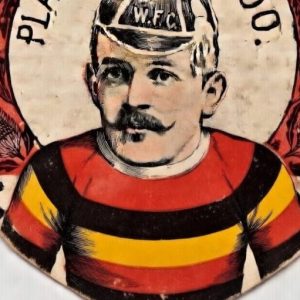
CLUB COLOURS
“… broad hoops of black, crimson and gold, and will, no doubt, look most imposing in the field …”
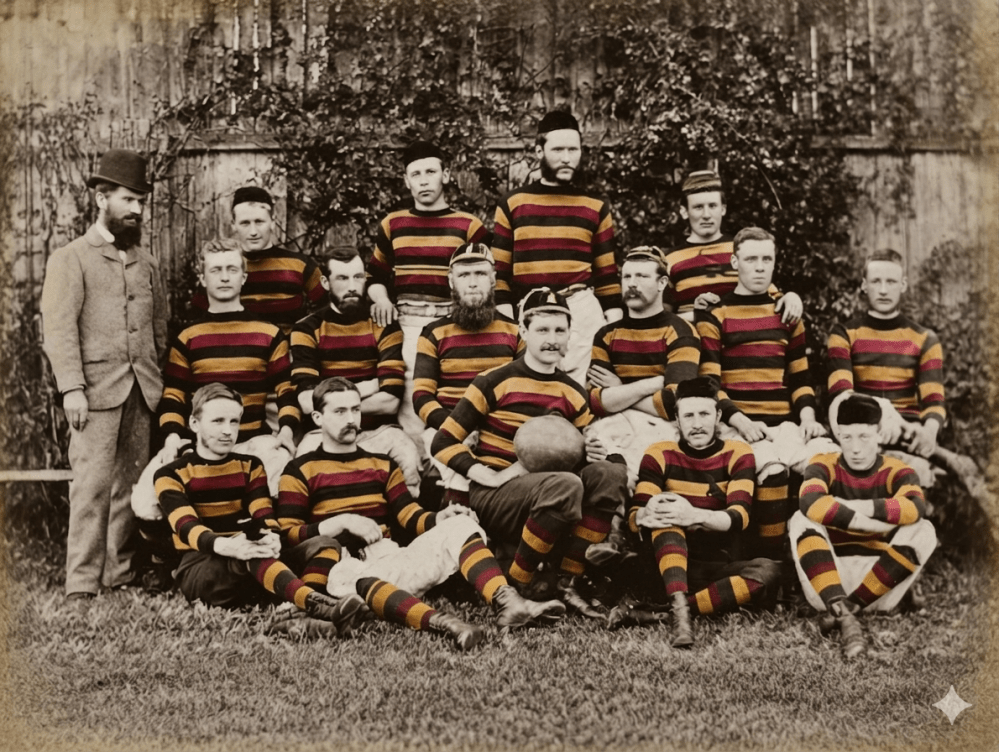
The visual identity of Wallaroo Football Club underwent a series of rapid changes during its earliest seasons due to manufacturing shortages and fabric supply issues.
The club began in 1870 with grey jerseys and blue caps to mimic the coat of the local Eastern Wallaroo, before in 1872 transitioning to new fashion of hooped striped jerseys, deciding on red, white, and blue. This look made Wallaroo the first football club in Australia across any code to adopt a tri-colour uniform, earning them the lifelong moniker of “The Tricolours” from supporters and the local press.
Following a brief stint in black and white hoops during 1875, Wallaroo adopted its definitive and most famous kit in 1876: broad hoops of black, gold, and crimson paired with white trousers.
This design was deliberately chosen to mirror the exact colours of England’s highly influential Richmond Football Club and the nomadic I Zingari Cricket Club, signaling international prestige and a shared Rugby heritage.
These striking colours became an imposing visual hallmark that defined the club until the end of the 19th century.
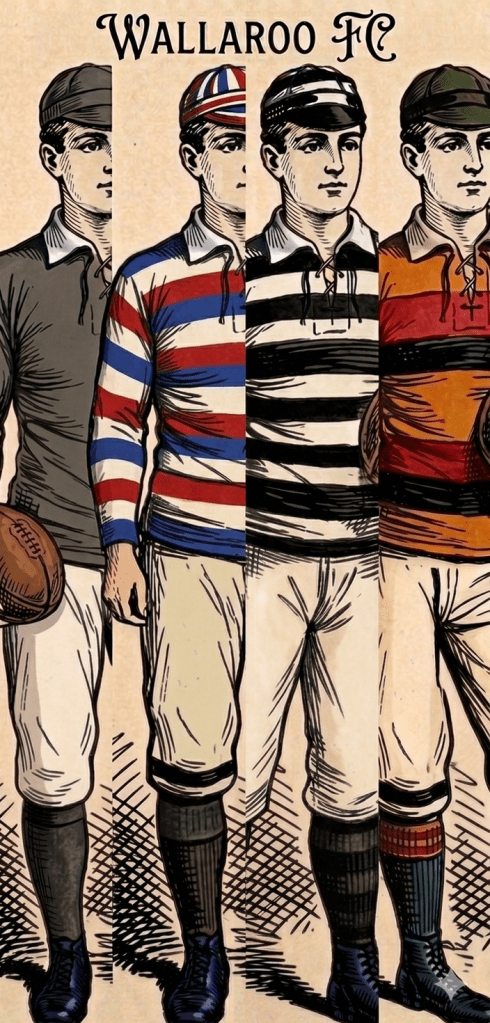
THE COLOURS OF THE WALLAROO FC were known famously throughout the Rugby-playing colonies of NSW, Queensland and New Zealand—gold, crimson and black in hooped jerseys and socks, with white trousers (‘knickerbockers’).
Owing to faded dyes, washing treatments and different manufacturer’s hues, and a Victorian era penchant at times for flourish in language, the Wallaroo FC colours were sometimes referred to as crimson red, old gold and black, or yellow, scarlet and black.
There was no dark secret behind the choice of these colours for the club, which were first used in season 1876, other than a tri-coloured jersey was still new to the colonies, elaborate and expensive.
Wallaroo FC had in its first seasons used other coloured kits, as difficulties with supply and quality caused a period of near constant change.
Notably, the club had since 1873 (and possibly 1872) been referred to as the tri-colours by supporters and newspapers, pre-dating its use by any other football club in Australia in any code.
“the Wallaroos sported the tricolour, which they carried so successfully last season” [Wallaroo vs King’s School (‘including some of the old boys’)]
— The Australian Town and Country Journal, 28 June 1873
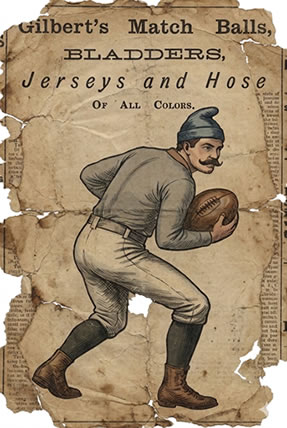
1870 to 1871: Grey jersey, white trousers and blue cap.
The Wallaroo FC began in 1870 with a grey jersey, no doubt to mimic (by visual identity) the colour of the local subspecies of wallaroo, the Eastern Wallaroo (Osphranter robustus robustus). This marsupial has a coat of grey to charcoal.
1872 to 1874: Red, white and blue striped jerseys and caps.
Unable to obtain the grey jersey for 1872, the club instead settled on a new three-coloured jersey, never before seen in the Australian colonies in any football code.
“No suitable grey jerseys being procurable, it was decided to alter the 8th by-law [club’s colours] by substituting red white and blue striped jerseys and caps for the coming season.” — Wallaroo FC meeting 14 May 1872.
“Most of the cries of encouragement being accorded to the “Unis,” but as a set off against this we noticed that the ladies almost without exception wore the red, white, and blue of the redoubtable Wallaroos.”
— The Sydney Mail, 1 August 1874
1875: Black and white hooped jerseys, white trousers.
The club was again forced into a change, although this one lasted just the 1875 season.
“Your committee regret that they could not procure the colours which have now become so well known in the Football field, but they trust that the black and white will be able to sustain with honour the name that the red white and blue has made for the Club.” — Wallaroo FC meeting 22 April 1875
Sydney University changes from all white kit to blue and gold hoops jersey.
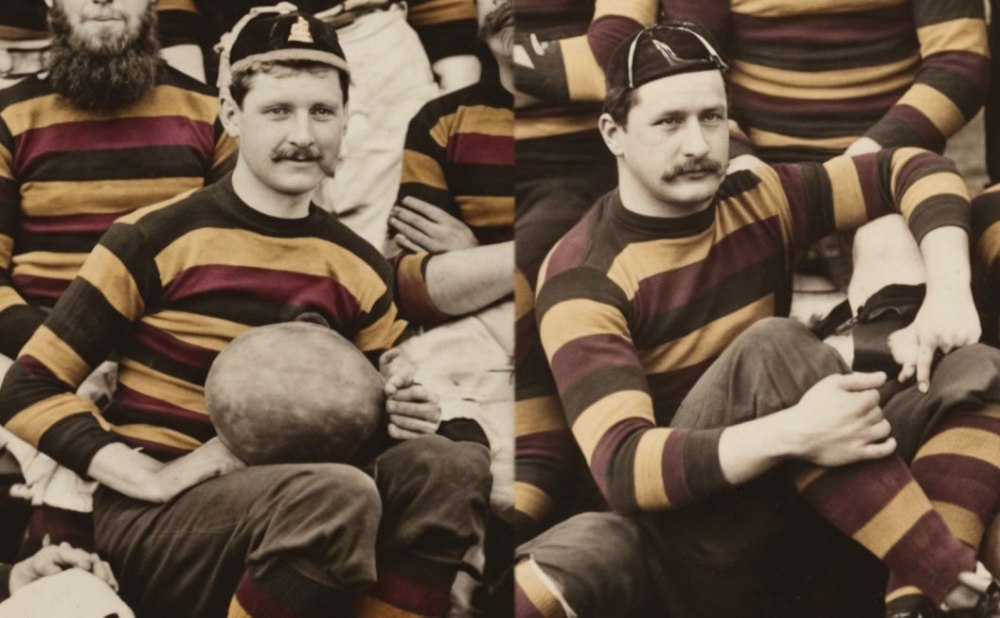
1876 & thereafter: Broad hoops of black, crimson and gold jersey, white trousers.
Another forced change, but the resultant choice of design in quick time became the Wallaroo FC‘s traditional and famous jersey.
“Owing to the uniform worn last year not proving suitable, your committee have selected new colours, deeming this course most advisable, as the new uniform can always be readily obtained from England when the present supply runs short, it being identical with that worn by one of the leading English clubs.” — Wallaroo FC meeting 24 April 1876
“The new uniform was exhibited at the meeting, and is identical with the well-known colours of the Richmond Football and I Zingari Cricket Clubs in England— viz., broad hoops of black, crimson and gold, and will, no doubt, look most imposing in the field.”
— The Sydney Mail, 6 May 1876
“The new uniform, black, gold, and crimson hoops, was approved of by the meeting, and generally admired”
— The Australian Town and Country Journal, 27 May 1876
“…amongst the tricolored hoops…”
— The Sydney Mail, 6 October 1877
In the mid 1870s the Richmond FC was one of the most influential football clubs in the world and adherents to Rugby. Aligning their club colours was a statement of ‘prestige’ for the Wallaroo FC.
The mention above to I Zingari (the famous nomadic cricket club) is worth expanding to note that they referenced using Black, Red, and Gold to symbolise “Out of darkness, through fire, into light.”
The Wallaroo FC continued through the 1880s-90s to be called ‘the tricolours’, as well as ‘the marsupials’.
All website text & content © Sean Fagan
[ site homepage ]
“The committee said, in conclusion, that they felt sure from present prospects and the promising material at disposal, that it was quite probable that the well-known and time-honored colors — “black, crimson, and gold”— would once again be heralded as those of the premier club.”
— WFC annual meeting, 18 March 1898 (The Daily Telegraph, 19 March 1898)
