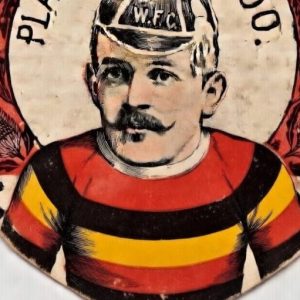
FOUNDERS OF WALLAROO FC & THE FATHERS OF AUSTRALIAN RUGBY
” … a club of 30 gentlemen, called the Wallaroo Foot-ball Club … “
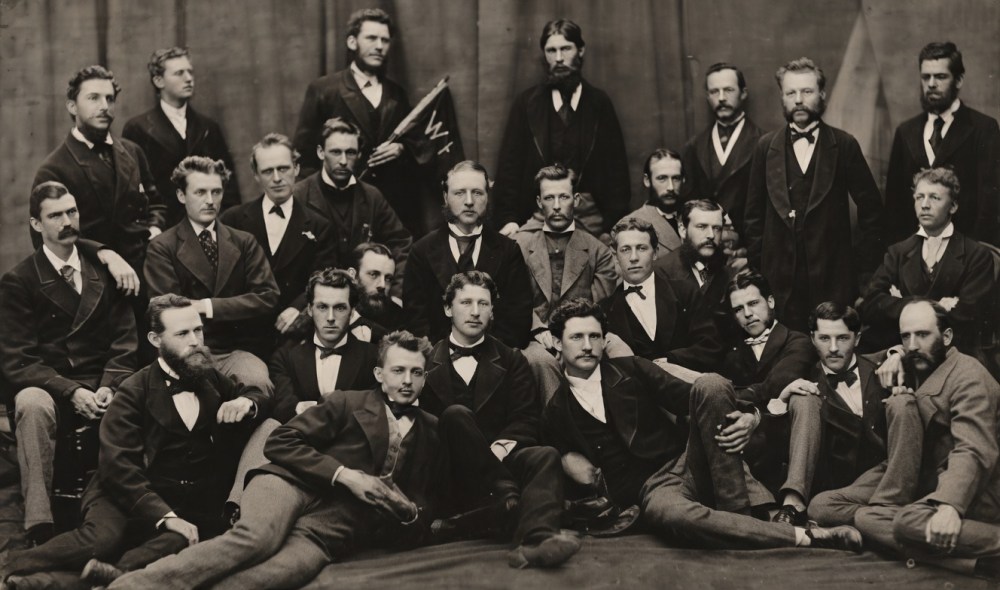
In May 1870, a public advertisement to form Sydney’s first Rugby club drew only five individuals to a meeting. Refusing to abandon the effort, these five young gentlemen—’Monty’ Arnold, Richard Arnold, George Deas-Thomson, Tom Brown, and Septimus Stephen—unanimously resolved to establish Wallaroo FC.
Bound by close family, legal, and political ties, these “thoroughbred Rugbeians” shared an unwavering vision to transplant the football rules and traditions of England’s Rugby School to the to Australia.
The founders used their elite social connections to ensure the club’s survival. The Arnold brothers guided the club and the broader NSWRU for decades as administrators, while Tom Brown served as the brilliant inaugural captain and club organiser. Simultaneously, Deas-Thomson provided sporting legitimacy by arranging matches against his Sydney University football colleagues, and Septimus Stephen secured exclusive training access to the fenced-off grounds surrounding Government House.
Along with early stalwarts like Frederick Campbell, this tiny group successfully assembled a full squad to win the city’s historic first formal Rugby match at the SCG in June 1870. By overcoming public apathy during these foundational seasons, these five young men laid the direct organisational foundations for Rugby in Australia.

“Our men play the Rugby game.”
THE PRO-RUGBEIANS WHO FOUNDED THE WALLAROO FC
They were five young gentlemen in their early 20s, with the oldest being just 28. Drawn from New South Wales’ colonial establishment, they were bound by close family, social, and professional ties. What they all shared was a desire to play football in an organised manner under the rules of Rugby.
All Australian-born, they were ‘Old boys’ of Rugby School or other institutions devoted to Rugby. They knew of London’s Blackheath and Richmond ‘open’ Rugby clubs, formed by similarly-minded young gentlemen, and they wanted the same for themselves, their friends and for Sydney.
“The first real football club, the Wallaroos, was formed in 1870, according to the Rugby rules.“
— The World’s News (Sydney), 23 May 1925
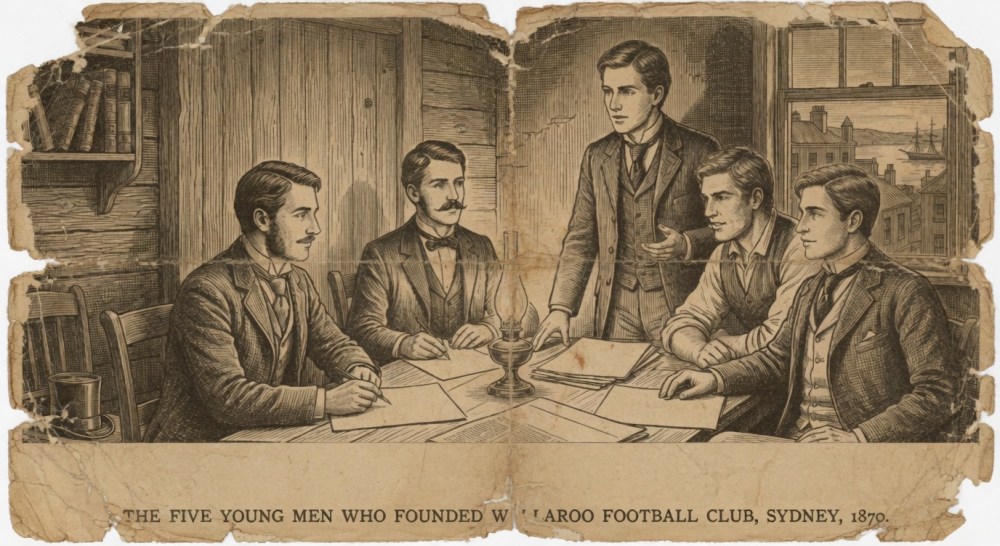
“When, in 1870, an advertisement was published in the papers calling upon all those interested to lend their aid in forming a football club, according to the Rugby rules, so weak was the interest shown in the matter that only five persons rolled up to the meeting. These were Septimus (Seppi) Stephen, Tom Brown, George Deas-Thomson, R.A. Arnold and myself.
“After waiting for some time to ascertain if any others would turn up, we determined to proceed to business, and, at that meeting, of five individuals it was decided to form a football club, the euphonious name of Wallaroo being unanimously adopted. … Amongst our first players, in addition to the original five who started the Club, were Fred Campbell …“
— ‘Monty’ Arnold, Old Times, July 1903
“… a club notoriously antagonistic to any alteration of the Rugby Union rules.”
— Football Editor of The Sydney Mail, 21 July 1877
“The brothers had the one hobby in life—to push ahead Rugby football.”
— The Arrow, 1 June 1923 speaking of the Arnolds
‘Monty’ Arnold (20)
Born in New South Wales to an influential Hunter River pastoralist and political family, at the time of the club’s founding meeting he was working as a clerk in the NSW Parliamentary staff office and his father was Speaker of the NSW parliament. Educated at England’s Rugby School and briefly in Germany, he was the chief organiser and guiding spirit of the Wallaroo FC’s founding in 1870. Playing in the forwards for the club until 1878, he remained actively involved as president and was still in the role as late as 1900. He also became for decades the most dominant figure on the NSWRU.
[Obit. The Referee in 1919]
Richard Arnold (21)
The elder brother, also NSW-born, Rugby School-educated and employed as a clerk in the NSW Parliamentary staff office. Played in the first Wallaroo teams, he took over the Wallaroo captaincy in 1872 and was re-elected to this coveted role every season until his retirement after 1880. By 1900 he was still serving as club vice-president. Like his brother, he became a defining figure with the NSWRU, much of it as treasurer. In later life he proudly walked with a noticeable gait from a rugby-injured foot and happily wore being described as “the old conservative type of Rugby Unionist”.
[Obit. Arrow in 1923]
George Gipps Deas-Thomson (22)
Returning from schooling in England in the mid-1860s, he entered Sydney University and helped organise their first ever football matches in-house among the undergraduates and against outside teams. As a solicitor and University football captain, his presence and involvement with Wallaroo gave the new club immediate credibility. While maintaining his allegiance to University football, he arranged for their team to play matches against Wallaroo and where needed assembled an opposing ‘scratch team’ to fill Wallaroo’s fixtures list. He is thought to have made one appearance for Wallaroo.
Tom Brown (c. 20–25)
The least-known figure and somewhat of a mystery, but of all the founders he was the best Rugby footballer and match-day organiser. Aided perhaps by his obvious Rugby School themed named, he was an immensely popular man with fellow players and supporters alike. Suggestions he may be an 1840-born ‘old boy’ from The King’s School, Parramatta are wrong, given in 1872 the newspapers called him a “young man” and he was still playing rugby in 1875. He captained the Wallaroos a number of times over 1870-72, continued serving on the club committee through the late 1870s and also with the NSWRU in its pioneering early years.
Septimus Alfred Stephen (28)
He immediately brought social and professional prestige to the Wallaroos. A qualified lawyer with one of Sydney’s leading firms, he had been admitted to the bar in 1864 with personal support from Sir William Manning, one of the most respected figures in the colony. An enthusiastic sportsman who owned racehorses and enjoyed gambling and cards, he arranged team training access to the public access restricted Inner Domain (part of Government House grounds) through his father, the Chief Justice of NSW. He played one game for Wallaroo late in the 1870 season.
[ADB bio]
“… they launched the club under the name of the Wallaroos. The names of the fathers of Australian Rugby football were:— Septimus Stephen, Tom Brown, George Deas-Thomson, R. A. Arnold, and W. M. Arnold … In spite of public apathy they succeeded in getting a full team together and went into the field to practise …”
— The Star, 24 June 1910
A FOOTBALL CLUB
Wallaroo avowed to be a Rugby-playing football club. Along with their counterparts in London, and even in Melbourne, the first clubs in the world were all called “Football Club” (FC). The concept of “Rugby Club” (RC) or “Rugby Football Club” (RFC) had not yet emerged. As cricket is today, “Football” was viewed as a single, collective sport played under various favoured or devised rules, rather than distinct, separate codes.
“The Rugby game is so complex in character and requires such a careful attention in practice that an average lifetime may be spent in becoming au fait at all the niceties of the game.”
— The Standard, London, 1870
THE FIRST CAPTAIN & THE FIRST TEAM
The first captain of Wallaroo FC was Tom Brown. The club’s debut game was played against a combined “sixteen gentlemen of the Army and Navy” side (military officers). Following the Rugby School tradition, the match was contested over two Saturdays (18 and 25 June 1870) after the first afternoon ended in a goal-less deadlock. At the time, tries did not yet count toward the final result.
The historic match took place at the Military and Civil Cricket Club Ground (now the Sydney Cricket Ground / SCG). Wallaroo FC secured the only goal on the second day to claim their first victory. While the full team lists from 1870 are incomplete, records show that the captaincy was held at various times by both Tom Brown and Frederick Campbell during this foundational season.
Born in what is now the Australian Capital Territory (ACT) part of NSW, the now 24 years old Campbell, like the Arnolds and Deas-Thomson, had been educated at an English public school. In August 1865, Campbell and Deas-Thomson had captained opposing sides in the University’s first recorded football match (an internal game among students). Campbell was also Septimus Stephen’s brother-in-law.
[Obit. T&A Times in 1928]
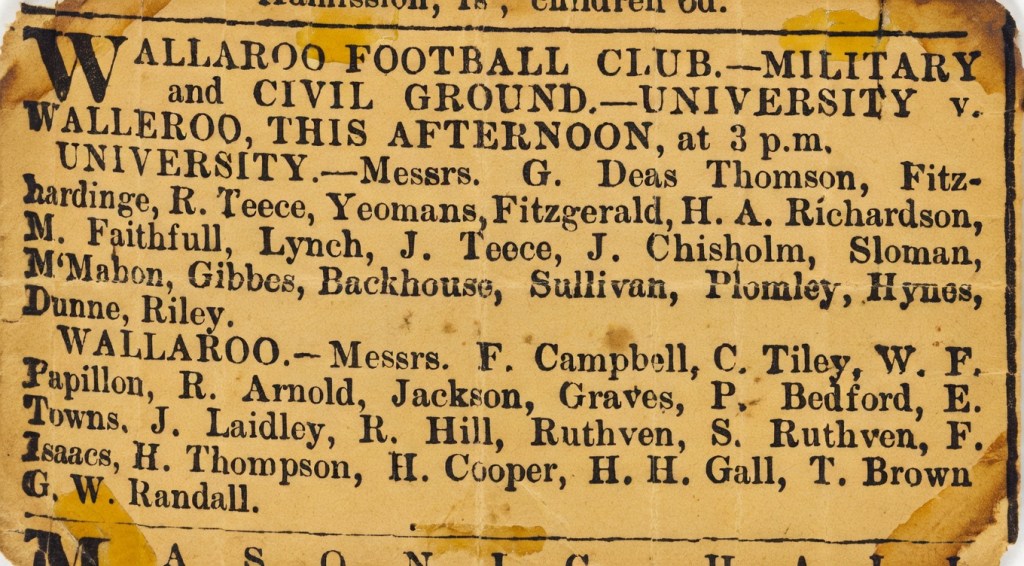
The earliest published Wallaroo FC team list in 1870 was in The Sydney Morning Herald of 13 August 1870, for a match that afternoon against the Sydney University team at the SCG. The players for Wallaroos named were: Messrs. F. Campbell, C. Tiley, W. F. Papillon, R. Arnold, Jackson, Graves, P. Bedford, E. Towns, J. Laidley, R. Hill, Ruthven, S. Ruthven, F. Isaacs, R. Thompson, H. Cooper, H. H. Gall, T. Brown, G.W Randall.
Note: The club’s training fields within the publicly restricted Inner Domain are likely the same piece of ground used in 1869 for a football game against the visiting British naval sloop HMS Rosario. The majority of the field was lost to the eastern opening of the Cahill Expressway (which continues on as the elevated roadway that is visible above Circular Quay). However, the western side of the field survives today as the narrow sliver of parkland situated directly opposite 89 to 119 Macquarie Street.
All website text & content © Sean Fagan
[ site homepage ]
“In the 1870’s football began to make its influence felt among the games and pastimes of this part of the world. Men from the playing grounds of the Great Public Schools of England, where the Rugby game was followed as a matter of course, and most enthusiastically believed in, first began to wonder why it should not teach its strenuous lessons of pluck, forbearance, endurance and general manliness in these Southern climes, among schoolboys and others; then commenced to talk among themselves, and to organise.”
— George B. Davey, 1911
