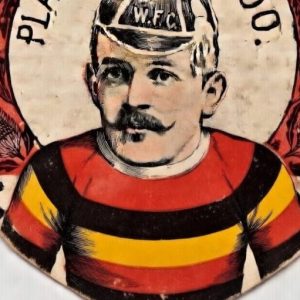
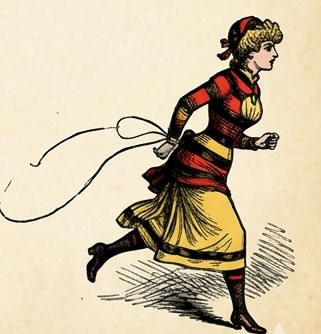
LADY WALLAROO – WOMEN & THE W.F.C.
The Victorian era denied women the opportunity to take to the football field, but it could not keep them from the heart of the Wallaroo football club and rugby.
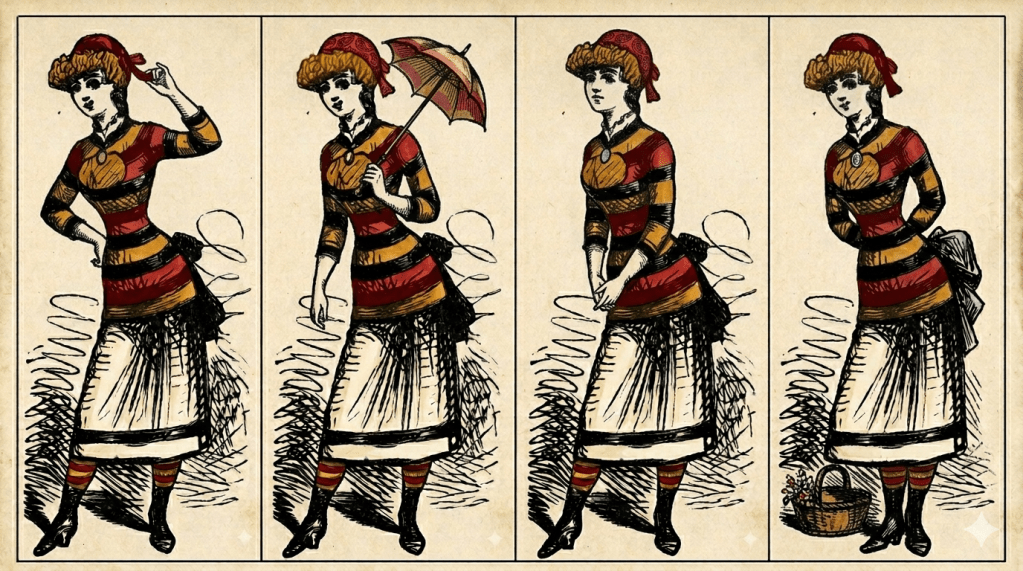
While the Victorian era denied women the opportunity to take to the football field, they were central to Wallaroo Football Club from its very beginning. Before Wallaroo’s arrival, football in Sydney was more often played in remote paddocks out of public sight, but the heavy attendance of women at the club’s matches instantly conferred social respectability and legitimacy on the sport.
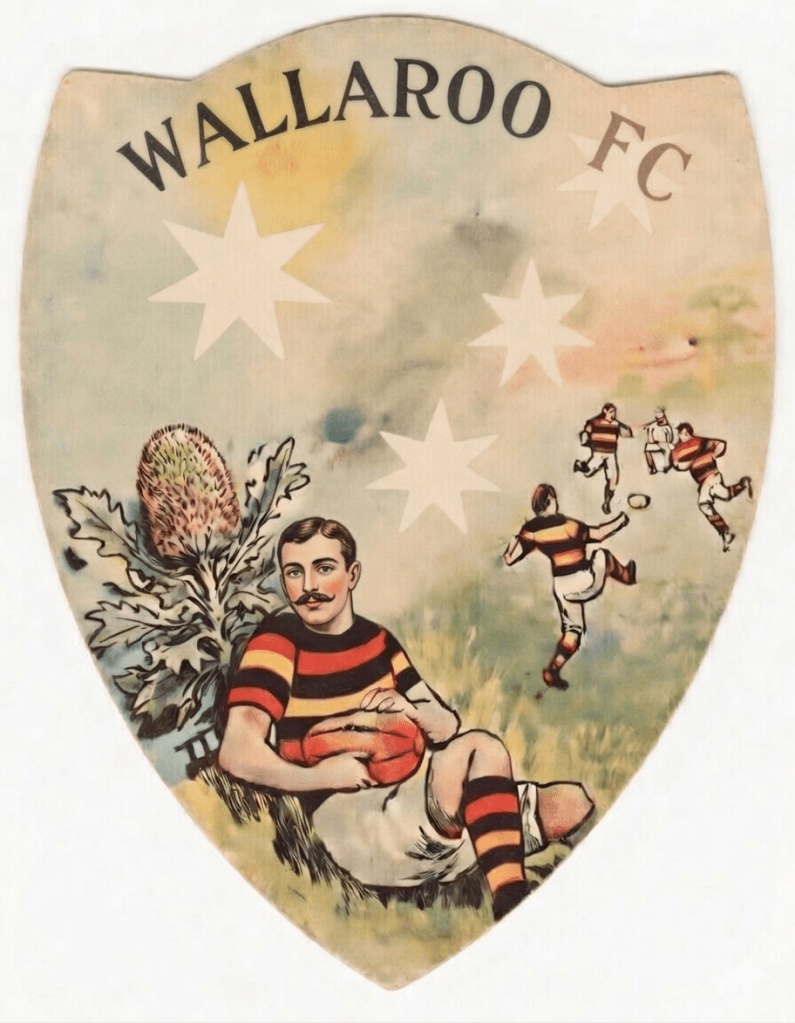
Admitted free to matches, these female supporters walked the touchlines or packed the grandstands at the SCG and country fixtures, loudly encouraging players while sporting the club’s black, crimson and gold (originally red, white and blue) in tricolour ribbons (“favours”). These passionate “lady barrackers” possessed a detailed understanding of Rugby’s nuances and provided a refined, civilising influence on the match-day atmosphere.
“Ladies show up well, most of them sporting the Goulburn blue and white, but I notice some with the Wallaroo tricolor, and the visitors are not a little proud of the wearers.”
— The Sydney Mail, 25 July 1874 (Wallaroo visit Goulburn)
“Most of the cries of encouragement being accorded to the “Unis,” but as a set off against this we noticed that the ladies almost without exception wore the red, white, and blue of the redoubtable Wallaroos.”
— The Sydney Mail, 1 August 1874
Off the field, women were deeply involved behind the scenes by repairing torn playing kits, treating injuries, and even hand-stitching the iconic wallaroo silhouettes onto player jerseys. Though nervous mothers and anxious sweethearts frequently dreaded the physical toll of the brutal game—and social convention meant new brides could expect their husbands to give away the game—their unwavering devotion ensured that women remained at the very heart of Wallaroo’s pioneering journey.
“The young ‘new women’ of the metropolis is evidently determined that she shall not be outdone by the masculine creature who has the audacity to proclaim that he is the superior being; and now even the arenas around the football fields of Sydney are crowded with female ‘barrackers’ …
… on the Sydney Cricket Ground on Saturday during the football contest between the Randwick and Wallaroo Clubs of a crowd of ‘lady’ ‘barrackers’. Not a movement of the closely-fought game escaped their eager eyes or their loudly-shouted comments.”
— Newcastle Morning Herald, 18 August 1896

LADIES IN THE STANDS
From the very beginning, women were central to the Wallaroo FC’s pioneering the Saturday-afternoon ritual of football as a social outing in Sydney. Whether sweethearts, friends, sisters, cousins or as interested onlookers. Wives were rarer, as Rugby “football was principally a bachelor game”— the convention of the time was for a footballer to retire upon marriage to avoid the risk of lost income through injury.
The presence of “ladies” at these first Wallaroo matches instantly conferred social respectability and legitimacy on the club, its gentlemen football players, and the game of Rugby itself. Before Wallaroo’s arrival, football in Sydney had usually been played in remote paddocks, keeping its broken bones and bad language well out of sight of respectable society—tucked behind stands of eucalyptus trees and rarely mentioned in the newspapers.
Match reports from the early-to-mid 1870s of Wallaroo games at Sydney’s Moore Park (the grassed area immediately west of the SCG) and Parramatta Park record a high attendance by women, including a match against the University where the writer reported the ground’s visitors as “the majority of whom were ladies” (Australian Town and Country Journal, 24 August 1872).
“The weather was hot and close, but the players, once in the excitement of the game, did not seem to feel any oppression. There was a fair concourse of spectators, numbering, during the afternoon, from 1000 to 1500; amongst them a number of ladies, most of whom sported the colours of their favourite players.”
— Australian Town and Country Journal, 29 June 1872
“The number of spectators was very large, numbering somewhere about ten or twelve hundred, about one third being ladies, who seem to think there is nothing like football.”
— Empire, 24 August 1874
“…in consequence the attendance was unusually large. The ladies especially were in great force, and their presence doubtless contributed in a great measure towards the brilliant play exhibited on both sides. Parramatta is certainly very hard to beat in the production of beautiful women, and, judging by the sweet smiles that were bestowed upon any player of unusual merit, it must be a nice thing to be a footballist.”
— The Sydney Mail, 9 September 1876
A CIVILISING INFLUENCE
Whether simply by their presence as onlookers or through their active applause and encouragement for a particular player or the team as a whole, women supporters spurred the Wallaroo footballers on.
They also helped curtail the rough language and rougher style of play that so often emerged in an all-male environment — although with the gentlemen footballers of the Wallaroo FC this was rarely necessary. Indeed, where many were even greater failures as gentlemen than as footballers, the Wallaroos’ own conduct was part of their attraction, as illustrated by their 1879 tour to Maitland:
“The play of the Wallaroos was remarkably free and easy, combined with a gentlemanly demeanour of conduct, free from any wrangling, or abusive epithets, and they thus gained the approval, not only of their opponents, but also of the few visitors who attended to witness the game.”
— The Maitland Mercury and Hunter River General Advertiser, 28 June 1879 (WFC vs Maitland Albions)
“The attendance on the ground, of all classes, was the largest yet seen at a football match in Maitland. The most conspicuous feature of the ground was the number of handsome and stylish drags with their fair occupants; the carriages looked very grand, with their showy coachers, as they trotted round the grassy enclosure…
…The Wallaroos played well together; every man was to be found in his place at the proper time. They also conducted themselves throughout the exciting contest in a gentlemanlike manner, which is not always to be observed in football matches on the Hunter.”
— The Maitland Mercury and Hunter River General Advertiser, 1 July 1879 (WFC vs ‘Northern Combined Team’)
This Maitland Showground fixture was very much an occasion. Local interest in seeing the visiting Sydney club was the main draw, and — as was usual when gate money was charged at Wallaroo matches — ladies were admitted free.
THE LADY BARRACKER
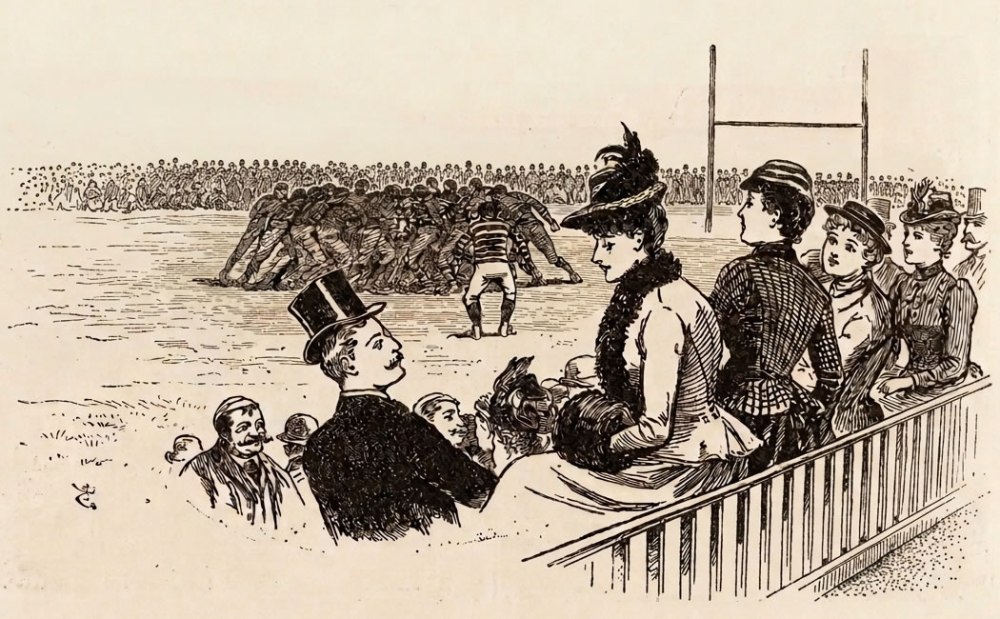
Many women attended purely for the Rugby. Some were more vocal or over-enthusiastic than others. But they understood and loved the game, often displaying not just the club’s colours, but possessed and armed with detailed knowledge of Rugby nuances at a time when many men still believed it was “too brutal” for the fairer sex to comprehend:
“…Wallaroos met nineteen of the Sydney Grammar School Football Club… There were a good many spectators, including several ladies, who manifested great interest and pleasure in witnessing the exploits of the stalwart and athletic knickerbockered knights who fought and charged and maneuvered in the field with marvellous skill and pluck.”
— The Sydney Mail, 10 June 1876
“At the Randwick-Wallaroo match many of the barrackers belonged to the prettier sex. They donned the colors, too, and their hearts and heads fluttered with every little change in the contest.”
— The Arrow, 11 June 1898
OFF THE FIELD
Women were also involved behind the scenes, repairing torn playing kits or attending to abrasions and injuries, particularly the girlfriends, sisters and mothers of players.
Some fortunate few Wallaroo players had the front of their jersey carefully emblazoned with a hand-stitched wallaroo-shaped silhouette or other meaningful adornments, reminiscent of medieval knights and a traditional “lady’s favour.”
Post-match dinners were generally held only on away trips, so the only women present were those connected with the local club or opponents. In Sydney, Saturday nights however were normally informal gatherings of footballers and their friends at popular city cafés or one of the grand coffee palaces.
Unlike some other Sydney clubs, the Wallaroos do not appear to have offered women club membership, and the doings of their club dinners and any other socials events were not reported in the newspapers.
A WALLAROO HARBOUR PICNIC CRUISE
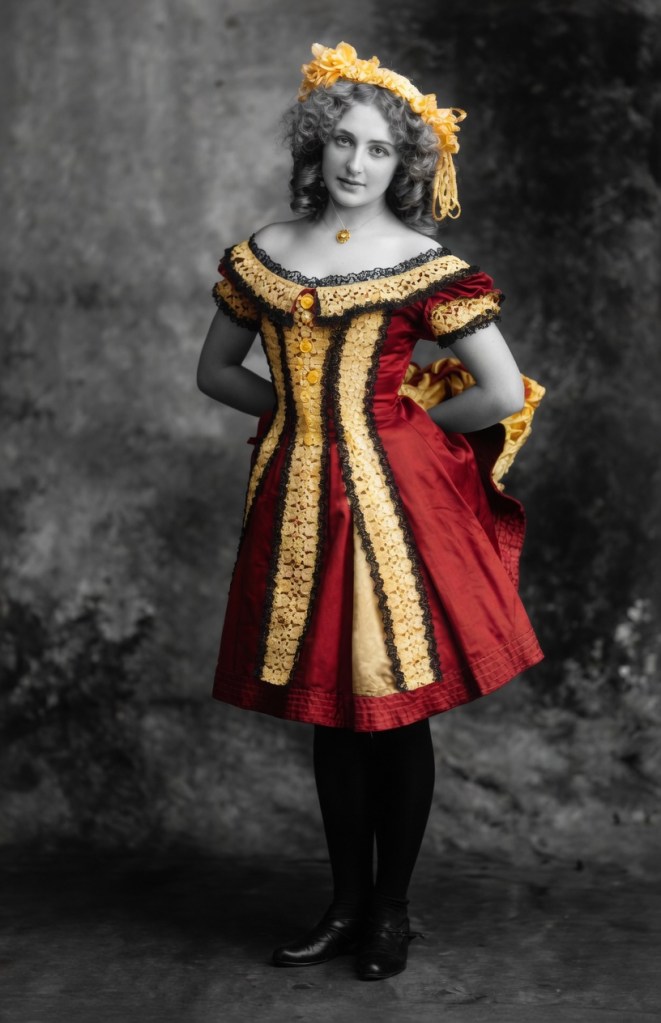
In once instance though in 1891, after joining the Wallaroos on an end-of-season six-hour-long Sydney Harbour picnic cruise — where boisterous fun and alcohol played a heavy part — The Referee football columnist suggested that next time the club ought to choose a day that would allow their lady friends to attend:
“… I cannot help thinking, however, that the club would do far better to give their next outing on a week-day, and invite their lady friends, as such a picnic is far more enjoyable, especially from a social point of view.”
— The Referee, 14 October 1891
NERVOUS MOTHERS & ANXIOUS SWEETHEARTS
No generation is immune to the feelings of concern and worry from a mother, sister or girl friend that a loved one will suffer an injury playing the Rugby game.
“Footballers are apparently awakening from their summer’s snooze… nervous mothers are picturing to themselves the danger attendant on the barbarous game, and anxious sweethearts are dreading the approach of the time when George and Charley will return home every Saturday with their eyes blackened, their noses broken, and minus their pearly teeth.”
— The Cumberland Mercury, 22 March 1884
It is of course impossible to engage in any outdoor sport without some risk to life or limb, but that is partly why one wants to play, in particular football of the Rugby kind.
“Very few of the players escaped without evidences of having kissed Mother Earth”.
— The Sydney Mail, 27 June 1874 (WFC vs The King’s School)
All website text & content © Sean Fagan
[ site homepage ]
“THERE was a brilliant and fashionable gathering on the Sydney Cricket Ground yesterday to witness the final meeting between the redoubtable Wallaroo Club and the representatives of breezy Randwick … The Members’ and grandstands were packed in every part, while the Ladies’ stand could hardly have held more, and the enthusiasm among the fair sex was intense. Randwick’s indigo and gold favors prevailing, although I Zingari ribbons [Wallaroo] were plentifully scattered among the crowds of fair admirers of the game — and the players.”
— Truth, 12 August 1894
