
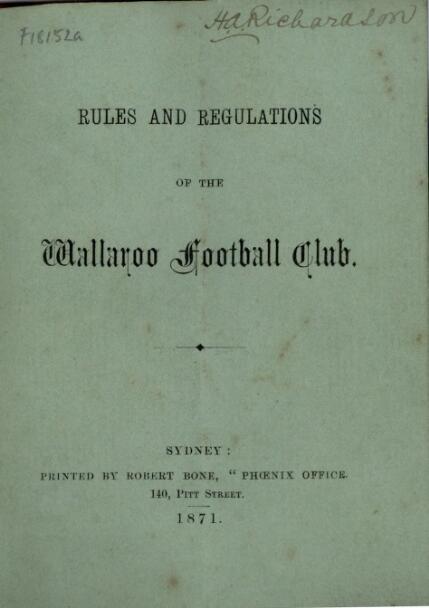
Found! The original set of Rugby rules used in Australia. Only those held by Blackheath FC and Rugby School itself are older anywhere in the world. The Wallaroo FC rules of 1871.
THE BIRTH CERTIFICATE OF RUGBY IN AUSTRALIA
Discovered hidden deep within the back-room archives of the National Library of Australia, were the true holy grail of Southern Hemisphere sport: the Wallaroo FC rules booklet of 1871.
While 1860s newspapers spoke of the “most confusing” hybrid games played by Sydney University, the rules of those early matches were ad-hoc compromises dictated by the whim of opposing captains. None of the games were Rugby football. The University’s rules for in-house contests were at most a modified form of Rugby and there is no evidence they were ever written down.
This extraordinary Wallaroo FC text (18 pages) stands alone as the oldest surviving printed set of Rugby rules in Australia—and, unless the club issued an 1870 version, almost certainly the first dedicated Rugby book ever published in this country— offering a raw, unfiltered look at the game before the formal laws of “Rugby Union” ever arrived here.
On a global scale, it is a treasured artifact second only to London’s legendary Blackheath FC’s surviving club Rugby rules document of 1862. Unlike Wallaroo, no such records have been found for any of the other principal clubs including Richmond, Harlequins and the tardy Wasps, before they formed and adopted agreed rules under the Rugby Football Union (RFU).
In Sydney and in the country towns, these 1871 rules held the first clubs and schools together, until the formation of the Southern Rugby Football Union (now the NSWRU) in 1874, where the RFU’s “rugby union” laws were adopted.
This specific copy was originally issued to Henry Richardson, a Sydney University player in 1871; which suggests all University players were each given one, confirming these Wallaroo FC rules were serving as the model rules.
Ultimately, this is the birth certificate of Rugby in Australia; from the national teams to the grassroots, every club, school, and representative team in the country (both codes) traces its lineage directly back to this single foundation document.
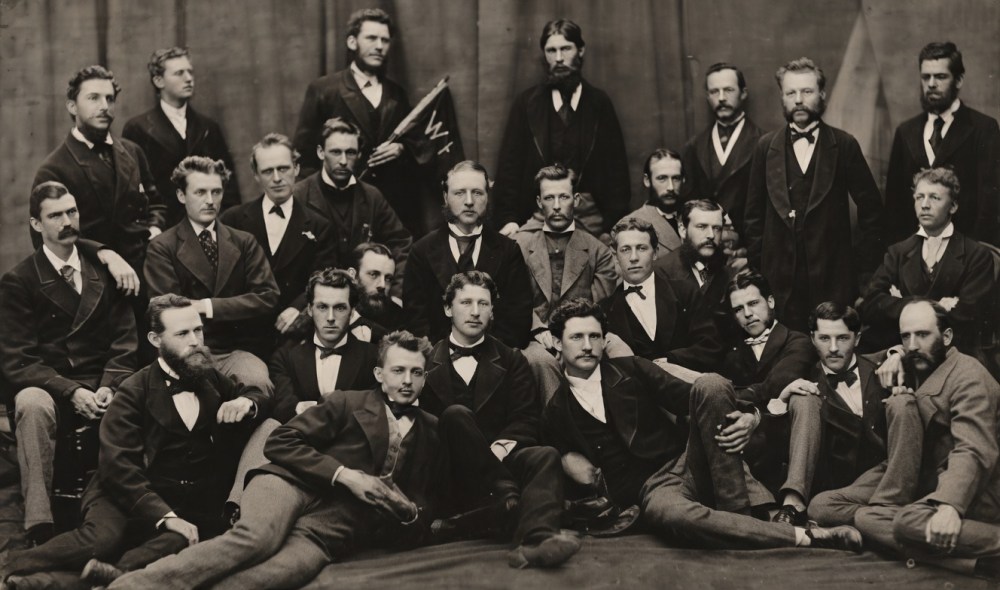
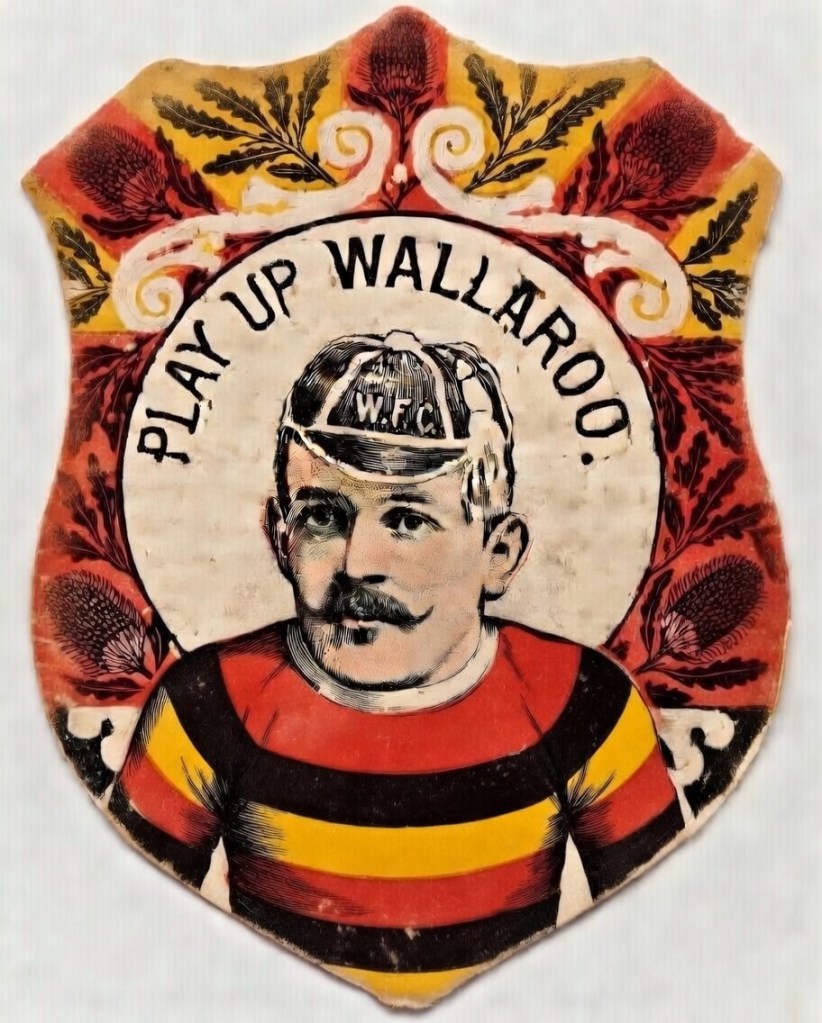
‘Monty’ Arnold rear row & holding flag. Tom Brown sitting in front of this flag. Richard Arnold front row with left hand below upright knee. Frederick Campbell first on outside left of photo seated on chair.
WALLAROO RUGBY, HOOLIGANS & GENTLEMEN
In drafting their first rules, Wallaroo’s ‘old boy Rugby’ founders seemed to implicitly understand that while Rugby may well be a hooligan’s game, not everyone who plays is a gentleman. Hence, at Rule XXIII, they noted that “attempts to throttle or strangle…are totally opposed to all the principles of the game.”
Given that brutal reality of Wallaroo’s early rules, it’s easy to see why the public struggled to define what kind of person played Rugby. This exact tension birthed the sport’s most famous maxim: “Football is a gentleman’s game played by hooligans, and Rugby is a hooligans’ game played by gentlemen.”
While frequently misattributed to historical giants and literary greats like Winston Churchill, Oscar Wilde, George Orwell, Walter Camp, or Rudyard Kipling (“the muddied oafs”), our original research has traced the true source to a Cambridge University Chancellor in the 1890s.*
Closing a debate on the merits of Rugby and soccer, the impartial Chancellor neutrally remarked:
“It is clear that one is a gentleman’s game played by hooligans; the other a hooligan’s game played by gentlemen.”
It serves as a perfect reflection of the exact era when Wallaroo FC was helping transition Rugby from a wild, unregulated battlefield into an internationally respected, gentlemanly pursuit.
So please, as you read on below, all the Wallaroos ask is there be no throttling or strangling!
“The time may come when we shall thoroughly appreciate a good game of football under Rugby rules. That will be when two stalwart teams enter the field, and one by one drop off fractured, until only two are left to gather up the fragments and lead the umpire home… A contract is to be taken to remove the debris, shins, teeth etc., left on the ground…We think that a player under Rugby rules has every opportunity to develop into a strong and courageous man, if he is not killed in the meantime.”
— The Bulletin (Sydney), 29 July 1882
THE FIRST RULES OF WALLAROO RUGBY
The Wallaroo club’s Rugby football rules from 1871 (scroll down to see), are very close to those of London’s premier football clubs in the mid-late 1860s Richmond and Blackheath.**
These were ‘Rugbeian rules’, styled for club matches from the laws of football used at Rugby School in England. The game in this era, with large packs of forwards constantly in close quarters battle, could be a robust, brutal, and “very willing” affair.
“The very terms of these rules suggest coarse violence, utterly alien from honourable and gentlemanly sport. They date back from the days of bull-baiting and prize-fights, and other brutal amusements.”
— The Leisure Hour (London) 1876
The reader should keep in mind that these Wallaroo 1871 rules are essentially rules of “the original rugby game”, not of the recently born “rugby union” (in relation to the latter see ‘RUGBY UNION LAWS’ at the bottom of this page).
Note too that the written rules are not exhaustive; the game was also played and governed by custom and convention. Nor should the rules be read in search of loopholes to exploit.***
“The game being essentially foot-ball, no player may take up the ball from the ground. If a player can catch the ball in the air, he may take a hand-kick without the other side being permitted to interfere.”
— The Sydney Mail, 3 June 1871 (commenting on a similar set of club rules reproduced from London’s “Every Boys Magazine”)
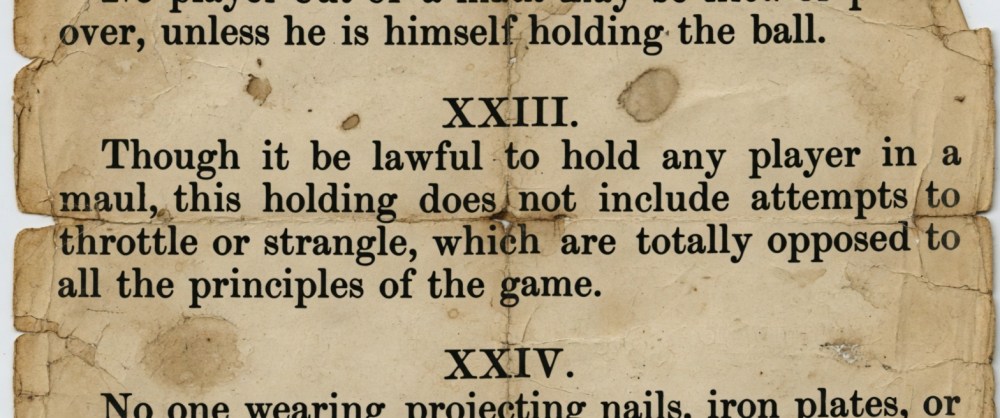
Though it be lawful to hold any player in a maul, this holding does not include attempts to throttle or strangle, which are totally opposed to all the principles of the game.
TO THROTTLE OR STRANGLE
Right there in Rule XXIII, plain as day, they wrote: “Though it be lawful to hold any player in a maul, this holding does not include attempts to throttle or strangle, which are totally opposed to all the principles of the game.”
What was the thinking here? In the middle of a great heaving, sweating, grunting pile of humanity, they thought it necessary to explicitly state that choking a fellow just wasn’t sporting. It wasn’t that the club expected sainthood on the Rugby field. They just wanted to draw a thin red line between honest, manly shoving and outright attempted manslaughter.
When you read those old rules today, you’re looking straight into the heart of early colonial Rugby. It was rough, honest, and fearless, but occasionally in need of a reminder that strangling your opponent wasn’t quite the done thing.
That was the Wallaroo way: play hard enough to make the angels nervous, but keep just enough civilisation so the game stayed a sport instead of an excuse for a riot.
Any skull-banker looking for easy glory while staying hidden and idle among the Wallaroo forwards, or worse found lurking on the outside skirt of the scrummage, needs to find another club. And if any milksop read Rule XXIII and decided he’d rather take up croquet, well… the Wallaroos figured that was probably for the best!
And don’t think you can get away with choking someone outside the maul either. Rule XXII is for you. ***
“There is also a rule which states that holding in a ‘maul’ does not include attempts to throttle or strangle, which are totally at variance with the principles of the game. The retention of such a rule as that in a game played at the present day, is rather surprising; but those who are familiar with the Rugby football, know that a player will endure a great deal before he cries ‘have it down.’ It is frequently very violent indeed. The bold fearlessness of the players, the way in which, to use the expression of ‘Rugbeiensis,’ they learn to ‘grin and bear it,’ would do honour to them in a better cause. They play their game splendidly; but is the game football?”
— The Field (London) 1864
RULES OF THE WALLAROO FOOTBALL CLUB (as published 1871)
I. The minimum length of the ground shall be 90 yards, and the minimum breadth 60 yards; the length and breadth shall be marked off with flags, and the goals shall be defined by two upright posts six yards apart, fourteen feet above the ground, and having a horizontal bar between them, ten feet from the ground.
II. The winner of the toss shall have choice of goals. The game shall be commenced by a place kick from the centre of the ground by the side losing the toss, which, even though it go over the goal posts, cannot count as a goal. Neither side shall approach nearer than 10 yards to the ball until it shall have been kicked off.
III. After a goal is won, the losing side shall kick off, and the goals shall be changed.
IV. A goal shall be won when the ball on being kicked from the foot, either a place or drop kick, not a punt, passes between the goal posts, over the bar, whether it touch it or not (at any height), without touching the person of another player.
V. When a ball is in touch, the first player on his side shall kick or throw it from the point on the boundary line where it loft the ground (at least 10 yards), at right angles with the boundary line, but may then take it on if he can.
VI. Kick out must not be more than 10 yards from the goal.
VII. Fair catch is a catch direct from the foot, or a knock on from the hand of the opposite side. Knocking on or throwing forward are disallowed. In case of this rule being broken, a catch from such a knock on or throw shall be equivalent to a fair catch.
VIII. If a player makes a fair catch, he shall be entitled to a free kick (punt or drop), providing he makes a mark with his heel at once; and, in order to take such kick, he may go as far back as he pleases, and no player on the opposite side shall advance beyond his mark till he has kicked.
IX. Charging is fair in case of a place kick as soon as the ball has touched the ground, in case of a kick from a catch, as soon as the player offers to kick, but he may always draw back unless he has actually touched the ball with his foot.
X. Off Side. A player is off his side when the ball has been kicked, or is being ran with by anyone of his own side between him and his goal.
XI. A player entering a maul on the wrong side, is off his side.
XII. A player is off his side when a player on his own side has kicked the ball from behind him and then run before him.
XIII. On Side. A player is on his side when the ball has touched the body of any player on the opposite side, before him, i.e., between him and his adversary’s goal.
XIV. A player being off his side is to consider himself out of the game, and is not to touch the ball in any case whatever (either in or out of touch), or in any way to interrupt the play.
XV. Tripping, Throwing, or Hacking, is altogether disallowed.
XVI. It is not lawful to take the ball off the ground, except in touch, for any purpose whatever.
XVII. It is not lawful to take up the ball when rolling, as distinguished from bounding.
XVIII. In a maul, should the player holding the ball allow it to touch the ground, it is dead, and the opposite side may not kick at it until he shall have got both his knees off the ground.
XIX. First of his side is the player nearest the ball on his side.
XX. Running in is allowed to any player on his side, provided he does not take the ball off the ground, or through touch.
XXI. If, in case of a run in, the ball be held in a maul, it shall be lawful for a player on the same side to take it from a runner in, provided he has entered the maul behind the runner in.
XXII. No player out of a maul may be held or pulled over, unless he is himself holding the ball.
XXIII. Though it be lawful to hold any player in a maul, this holding does not include attempts to throttle or strangle, which are totally opposed to all the principles of the game.
XXIV. No one wearing projecting nails, iron plates, or gutta percha, on the soles or heels of his boots, shall be allowed to play.
XXV. Trial at Goal. A ball touched between the goal posts may be brought up to either of them, but not between.
XXVI. The ball when punted must be within, and when caught without, the line of goal.
XXVII. The ball must be place-kicked, and not drop-kicked.
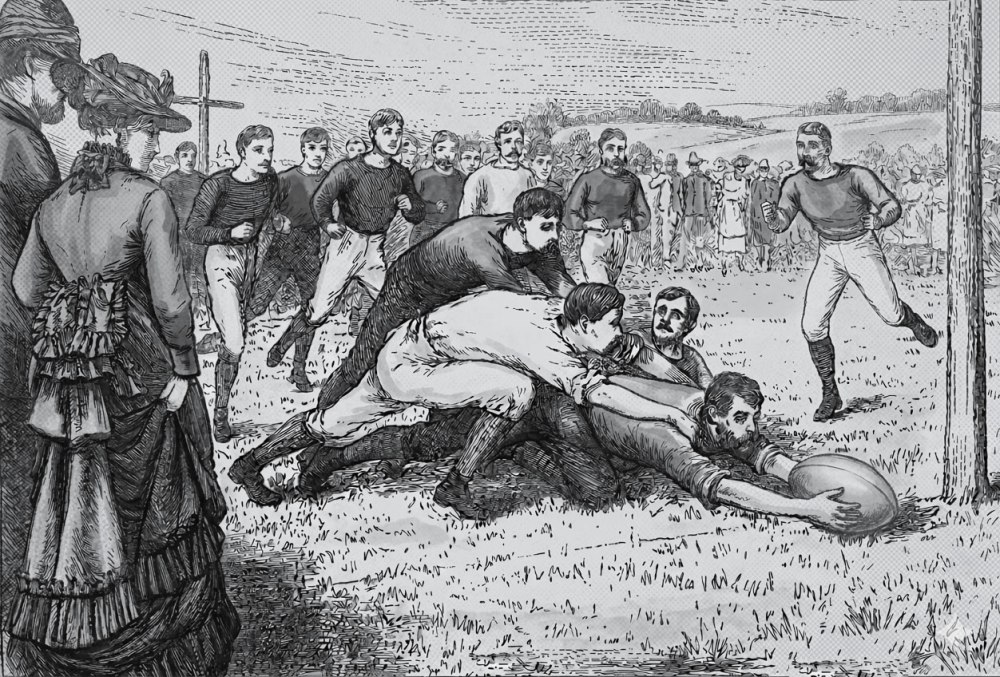
DEFINITION OF TERMS
A Place Kick is a kick at the ball while it is on the ground, in any position in which the kicker may choose to hare it placed.
A Free Kick is the privilege of kicking the ball without obstruction, in such manner as the kicker may think fit (except a place kick).
Hacking is kicking an enemy intentionally.
Touch is that part of the field, on either side of the ground, which is beyond the line of flags.
Run in is when a player takes the ball and manages to run with it, and touch it down to the ground behind the enemy’s goal line, he may then take it to the front and try to kick a goal.
Try at goal. If the touch down be near enough to try a goal, then two of the side that touched it down are deputed by the head of the side to take it out—one to place the ball on the ground, the other to kick it. Then he who is going to kick it, takes it up, brings it to the line of goal, and touches it down inside or on the goal-line, and in a line with the place at which the player who ran in touched it down : if the runner in touched it down between the posts, he touches it down at either of the posts. He then makes a mark with his heel on the spot, taking care all the time to keep within the line of goal, and touches it down in that mark. The players of the opposite side may then come as far as the mark, and no farther, and may stretch forward with a view of mauling the two who are taking it out, if they do not succeed in the following action. The player who is to place kick, goes just out of the reach of the opposite side who are stretching forward. He then, still standing within the goal-line, punts the ball gently off his toe or knee into the hands of the other, who is standing just out-side the goal-line to receive it. The moment it is in his hands, he makes a mark with bis heel outside the goal-line, and, of course, as far as he can stretch in the direction of the goal posts, which his opponents may prevent if they can by charging, but not until the ball has left the knee or toe of the player behind the goal-line.—(This is called Mauling). This however they cannot do when he has made his mark, so that only in cases where they prevent his catching the ball, or he fails in making his mark directly, or makes it inside goal-line, or touches the ball before it is off the knee or toe of the other, do they succeed in mauling him. When he has made his mark, he carries the ball out in a line with the mark at right angles to the goal-line, until it is at a suitable distance from the goal for a place kick. A small nick is then made in the ground for the ball to rest upon, and in it he places the ball. If however the ball be touched when once outside goal by any but the player who is taking it out, the other side may charge or maul. The ball being placed in the nick, the kicker takes a place kick at it. The moment the ball is on the ground the other side may charge from a line drawn through the mark made by the player who took it out parallel to the goal-line; but the kicker’s side may not charge till the ball is actually kicked, and must all stand behind or on a level with the ball in accordance with the rules of On aide. If the ball goes over the cross-bar, whether it touches or not at whatever height, it is a goal. If it rises directly over the end of one of the posts, it is called a poster, and is no goal.
A Punt is when the ball is taken in the hands, let fall and kicked before reaching the ground.
A Drop Kick is when the ball is taken in the hands, let fall and kicked the moment it touches the ground.
A Maul outside goal-line takes place when a player holding the ball is held by one or more players of the opposite side, and if he cannot get free of them, or give the ball to some other of his own side (not in front of him) who can run with it, he cries, “Have it down,” when
A scrimmage commences, i.e., the holder puts the ball down on the ground and all who have closed round on their respective sides begin kicking at the ball.
Reproduced from WFC rules booklet printed in Sydney, 1871. Original held by the National Library of Australia, however it is not on display – Call Number: SR 796.33302022 W195
“The Rugby game is so complex in character and requires such a careful attention in practice that an average lifetime may be spent in becoming au fait at all the niceties of the game.”
— The Standard, London, 1870
RUGBY UNION LAWS
The Rugby Football Union (RFU) was founded in England primarily to establish uniform playing rules for its member clubs. While the RFU published its first laws in mid-1871, they had no immediate impact in NSW.
For similar reasons, and at the urging of the Wallaroo club, the ‘Southern Rugby Football Union’ (now the NSWRU) was founded in Sydney in mid 1874. Though all of the local clubs were playing to rugby rules, each club’s rules were not word for word alike, causing some disputes in games.
A committee of club delegates met five times across June and July 1874 to negotiate a standard code. The process was delayed, partly due to the absence of a Sydney University FC delegate. Eventually, Wallaroo FC secretary ‘Monty’ Arnold settled the matter with a historic motion: that the laws in NSW be those of the English RFU without alteration.

Consequently, Sydney games immediately proceeded “by the Union rules.” This was no small feat for players, who now had to commit 59 complex rules to memory, replacing those like Wallaroo’s set from 1871 with 27 rules.
This uniformity of rules and the prestige of alignment with England and the RFU accelerated the game’s growth in NSW by reducing disputes and encouraging new clubs to join. It simplified the transition for rugby-playing ‘new chums’ arriving from England and, crucially, laid the groundwork for future international tours by ensuring NSW played the same game as London.
It was also, on Arnold’s part, a tactical and belittling move against the Melbourne rules code, reinforcing that it lacked the capacity for international contests.
“Several other extraordinary similar rulings existed, but fifty years have worked wonders in the Rugby game, and whilst it has become faster, and rules more comprehensive, the principles are the same, viz., “no throttling or strangling.”
— The Sydney Morning Herald, 15 November 1911
* See in London’s The Times newspaper in an article “The Evolution of Football” on January 30, 1953 (pg. 10) and a letter in The Spectator weekly of December 25, 1953 (pg. 17).
** In the Blackheath FC rules of 1862 the term “scrummage” was used for the same feature of the game that Wallaroo 1871 and Rugby School 1858 rules called a “maul” viz., “10. Though it is lawful to hold a player in a scrummage, this does not include attempts to throttle or strangle, which are totally opposed to the principles of the game.” See as well “Maul outside goal-line” in the Definitions above, which also describes a “scrimmage” (as distinct from a “scrummage”). Today’s scrums and rucks are descendants of the “scrimmage”, whereas the “scrummage” was/is a maul.
*** For example, while Rule XXIII speaks of not allowing throttling and strangling in mauls, it doesn’t mean manslaughter may (or did) freely occur elsewhere across the rugby field. But if you must look at it with the eye of a lawyer, Rule XXII deals with conduct outside of mauls, and Rule XXIII does go on to state that throttling and strangling “are totally opposed to all the principles of the game”.
WallarooFC1870.com – All website text & content © Sean Fagan
[ site homepage ]

3 Comments
Comments are closed.