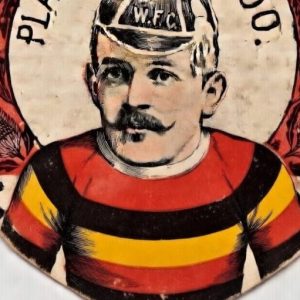
In the pioneering first years of Wallaroo, they made it the ‘Grand Football Match’ era, where ‘First Fifteens’ weren’t anywhere near enough – these ‘Bigside’ games needed ‘First Twenties’, each featuring a pack of up to 16 bulwark forwards, leaving just four backs behind to patrol the field.
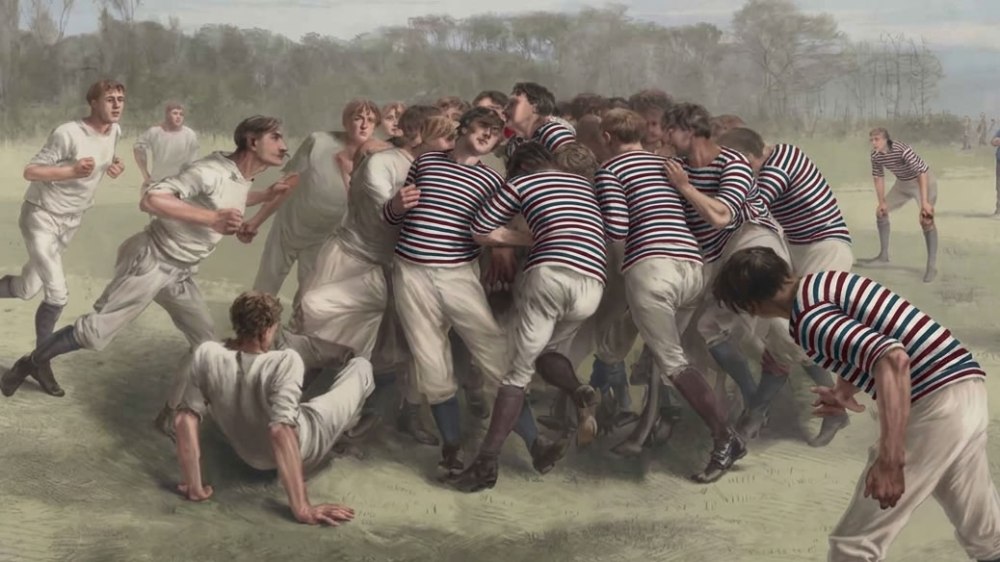
In 20-a-side the best part was the shoving—pure bulldog work—pushing and backing until the ball somehow escaped. Nobody put their head down. The result was a melee of men with wounded shins, but oh, what Rugby fun!
THE NEVER-ENDING SCRUM
Reminiscent of Napoleonic skirmishes, nothing drew a crowd in early 1870s Sydney like these fantastical Rugby “shoving matches” between Wallaroo’s ‘1st Twenty’ and their opponents.
The spectacle awed the gathered crowd and military men alike. The colony’s capital remained in a martial mood, with the New Zealand Wars drawing to a close and fears of conflict with Russia looming on the horizon.
At its heart lay an “infantry square” of up to thirty-two heaving combatants locked in a raw struggle of bone and muscle for ground and ball in a never-ending scrum. On heavy, wet, cold late-winter afternoons, the sounds of blows, shouts, and cries rose from the fray. Above the giant scrummage hung a gunpowder-like steam cloud of “reek and mist.” Black eyes, skinned knuckles and hacked shins were indispensable marks of honour, but there was no bad blood.
There was something in this grander-scale Rugby — its rough manliness and mimic battle — that appealed to the primitive instincts and set the blood and pulse dancing. An ‘old boy’ of Rugby football at Oxford University speaking of the era at NSWRU dinner said:
“For it was the oldest game to begin with. Then it was the game which the Duke of Wellington had said made soldiers because it taught men to fight; when they were boys this game taught them to scrimmage, and, and fellows who had pluck enough to do so were plucky enough to do anything.”
“BIGSIDE” & TOM BROWN’S SCHOOLDAYS
In the early days of Rugby football in the mid 1800s, the laws of the game were silent on team sizes. Tradition though had meant the use of twenty-a-side teams was thought the “beau ideal” across Rugby in Britain and even in faraway Melbourne.*
Each twenty men with forty soles,
Safe guarding their respective goals.
And now the kicking fun begins,
The battle of the toes and shins;
Down went the ball, and, crushing thick,
The strife was great for primal kick
— Melbourne Punch, 30 September 1858 (South Yarra vs Melbourne Rugby game, Richmond Paddock)
The tradition of twenty-a-side and other large numbered teams was rooted in the legendary ‘Bigside’ matches of Rugby School, whether handed down by old boys, or as read from the pages of Thomas Hughes’ famous 1857 novel Tom Brown’s Schooldays. These were games of staggering scale. Another well-known Rugby School story told in schools and Rugby clubs was that in 1839, 75 boys of the School House famously took on “The Rest”—a mass of 225 opponents.
Montague Shearman, a titan of 1870s Oxford University Rugby, recalled that these “Bigside” traditions were treated as an article of faith with Rugby footballers. Even as the game began to modernise, players still believed twenty was the minimum for a “model side.” To these traditionalists, the “scrimmage” (scrum) was the very essence of the game.
The 1875 edition of the ‘Football Annual’ in England still recommended playing 20-a-side whenever enough players were available. The system was also honoured and sustained by the international stage, where the inaugural era of matches between England, Scotland, and Ireland (the first was in March 1871) were all twenty-a-side encounters.
THE WALLAROO ‘1st TWENTY’ MATCHES
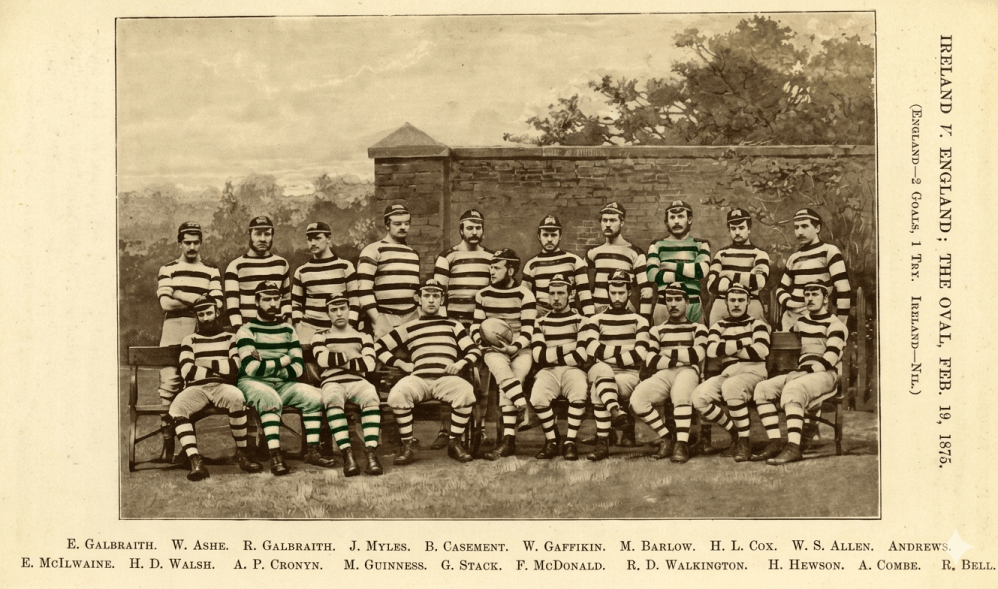
As the Wallaroo club and its membership and support grew, so did the desire to participate in these massive, classical contests of Rugby comradeship with twenty-a-side teams. Ten such epic matches were played by the Wallaroo ‘1st Twenty’ between 1871 and ’74.
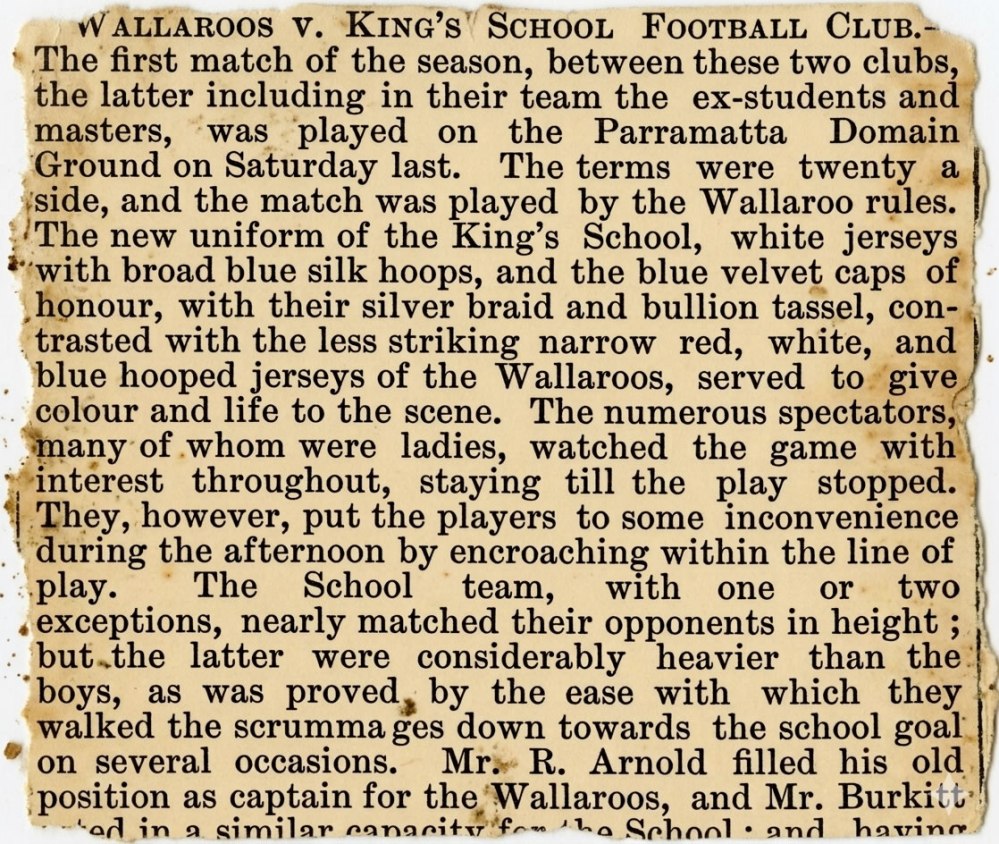
In 1871 the Wallaroo men wore sombre grey jerseys and white knickerbockers, their heads topped with a distinctive blue cap. But for 1872, they adopted the new style multi-colour hoop jerseys imported from England in thin horizontal stripes in the Union Jack colours red, white, and blue. This tricolour combination is unique to the club’s twenty-a-side era.
On the touchlines of Moore Park and the Parramatta Domain, the sight of these “striped giants,” with a mastodon-sized forward pack colliding and moving with their opponents, offered a sharp, visual drama that captivated onlookers and served to give colour and life to the scene.
Unlike the first Wallaroo game of 1870 against ‘Army and Navy’—which followed the Rugby School tradition of playing over consecutive Saturdays until a goal was scored—these matches were settled on the one afternoon in two hours of play from 3 p.m kick-off to 5 p.m or dusk.
Many of these games were goalless draws and, as far as we know, none were resolved by resorting to the famous post full-time tug-of-war between the two twenty-a-side teams used by London’s Richmond and Blackheath clubs in 1864!
Between 1871 and 1874, the “First Twenty” (WFC) was a regular fixture of the Sydney winter:
- 1871 July 22: WFC & Sydney University (SUFC) drawn (no goals) at Moore Park.
- 1872 Jun 22: WFC def SUFC by 1 goal to nil at Moore Park.
- 1872 Aug 03: WFC & SUFC drawn (no goals) at Moore Park.
- 1872 Aug 17: WFC def SUFC by 1 goal to nil at Moore Park.
- 1873 Jun 21: WFC & The King’s School (TKS) drawn (no goals) at Parramatta.
- 1873 Aug 16: TKS def WFC by 1 goal to nil at Parramatta.
- 1874 May 31: WFC & TKS drawn (no goals) at Parramatta.
- 1874 Jun 20: WFC def TKS by 1 goal to nil at Parramatta.
- 1874 July 11: WFC & Waratah FC drawn (no goals) at the Military & Civil Ground (SCG).
- 1874 July 25: WFC & SUFC drawn (no goals) at Moore Park.
**
A GAME OF BULLDOGS & GREYHOUNDS
One could readily deduce from these 1871 to ’74 match results what Wallaroo twenty-a-side Rugby actually was. With the ball entombed within a massed pack of up to thirty-two forwards — sixteen from each side — games were often desperate stalemates determined by a single goal kick, decided by endurance and brute strength rather than skill.
The Wallaroo men formed a full brigade, dressed for battle they presented quite a formidable sight taking to the field. Near three-quarters of the side were forwards, selected for their size, weight, and “bulldogism” — that stubborn, unyielding spirit of the era. Indeed a football animus.
“…the superior weight and compact play of the Wallaroos kept the ball continually at their opponents’ goal…”
— The Sydney Morning Herald, 12 August 1872 (Wallaroo v Sydney University on 3 August 1872)
These were heavy, powerful men built as living bulwarks for a monotonous, heaving struggle where the ball was rarely seen and even less often kicked. It was mountain against mountain: a primeval test of bone, muscle, and willpower that defined Wallaroo’s reputation in those pioneering years.
Matches were played against Sydney University, alongside a single meeting with the Waratah FC. Other fixtures came via challenges from “The King’s School (Past & Present)”. They were no pushovers, as their “twenties” routinely comprised the best “old boys, masters, and beardless youths” (alumni, teachers, and senior students). Wallaroos who emanated from the School (most notably W.R.F. “Gurry” Burkitt) were given a leave ticket to change colours and loyalty for the day if they desired, which also served to level the field of battle.
At the heart of every match lay the enormous scrum. The two packs met in a chaotic, sweating mass—faces up, shoulders and legs driving, boots pushing at the turf. Some preferred to turn their backs and push forward that way. The ball could disappear for minutes while the Wallaroo forwards pushed, wheeled, and strained to break the opposition. Looking downwards for the ball and hooking it backwards was a publicly deplored sin.
“…the Waratahs practised the reprehensible system of rolling the ball back to one of their side behind them…”
— The Australian Town and Country Journal, 4 July 1874
Spectators loved the raw power — the grunts, shouts, and sudden surges when the Wallaroo pack gained the upper hand and the ball finally squirted free. To the players, the scrum was the game – that’s where all the action was.
For the bulk of the game, the spectators could not see the ball at all; there was just a “violent agitation” in the middle of it all where, undoubtedly, the pigskin was being fought over. The crowds were often not content to watch from the touchlines, preferring to follow the scrimmage as it meandered about the field. Those who got too near the “hot” fully expect “they get well shinned for their pains.”
“The ball has just fallen again where the two sides are thickest, and they close rapidly around it in a scrummage. It must be driven through now by force or skill, till it flies out on one side or the other. Look how differently the boys face it! Here come two of the bulldogs, bursting through the outsiders; in they go, straight to the heart of the scrummage, bent on driving that ball out on the opposite side. That is what they mean to do.”
— Tom Brown’s Schooldays by Thomas Hughes
While the forwards were the team’s bulldogs, the backs were its greyhounds. Wallaroo was so strong in the forwards, that they often played the entire match with a fourteen-man pack and six backs. In contrast SUFC, for example, would face the heavier Wallaroos with sixteen forwards and just four backs.
The Wallaroo backs were usually deployed as three half-backs, two backs, and a full-back (“goal-keeper”). If we picture the scrimmage in the centre of the field, the half-backs flanked the sides and rear of the scrimmage at about 4-5m distance. Further away, some 20-22m, are two backs, with one deeper still patrolling the goal area — he is the last line of defence, valued for kicking, fielding, and tackling.
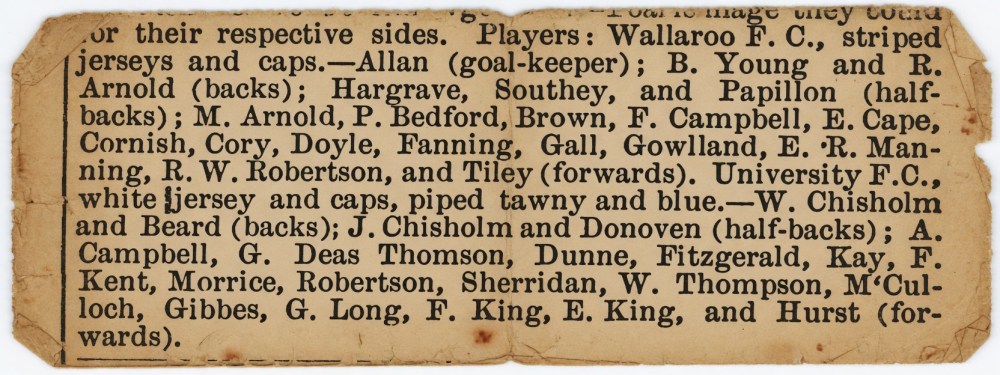
1872 WFC vs SUFC twenty a side game – Australian Town and Country Journal, 10 August 1872
Picking up the ball and running required real courage. And possession of an evasive and artful “dodge” too! Get caught and both packs would descend in a crushing pile upon you. Many still objected to “seeing the ball run with,” favouring the honest grind of the forwards. Yet for the brave Wallaroo half-backs and backs, the thrill was in “adventuring your life” with a solo dash.
For the backs the game remained direct and individual. Passing away the ball when encountering an opponent was unmanly and so rarely done. Ending a long run with a try or a flying drop-goal could turn a dour afternoon into legend.
“Play was commenced at 3 o’clock by a kick off from the middle of the ground by the Wallaroos, and for the first half hour the ball was kept in the middle of the ground. However, the superior weight and, we are bound to say, the excellent forward play of the Wallaroo began to tell, and while the ball was in dangerous proximity to the University’s goal line, Hargrave [WFC] very smartly ran in and touched it down [a try] behind the line on the east side; however, the chance [conversion] was missed by a bad kick from R. Arnold.”
— The Sydney Morning Herald, 29 June 1872 (Wallaroo v Sydney University on 22 June 1872)
“The result of the contest was extremely doubtful for some time, but about 5 o’clock the Wallaroo team (who had three trials) [3 tries] succeeded in obtaining a goal [conversion], kicked by Mr R. Arnold. There were a large number of spectators present, who appeared to take the liveliest interest in the competition, especially when it came to close quarters.”
— The Sydney Morning Herald, 24 June 1872 (Wallaroo v Sydney University on 22 June 1872)
This was Rugby at its most elemental — raw, physical, and uncompromising. There was no referee. Disputes were left to the captains to resolve; however, on the most important occasions, following an ancient boxing tradition, each side brought their own umpire, just “in case of a gentlemanly disagreement.”
The Wallaroo 1st Twenty embodied a rugged spirit. Their era of the great shoving matches would soon yield to the faster and open fifteen-a-side game, yet the memory of those massed mastodon packs struggling against each other for minutes and longer endures as a testament to the rugged, riotous dawn of Rugby in Sydney.
The great Wallaroo ‘First Twenty’ made their final stand on the Moore Park field in the dying days of the 1874 winter.
WELCOME TO THE FIRST XV
Britain officially moved to fifteen-a-side for the 1876/77 season, though the laws didn’t formally mandate the number as fifteen until 1892 amidst the looming threat of professionalism (rugby league). The catalyst was the December 1875 Oxford vs. Cambridge match—played with fifteen a side—which showcased a faster, more open style of play.
Unlike in Britain, the move to fifteen-a-side was driven less by a desire for “open play” and more to do with the strength of the Wallaroos.
“In those early days they played 20 men aside … The Wallaroos, however, had been playing 15 men aside. They were so strong a club that they could meet their opponents with five men less — and beat them.”
— The Newcastle Sun, 13 April 1921
Although the quote above tends towards the apocryphal, it was common practice for Wallaroo, in a well-established custom, “to even the odds” by agreeing to let the opposition have more players, or for Wallaroo to reduce its numbers, especially against school teams (when without their ‘past players’) or country clubs.
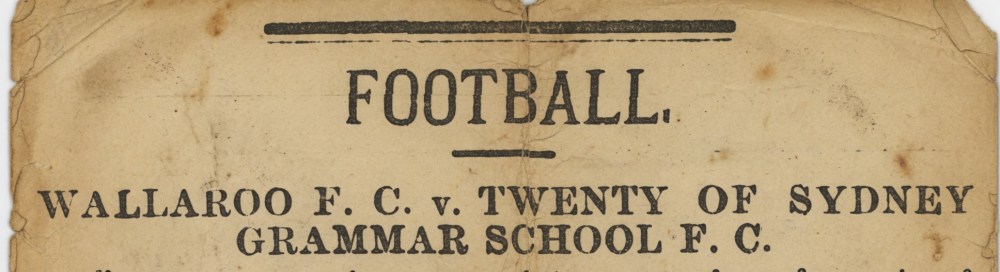
Still, the most likely factor in reducing teams from twenty men was colonial pragmatism. The city simply lacked the depth of players to consistently field forty men for a single match. The first Rugby game that Wallaroo ever played in 1870 against ‘Army and Navy’ was arranged and held as sixteen a side. Though played under different rules, the city’s first inter-club match between the Sydney and Australian FCs in July 1865 was a mere fourteen a side.
There was also the problem that come game time teams could be smaller in number without any warning at all. The bigger the team the greater the chance of players unable to turn up, missing transport options and obviously very limited means of communication.
The earliest confirmed Rugby match of fifteen against fifteen in Sydney was between Wallaroo and a team from ‘No. 10 Battery of Volunteer Artillery’ played at Moore Park on 8 July 1871. Tom Brown for Wallaroo kicked a drop goal near full time to give his side victory.
The transition from twenties Rugby to fifteens was laid bare at the Wallaroo FC annual meeting in April 1875. The records told the story: of the ten first-class matches played in 1874, four were contested by the ‘1st Twenty,’ while six had already moved to the ‘1st Fifteen.’

The reality looming over Sydney football was that while many players and spectators still revelled in the heavy, twenty-a-side Rugby game, like with stout beer and heavy plum pudding, a far larger audience preferred lighter tastes.
Not that fifteen a-side was yet fully tamed Rugby either – it still meant ten forwards side-by-side in a line trying to push and kick themselves and the ball up-field and through an equal body of opposition.
“…a great outcry had been made against scrimmages. He must say, that the old form of scrimmages was very dear to him. It had been said that there was no skill required in these scrimmages, but he thought that when a player put the ball down with ten trusty opponents standing shoulder to shoulder in front of him, and got it through, it required no little skill, and there was no pleasanter feeling than that which attended the successful effort in this part of the Rugby game.”
— William ‘Gurry’ Burkitt, Wallaroo FC, The Sydney Mail, 7 August 1880
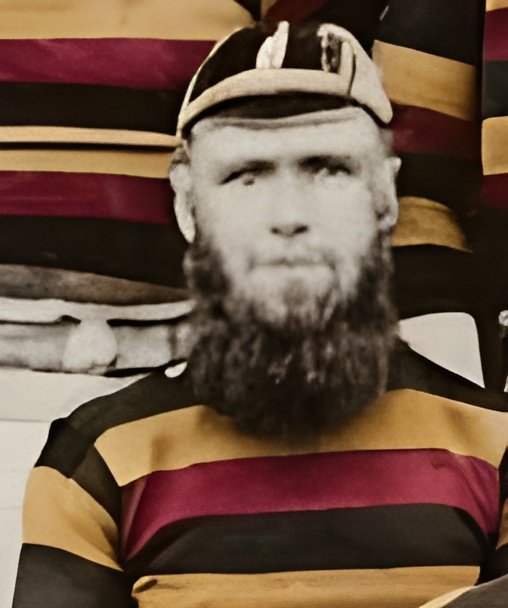
By the winter of 1875—the inaugural season under the Southern Rugby Football Union (today the NSWRU)—Sydney’s first-grade clubs had settled on fifteen players by convention.
While some contests over the ensuing years still saw teams of twenty take on the Wallaroo fifteen, the era of the Wallaroo FC ‘1st Twenty’ and their mastodon forward pack was over.
Black eyes, skinned knuckles and hacked shins were indispensable marks of Wallaroo honour, but there was no bad blood.
* Melbourne rules football teams (VFA & VFL) retained twenty players a side until the end of the 19th century. Eighteen a side used today in AFL is a direct child of this Rugby era. “The rules of the Victorian game were framed in the sixties with the existing Rugby laws as their basis, which at that time provided that twenty men aside were to be played. But in 1877 the Rugby people substituted fifteen for twenties, and the change in the style of play became rapid; the loose game coming into fashion. But Victorians did not keep abreast with the times, and they stuck to the old-fashioned twenties until very recently, when the number was reduced to eighteen.” – Leader (Melbourne), 20 April 1912
** Melbourne Punch edition 30 September 1858 published a lengthy poem detailing a twenty-a-side Rugby match between organised team from South Yarra and one comprised of Melbourne cricket club members & others. The game is described as a grueling, non-stop scrum that only ends after a conversion goal is kicked following a try. The South Yarra men were likely the South Yarra FC which in 1858-59 was probably Australia’s first football club and its playing rules were Rugby.
***This list, as far as it is known, does not include matches arranged to be 20-a-side that due to player absences or other reasons proceeded with one or both teams having less than twenty players. Also does not list any of the club’s in-house ‘scratch twenty’ matches.
WallarooFC1870.com – All website text & content © Sean Fagan
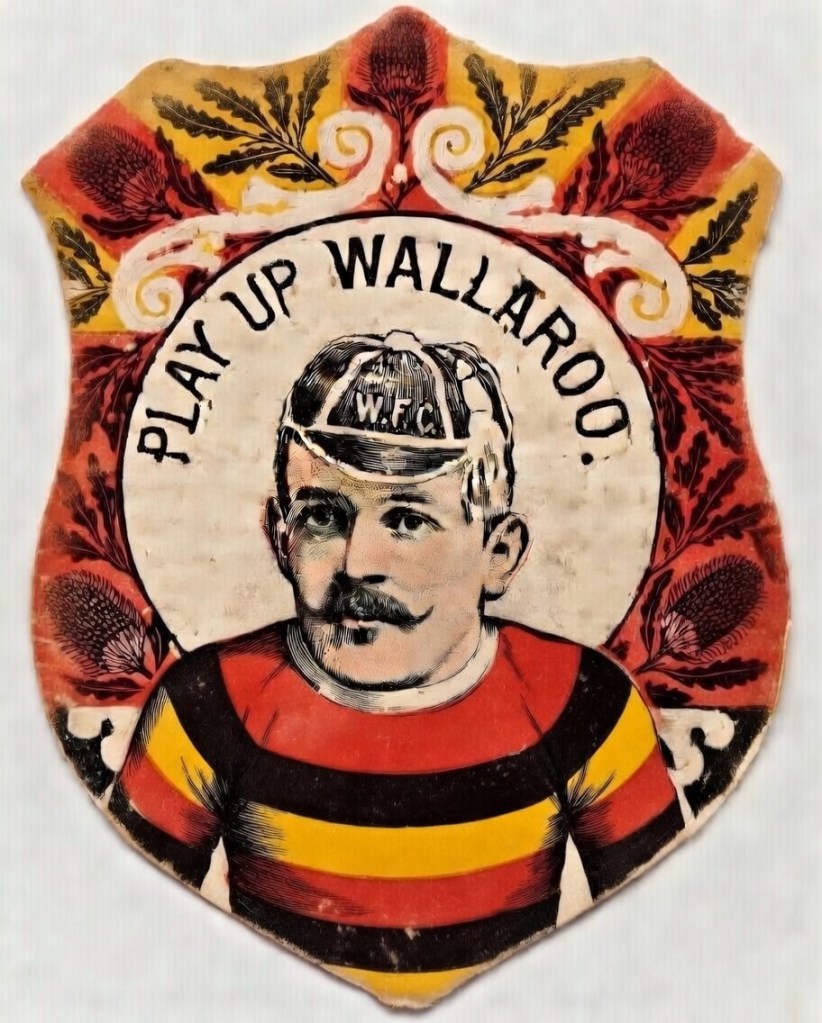
[ site homepage ]
