
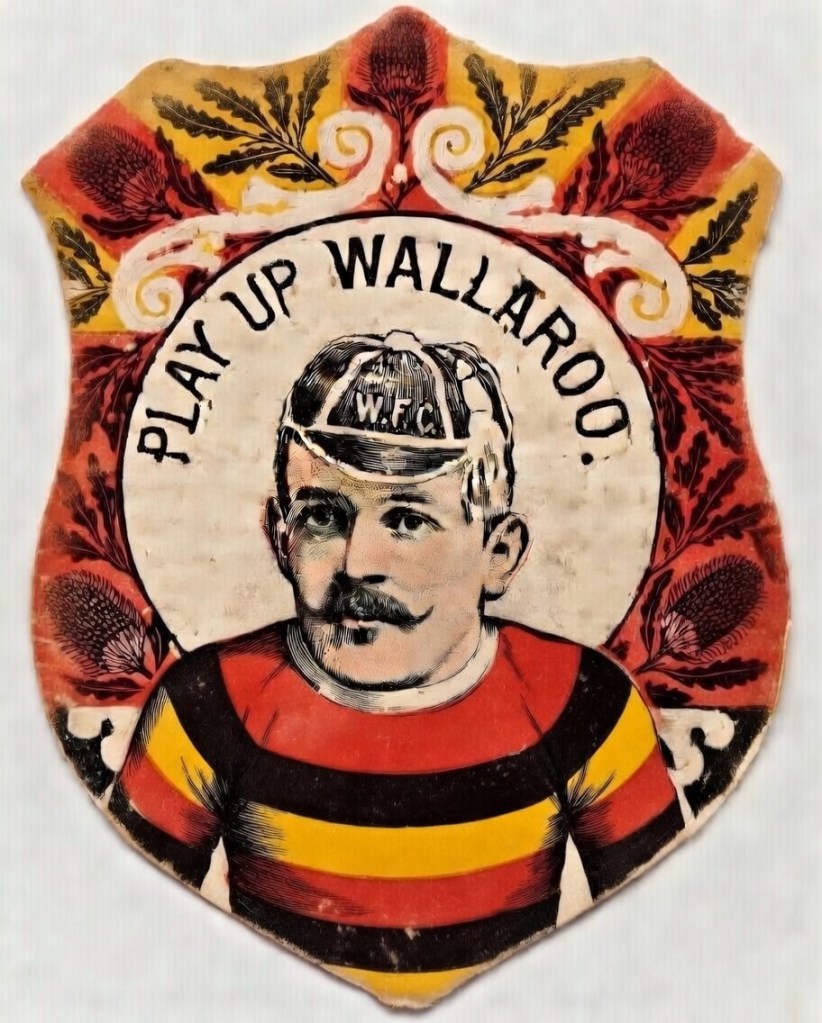
The first football game in Sydney under Rugby rules came in 1870 with the arrival of the Wallaroo FC. Incredibly, this match against ‘Army and Navy’ at the SCG went on for two afternoons until a winning goal was kicked, all while a spectator looking on was accidentally shot by musket fire.
SYDNEY, SATURDAY, JUNE 18 1870
FOOTBALL. – The opening match of the Wallaroo Football Club will be played this afternoon, on the Military and Civil Cricket Club Ground, between sixteen gentlemen of the Army and Navy and sixteen of the above club.
SYDNEY’S FIRST RUGBY GAME
The Wallaroo’s opponents were British ‘Army and Navy’. The colony’s capital was still very much a martial city, involved with the end years of the New Zealand Wars (Maori Wars) and amid the growing fear that war with Russia was on the horizon.
The match was played on “the Military and Civil Cricket Club Ground” (now the SCG), near the Victoria Barracks and the Paddington Rifle Range. It was the first time that the “hallowed oval” had been made available for winter football.
While games between clubs, the University, and others had been played in Sydney since 1865, they were contested under unknown ad hoc rules, a mix of Rugby and “something else,” or a rough idea of Melbourne’s football rules.
It took the arrival of the Wallaroo FC, and their determination to play football under nothing other than Rugby laws, to truly get the code started. On 18 June 1870, an unpretentious announcement hidden in the columns of The Sydney Morning Herald signalled the arrival of football as a serious sport in Sydney:

Those few words heralded not only the arrival of a new club—a significant milestone in itself for Sydney football—but the playing of a match on an enclosed ground. For the first time, footballers could enjoy their sport free from the interference of people wandering across the field and interrupting the game (as per Hyde Park or the Inner Domain), or falling into a water-filled ditch or upon animal excrement (at the University Paddocks).
From the day of its first outing in the winter of 1870, the Wallaroo FC was Sydney’s premier Rugby club until the arrival of the 20th century. Led by men of influence, most notably the Arnold brothers (Monty and Richard), the club not only resolved from the outset to play Rugby exclusively, but also to obtain, through their connections, the use of the SCG. To achieve such a feat for their opening game was an accomplishment indeed.
How the Wallaroo members gained access to the SCG remains a mystery. Some events held at the ground circa 1869–1870 appear to have gained permission directly from senior British officers at Victoria Barracks; others via the Military and Civil Cricket Club (SCG) committee. The latter group had fielded a football team against Sydney University in the winters of 1866–67, though all of those games had been held in the University Paddocks.
It was, after all, still a cricket ground, and the prospect of footballers “running and mauling away” over a cricket wicket was unpalatable to many officials. However, with the Wallaroos’ opponents being a composite of officer “gentlemen of the Army and Navy,” obtaining the use of a ground under British military control likely proved straightforward.
Watched by a few hundred men in various uniforms intermingled with the sober grey and brown hues of civilian clothing, and no doubt with a sprinkling of ladies in colourful dresses, the first football game on the SCG now got underway.
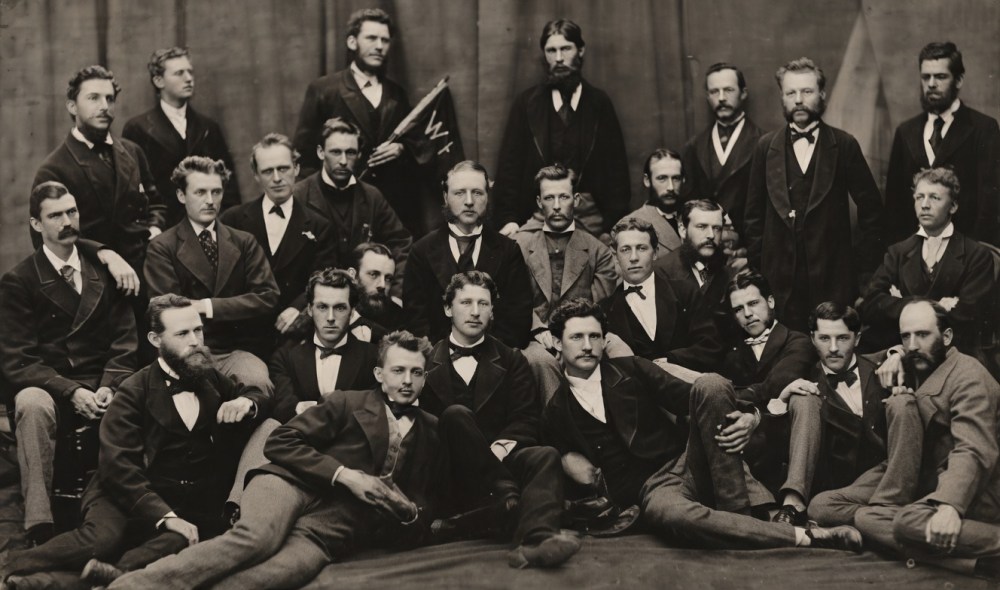
“FOOTBALL MATCH. A most exciting football match came off between the Military and Naval officers on the one side, and the Wallaroo Club of Civilians on the other, on last Saturday, on the M. and C.C. Ground near the Barracks.”
— Bell’s Life in Sydney. 2 July 1870
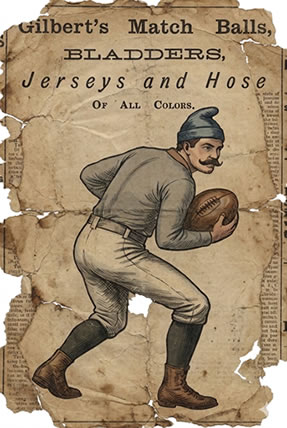
The Wallaroo team uniform was a grey jersey, white pants, and blue cap. Through the 1860s these had been the colours of the Sydney Battalion Volunteer Rifle Corps, the colony’s first volunteer civilian regiment. The military side, based on reports of similar outings, wore merely their “undress toggery” and heavy black boots.
Unfortunately the full team lists for Wallaroo from 1870 are incomplete, but records show that the captaincy in this first game was held by Tom Brown, who was one of the five founders of the club.
‘Army and Navy’ were led by Lieutenant John Boddington Jackson of the 18th Regiment of Foot (Royal Irish Regiment) of the British Army. The 18th Regiment had been serving in New Zealand. The team also included officers from Royal Navy vessels HMS Challenger and HMS Blanche. Later in the season Jackson played for Wallaroo FC against Sydney University.
The Wallaroos lugged their own sets of goal and boundary posts to the ground, stringing a rope as a make-do cross-bar and marking out the field of play themselves. There was no referee, so no penalties and no shouts of direction, and no intervention of a whistle. Disputes were resolved on the field in discussion between the opposing captains, and if they couldn’t, they called upon the word of the civilian-dressed gentleman umpire (Mr John Calvert).
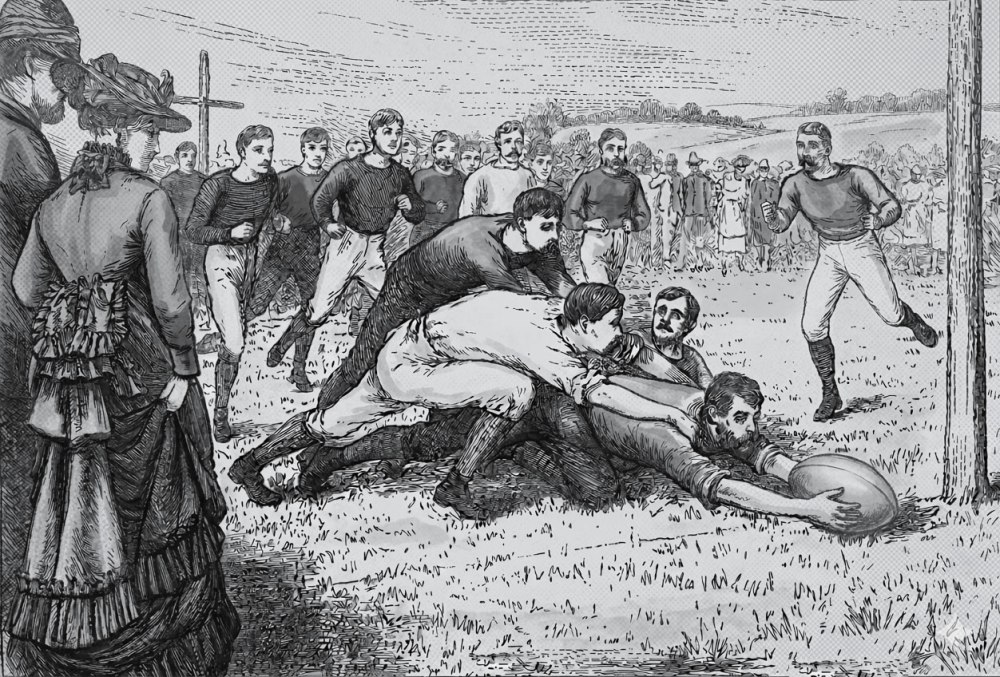
It was a time early in Rugby football when physical strength counted more than science. A closely fought struggle between heavy forwards ensued with no goals kicked at all. Tries were run in (reported as ‘touch-downs’), but they did not yet count for points.
The contest though was not yet done. It was not a draw.
In Rugby School tradition, a goalless day did not mean the contest was over; instead, the match was continued the following Saturday, when the Wallaroos finally landed a goal to take victory.
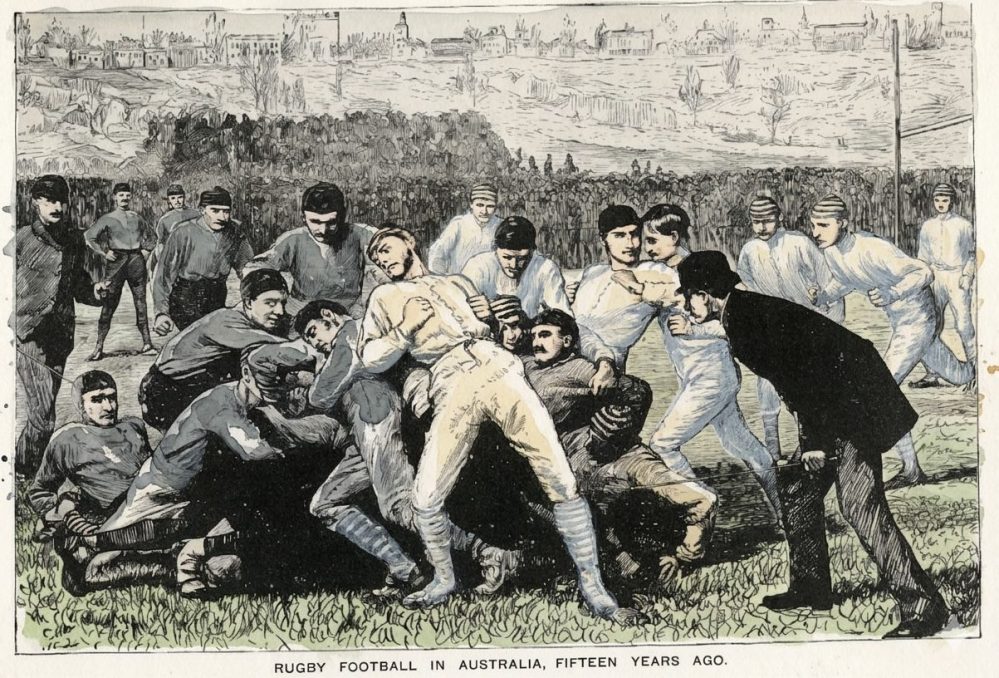
That it took more than one afternoon to land a single goal is unsurprising. To 21st-century eyes, the game would have appeared a never-ending scrum—made even more so as the playing field had been noticeably reduced in size, pushed and cramped into the edge of the SCG to ensure the cricket wicket was not trampled upon.
“…the dimensions of the ground, which is altogether too small, 90 x 60 [yards]. On Saturday last the ball was in touch during a great portion of the afternoon. The ground for effective play should be at least 150 x 100, especially when the wind is high. I am informed, however, that the small size of the playing ground is attributable not to the framers of the rules, but to necessity, as it is the only piece of the M. and C.C. ground available, except the centre, which is kept for cricket.”
— The Australian Town and Country Journal, 2 July 1870 [a 21st century Rugby field today is usually 110 yards by 74 yards]
The same reporter took exception to the teams’ preference for Rugby rules:
“The play on both sides… was very fair. Mauls and scrimmages were, however, too fierce and frequent… The rules of the Wallaroo Club are very nearly identical with those of the Sydney University Football Club, which were framed from the Rugby School code. The greatest objection thereto is the encouragement given to mauls and scrimmages… Moreover, the best of players soon get pumped [worn] out, if they go into every maul and scrimmage.”
— The Australian Town and Country Journal, 2 July 1870
Another account was provided by a letter published in The Empire, which described the scene from near the military rifle range at the rear of the Paddington barracks. Writing under the pen name of an “Irish point of view,” the author found the Rugby code fearfully tame, but acknowledged:
“There were amongst the players assembled on Saturday some smart young fellows, with any amount of pluck and determination … When looking at the game on Saturday evening I saw some glorious chances for spills, and it made me almost feel young again … You will see in the headlong dash after the football the same spirit of daring determination that is to be met in the soldier’s storming the fort or boarding a ship. Such manly sports should be encouraged.”
— The Empire, 28 June 1870
Another newspaper review of Sydney’s first Rugby football match:
“We must say that we enjoyed the sport immensely, and hope it will be kept up by more than one club. The game is played in the Rugby style and not the Irish, every one being allowed to catch the ball, and get away with it if he can. The spirits of some gentlemen got rather scarce towards the end of the game, and we saw several cases of limping home.”
— Bell’s Life in Sydney. 2 July 1870
However, as if the Wallaroos and their opponents didn’t have enough obstacles in their way that first game, the match was regularly punctuated by the sharp sound of musket-fire from the military’s adjacent rifle range.
A frightful event ensued when one of the spectators at that end of the SCG was shot, as an “Irish point of view” explained:
“Whilst looking at the game on Saturday, a poor fellow was wounded at the rifle range. I did not go to look at him. If I could have been of assistance I would have gone readily; but seeing so many running to his assistance, I felt satisfied he would be looked after.”
— The Empire, 28 June 1870
The full extent of the range’s location is now difficult to pin down, but when the Sydney Sports Ground opened in 1903, newspapers noted that part of its land came from the old range. Firing was made in a south-easterly direction from the 1,000-yard mark, which was adjacent to the eastern end of what is today Paddington’s Captain Cook Hotel (Moore Park Road).
Dodging bullets was a hazard locals endured for decades. Before the range was fenced, many preferred to risk life and limb by dashing across the 100-yards wide range rather than taking a long detour, using the puff of gunpowder smoke as a signal to bound off like a hunted hare before the soldier could reload.
The Sydney Football Stadium today stands upon part on the old rifle range site and it is still the primary host and venue for all of the big Rugby matches, of either code.
Note: There is no contemporaneous reports to verify claims that in 1869 the Sydney University played Newington College (Wesleyan Collegiate Institution) in Australia’s first rugby game. The story first appeared 70 years later in The Referee on 3 December 1930 and states it was “played under University Football Club rules — twenty aside”. The latter is not confirmation it was a rugby game as none of the University’s 1865-69 external games have been verified as rugby. a copy of the University’s rules of the 1860s have never been found, and the first documented mention of the University having Rugby School devised rules is in 1870 (although the same description had been commonly said of the Melbourne FC rules). In the book ‘Guardians of the Game‘ by John Mulford he reproduces an undated notice of such a match “to be played according to the rules of the University. Twenty a side.” Mulford also includes a Newington football team photo which he ascribes as the 1869-70 rugby team, noting the round ball in the photo is result of rugby balls had to be imported and were often not available. However, contrary to that, a round ball was no easier to make locally either, and the use of a round ball was common to many Melbourne rules clubs until the 1870s. Per the College’s own history the headmaster at the time (1866 to early 1869) had been George Metcalfe, a former player and vice-president of the Geelong FC in Melbourne, and “he also introduced an early form of Australian Rules Football” to the young men [link]. Metcalfe departed Newington early 1869 well before winter football, the lead then being left to Joseph Coates. Despite the increase in reporting of football matches from 1870 onward, there is no mention of the College playing externally at all until meeting The King’s School in 1873 and then Wallaroo FC and University in 1874. If the 1869 game did happen, these were in any event not football clubs i.e. they were teams of students from education institutions.
WallarooFC1870.com – All website text & content © Sean Fagan
[ site homepage ]
