A timeless sentinel modelled on the first Wallaroos stands silently over the Australia’s birthplace as a nation.

“It is estimated there were more than 150,000…from the footballer’s statue, which is so prominent a landmark in the park…the area was commencing to be thickly covered with humanity.”
Physical traces of Sydney’s pioneering football age have nearly vanished from the modern landscape. The Wallaroo club’s old meeting venues—once among the most famous hotels in Sydney—are all long gone.
For a time-travelling Wallaroo looking for familiar football surroundings, comfort survives in a few historic pockets: the open grass fields of Moore Park, the old Sydney Showground, and the hallowed turf of the SCG. Crucially, the SCG’s magnificent Members’ Stand and Lady Members’ Stand offer a direct portal to the past, remaining virtually unaltered since the late Victorian era.
The most strikingly familiar friend from this bygone era is the Wallaroo-inspired “Footballer” statue in Sydney’s Centennial Park.
From a time before there were any Wallabies, any Kangaroos, or even a nation, this bronze Rugby guardian has stood in silent watch over Australia’s first city from the 19th through into the 21st century.
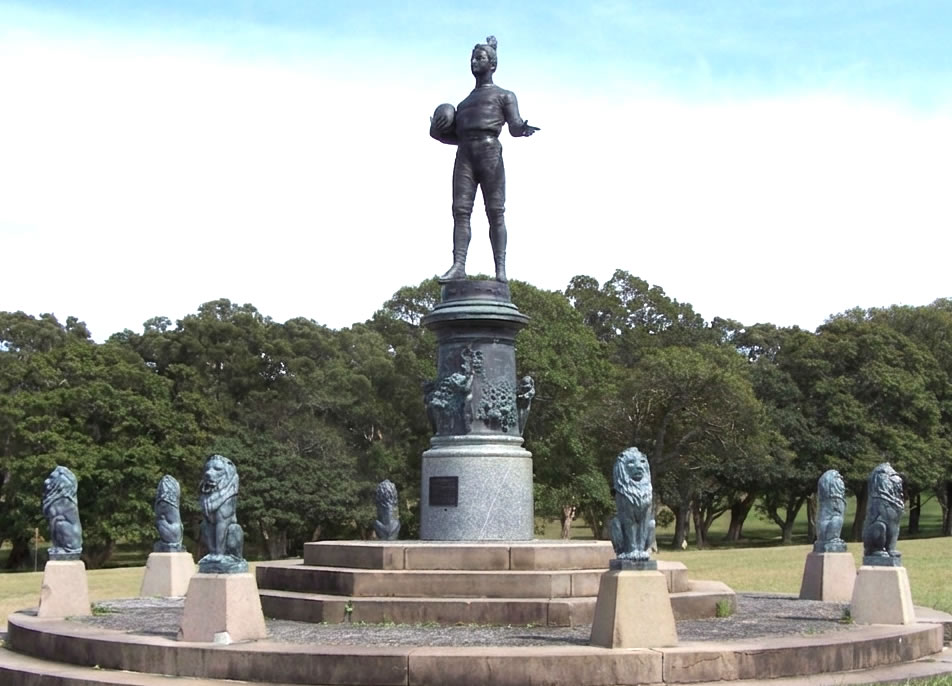
FOOTBALLER IN CENTENNIAL PARK
Following his official opening of Centennial Park in 1888, NSW Premier Sir Henry Parkes elevated its civic prominence in 1889 by personally authorising the purchase of its initial statue collection.
Today, Parkes is revered as the “Father of Federation” for launching and leading the 1890s movement that united the separate colonies into the Australian nation—a triumph realised when Centennial Park served as the official site for the Inauguration of Australian Federation on 1 January 1901. Centennial Park is located a little over 15 minutes walk to the east of the SCG and the Sydney Football Stadium.
Parkes firmly believed that showcasing grand sculptures was essential for educating the public and establishing a world-class “People’s Park” for Sydney and Australia. Under this broad artistic scheme, he populated the landscape with literary icons like Dickens and Shakespeare, classical allegorical figures like “The Four Seasons,” the goddess “Diana the Huntress,” and a pair of protective, mythological ceramic “Griffins.” There was even a monument crafted to honour Parkes himself.
As part of this grand vision, Parkes specifically commissioned the world’s first public statue of a footballer—officially titled “We Won!” and sculpted between 1891 and 1893 by Italian artist Tommaso Sani. The sculptor was already well-known across the city for sparking a fierce, multi-year political uproar with his unapologetically realistic sandstone carvings, which are still visible today on the Pitt Street façade of Sydney’s General Post Office (GPO) in Martin Place. He also did three of the exterior ledges statues on the NSW Lands Department building.
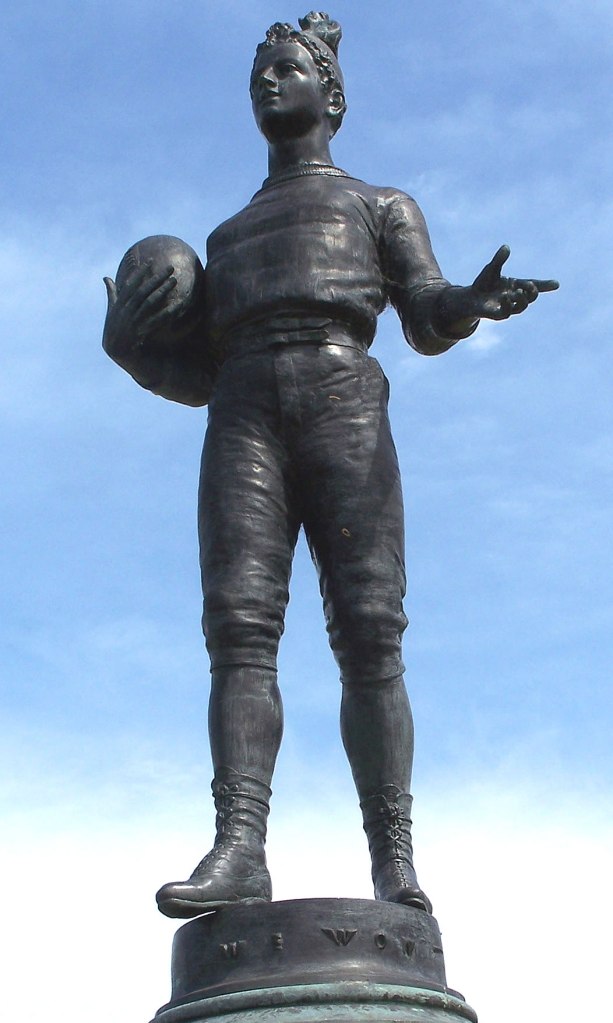
This unusual footballer statue reflects Parkes’ friendship with British author Thomas Hughes, whom he met in 1861. While often tied to “muscular Christianity,” the monument actually embodies Hughes’ philosophy of character and endurance—serving as Parkes’ political metaphor for the grit needed to achieve Australian Federation.
Popularised by Hughes’ immensely famous 1857 novel, Tom Brown’s School Days, this Victorian ideal argued that physical health, sportsmanship, and moral fortitude were vital components of a strong, virtuous citizen. Though Parkes himself had never played Rugby, he strongly believed that Australia needed to cultivate a robust, virile, and resilient native-born generation to lead the upcoming Federation.
This deep Rugby connection is anchored by a remarkable historical encounter: in 1893, although he no longer held the role of NSW Premier, Parkes welcomed the visiting Rugby men of the New Zealand team to his private home, “Kenilworth.” There, the players and the veteran statesman exchanged autographs with each other and talked at length about the prospects of the New Zealand colony joining the proposed Federation.
Due to a severe economic depression and depleted park funds, the statue was quietly raised in June 1895 without any public fanfare, beyond sparking a very short-lived “letter war” in The Sydney Morning Herald between interested users of Centennial Park.
The primary tie of the “Footballer” to the Wallaroo FC is not just its familiarity to the players and supporters of that time, but comes down to its absolute historical accuracy in representing the birth of Sydney club Rugby, which began with the arrival of the Wallaroo club.
Unfortunately, many of the park’s original sculptures have not survived into the 21st century; however, the “Footballer” continues to stand proudly today.
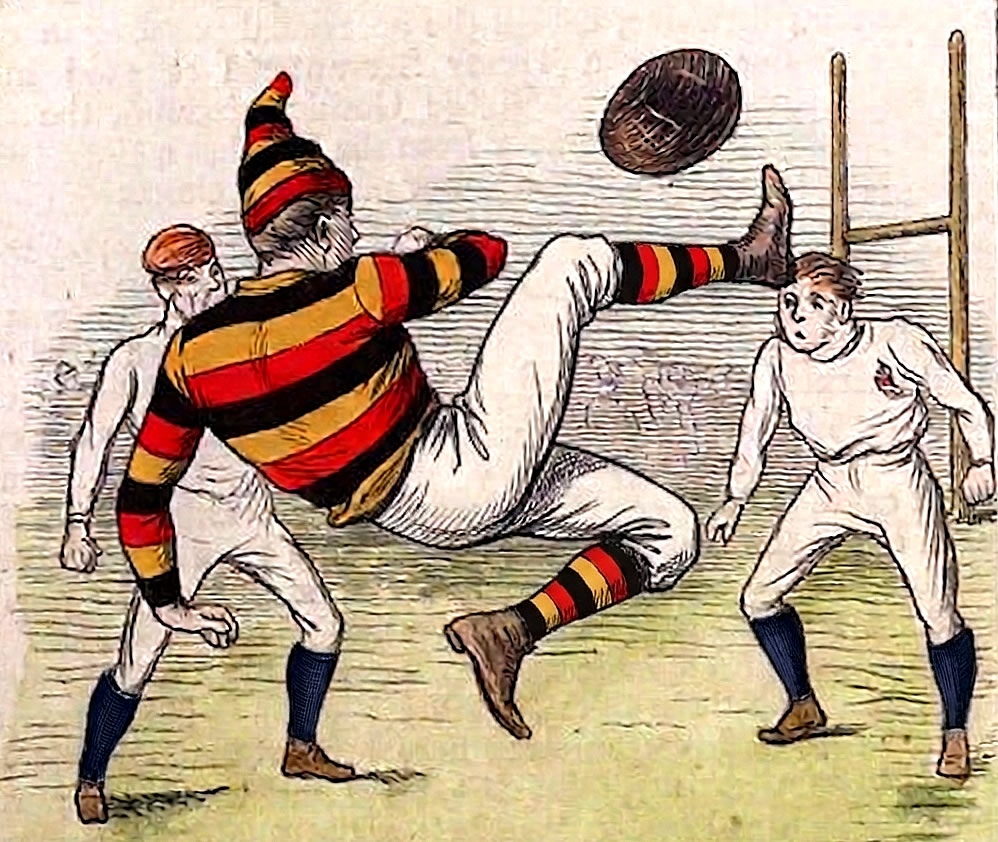
THE UNIFORM AND KIT
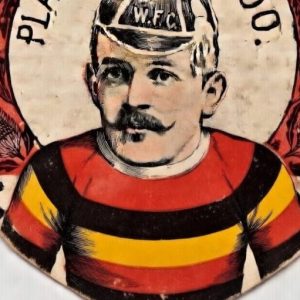
The “Footballer” statue features a life-sized bronze athlete clutching a Rugby ball. He is dressed in the early 1870s style uniform of a Sydney Rugby player: a heavy woollen jersey, tight knee-length knickerbockers trousers, lace-up boots, and a woollen skull cowl cap (a close-fitting cap reminiscent of pirates and sailors).
This footballer’s detailed playing-strip directly mirrored the first style introduced by Wallaroo FC to Sydney in the early 1870s, just as it was worn on the adjoining open fields at Moore Park. Wallaroo won all but one of Sydney’s 1870s football premierships.
The physical “Footballer” model was Arthur S. Price, a well-known Eastern Suburbs athlete and Rugby referee chosen specifically for his remarkably symmetrical figure.
THE “PUTTI” PANELS
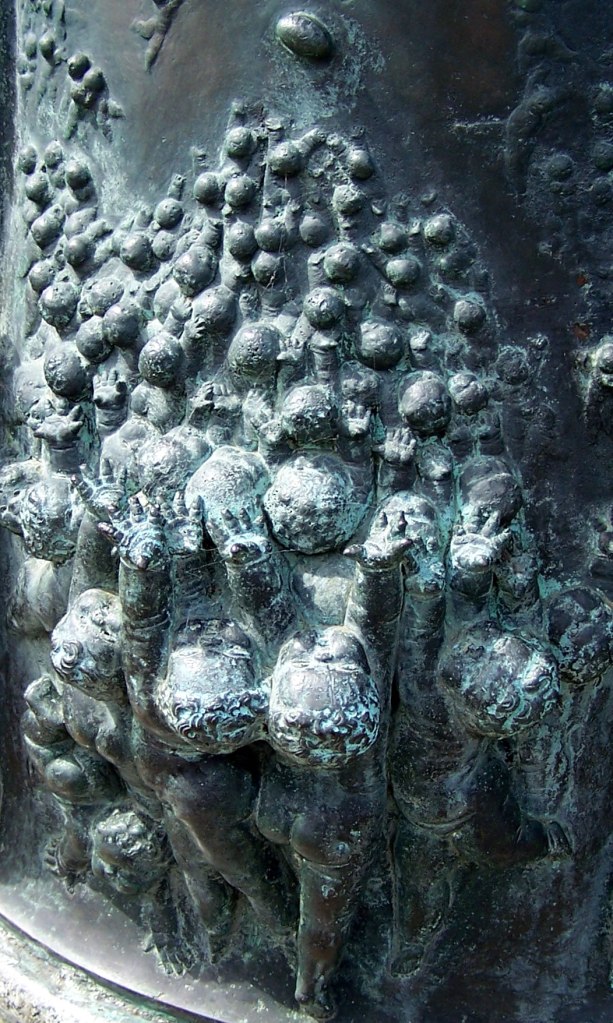
Rather than merely celebrating a game, the statue represents Tom Brown’s School Days cast in metal. The cylindrical pedestal features intricate high-relief panels of small cherubs (putti) engaging in a massive bigside football match at Rugby School.
The creation process is captured in a contemporary letter from James Barnet, the Colonial Architect, to Parkes in 1891:
Dear Sir Henry,
This morning at the request of Sr Sani I visited his studio to see the progress he has made with the model of a “Footballer”, to be cast in bronze for the Centennial Park for which you were so kind as to give him a commission.
The figure (which is six feet in height) is nearly complete in plaster, and in my opinion successfully and pleasing in its expression of victory.
The pedestal with its four little girls representing respectively Glory, with the victor’s wreath, Fame, sounding its trumpet, History, reading the deeds, and Modesty, looking on with approval, are all cleverly posed and expressive.
Between these four Babies are Basso Relievos representing the game of Football in four stages, such as “Throwing”, “Scrimmage”, “Free-kick”, and “Hurrah”, each one full of life and expression, in fact the whole when complete will be like a dream in bronze….
Yours truly, James Barnet.
FEDERATION
On 1 January 1901, the “Footballer” looked directly down upon the massive sea of people celebrating Australia’s Federation.
The road to this moment had been a grueling political battle; Parkes’ campaign for a united nation faced fierce opposition from anti-federationists, bitter interstate rivalries, and protectionist trade disputes. Yet, against all odds, the vision prevailed.
“The scene—in Centennial Park, the great heritage bequeathed to the people by the forethought of Sir Henry Parkes—was one of unparalleled grandeur and natural beauty. It was a scene that will last in memory throughout the lives of those who witnessed it. …
It is estimated there were more than 150,000. The people, later on, when the ceremony was in full swing, did not distribute themselves on the long slopes to the northward, but crowded on the rocky ground to the east and west.
From the footballer’s statue, which is so prominent a landmark in the park, to Boundary Road on the eastern side, the area was commencing to be thickly covered with humanity.”
— Evening News, 1 January 1901
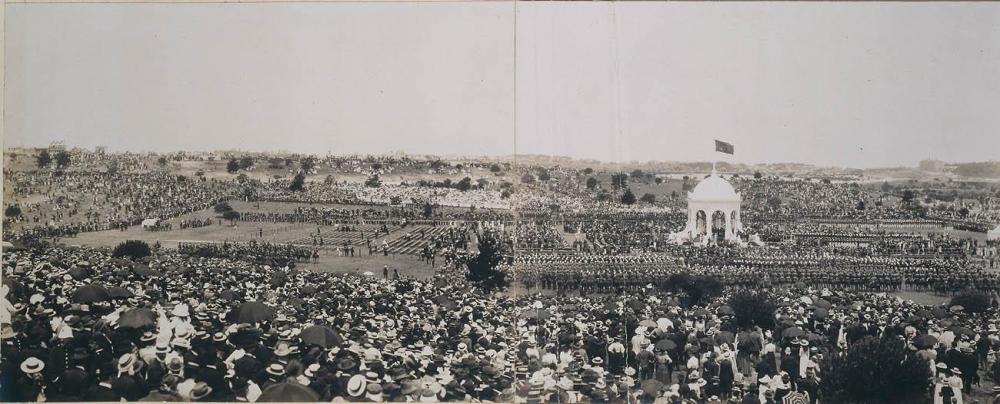
Though Parkes had passed away five years prior, some in retrospect have suggested that at the outset he added the triumphant inscription “We won!” with this exact historic day and hard-fought political victory in mind.
The vista was certainly true to that.
Through the crash of the scrum and the grit of the play,
When the bold Wallaroos broke the line of the fray,
Stands the bronze-moulded vanguard, unyielding and lone,
With the shout of “We Won!” o’er a commonwealth grown,
A sentinel of iron for the seed we have sown.
Note 1 : The “Footballer” statue was restored resultant of funds raised under a 1986-88 Bicentennial project of the Eastern Suburbs District Junior Rugby League and also funded by the Centennial Park Trust. See comments by Leo Schofield in The Sydney Morning Herald 15 November 1986, and “We Won” entry in book “Poetry of place: Royal Botanic Gardens, Sydney” by Edwin Wilson (2004).
Note 2 : See the “Footballer” statue in Centennial Park via Google Streetview > https://maps.app.goo.gl/6j6iD9MyAzDqD9pz7
WallarooFC1870.com – All website text & content © Sean Fagan
[ site homepage ]
