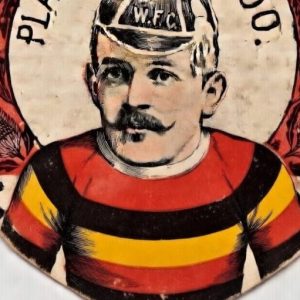
The remarkable story of a Rugby prodigy, from the Wallaroos to the England XV, collecting eight international caps a quarter of a century before the first Wallabies sailed.
His off-field deeds were equally illustrious, ultimately bestowed a knighthood by King George V. The first Wallaroo Knight.
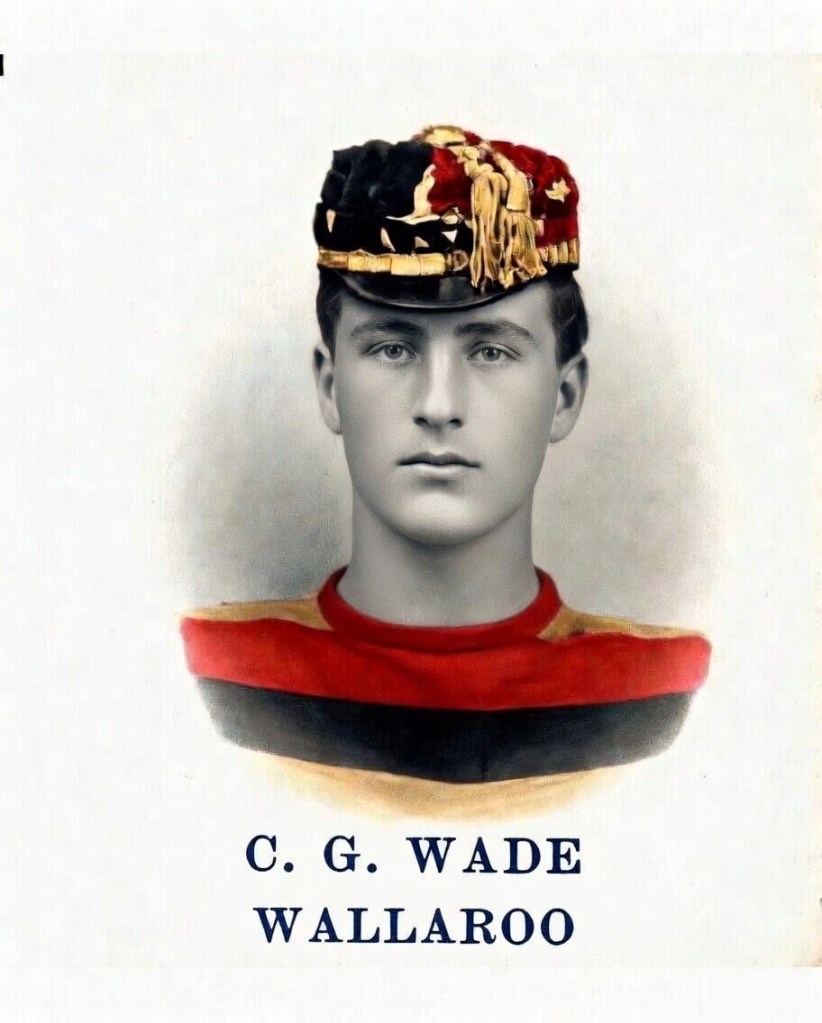
“A veritable Hercules in stature, and having trained here in the old Wallaroos…He was considered one of the fastest runners and hardest tacklers who ever played in international Rugby.”
THE WALLAROO JOEY
Well, he started the day in obscurity. Not yet in his final school years, a 15-year-old boy was quietly hidden among The King’s School (TKS) forwards for the 1878 annual game against the redoubtable Wallaroo FC. Not usually a forward, it was a safe, low-profile way to ease a talented youngster into big-match football as a galley-slave scrummager under the experienced eyes of the older boys.
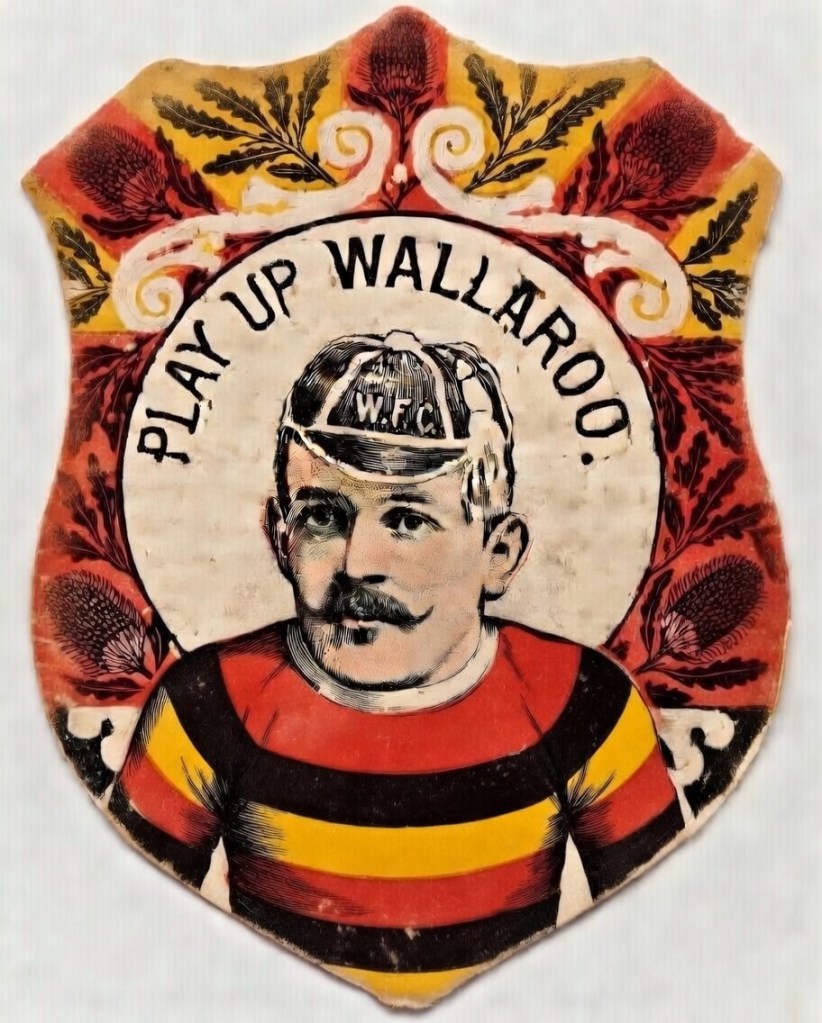
He stood out all the same and impressed the Wallaroos. Still at school in 1879 and 1880, he bypassed the Wallaroo Seconds and was chosen at half-back alongside the club’s legendary co-founder, Richard Arnold, in the First XV.
That schoolboy would later become Sir Charles Gregory Wade — Oxford University XV player, and remarkably for a boy from the NSW colonial towns of Singleton and Muswellbrook, an eight-cap England international (including a sensation-causing debut crossing for the first ever hat-trick of tries in the Home Championship).
“Charles Gregory Wade, the T.K.S. boy, who lived in Elizabeth Farm House, and by his rugged manliness forced his way to the very front in the old school, and battled for Alma Mater against all other schools for supremacy, not only in the football field … ‘Charley,’ as he was familiarly known, was the idol of the old boys.”
— The Cumberland Argus, 30 September 1922
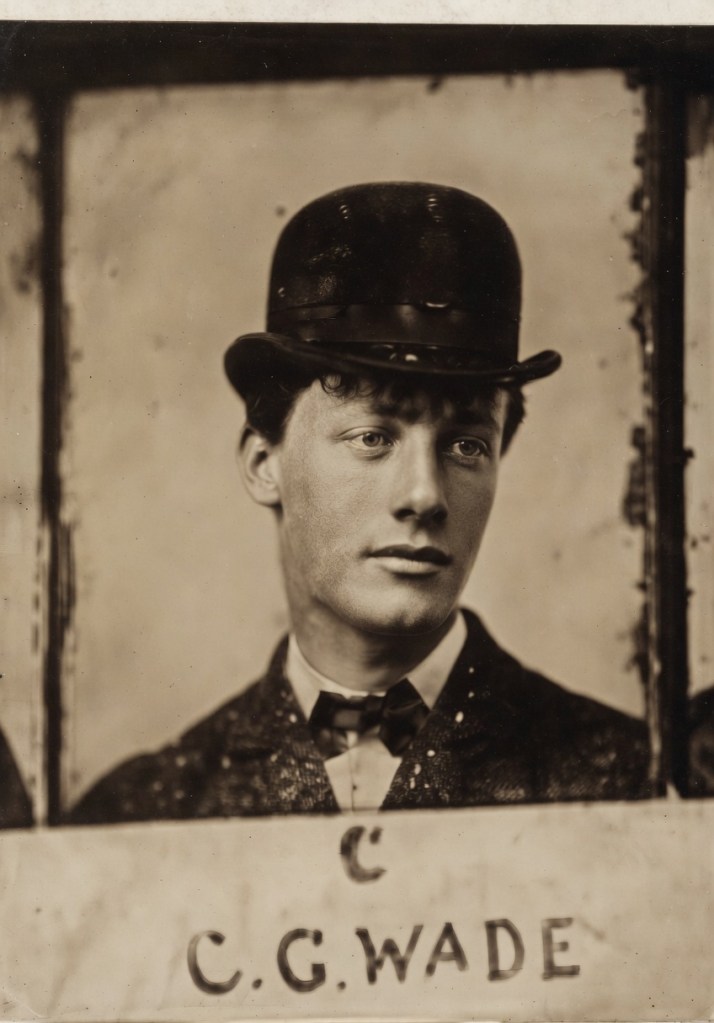
The old hands at Wallaroo too clearly rated the schoolboy, but were careful not to overplay him. During the 1879 and 1880 seasons (both of which saw the Wallaroo crowned Premiers of the Colony), Wade featured against Sydney University, Waratah, and “Old Kings”. His name began appearing regularly in newspaper reports for long runs, tries, and well-judged drop-kicks.
His father took a similar approach — keeping him at TKS for an extra year rather than letting him sail immediately for England to study law, the result of his winning the prestigious Broughton and Forrest Exhibition.
Wade also continued to turn out for TKS, now as captain except where William R. Burkitt (the Senior Master) took the helm. He also played for TKS against the Wallaroos — for both the current boys’ teams and in the legendary hard-fought but always good-spirited “Past & Present” matches. The latter side was often full of Wallaroos, some even from the current year’s team swapping colours and loyalty for the day. Wade too donned the TKS blue-and-white.
“A grand run from Wade placed the Wallaroo goal again in jeopardy till the ball was worked away by Boydell and Arnold. The indomitable Wade was not to be denied, for after a wonderful run he drop-kicked a neat goal amid great applause from the spectators and both teams…The school played up harder than ever, and Wade made another fine run, and gained a try for his side; but Burkitt failed at the place-kick. The Wallaroos were kept very busy defending their goals…where it remained till the close of the game. The Wallaroos were thus victorious, scoring one goal and three tries to one goal and one try.”
— The Sydney Mail, 26 June 1880 (Wade playing for TKS vs Wallaroo)
Sadly for the Wallaroos, but excitingly for the young man, the time finally came to travel to London. The Wallaroo Joey was leaving the troop—about to make his mark on Rugby football in the Old Country.
Perhaps the most prescient view of Wade’s prospects was given in the Australian Town and Country Journal in mid 1880 by “Free Kick,” who had some experience of Rugby in England. Speculating on a colonies-wide Australian team to visit Home, the writer predicted a NSW contingent alone, including Wade, would be “unequalled in the world.”
JUST ANY OTHER OXFORD “FRESHER”
Rumours of the Australian’s football talent had crossed the seas. Like every “fresher” he was bombarded within his first days whether he was for “rugger” or “soccer”. But otherwise, the Rugby crowd at Oxford greeted him with the polite scepticism especially reserved for a colonial.
Wade stayed silent about his Rugby attributes. The captain of his Merton College boat club nabbed him for the rowing team purely on his physique and broad shoulders, and he also impressed at cricket reaching the Oxford XI.
“Wade was a wonderful three-quarter back, and yet when he went to Oxford he was utterly overlooked for a year. As a matter of fact, he never went near the Parks, but contented himself with rowing until Vassall was persuaded to try him.”
— by W.L.S. in the Athletic News, October 1916
At Oxford there was an annual Rugby “freshmen’s match” of invited untried players, which tradition recorded would reveal one great footballer. Belatedly, Wade was invited by “the squash” to take part, with the newly appointed First XV captain Henry (“Harry”) Vassall watching on. Vassall, three years older than Wade, was already making his name; months earlier in 1881 he became the first player in international Rugby history to score a hat-trick of tries, a feat made during England’s inaugural match against Wales.
“…to our shame, be it said, he had been in Oxford a year before we discovered him. From outside sources we heard that there was a great Australian player at Merton College called Wade. At first we were somewhat disinclined to believe the report, as he had not been near the Parks the year before, but when we found that there was such a man rowing in the Merton boat we sent him an invitation to play in ‘picked fifteens.’”
— Harry Vassall in ‘Football: The Rugby Union Game’ by FR Marshall (1894)
Wade’s “costume caused great hilarity,” but his play surprised everyone.
“We are told that one year a sturdy-looking person casually strolled on to the field with flannel trousers tucked into his socks, and, when questioned, said he played three-quarters. His first appearance did not impress spectators with the idea that he was likely to turn out a great player; but he soon opened their eyes, for he got the ball, dashed straight ahead, knocking down everyone in his way, and got a try. This he repeated seven times, making lanes through his opponents on each occasion. Needless to say he got his blue, and his play was always characterised by that go-ahead style which astonished everyone in the freshers’ squash.”
— by C.J.N. Fleming, Badminton Magazine of Sports and Pastimes (1896 edition)
“We shall never forget the curiosity with which we watched his first appearance. He did not seem quite at home with his ball at first, and his kicking was a little faulty, but everybody who tried to tackle him retired from the attempt convinced that the rumour was true — and that we had secured a wonder, who only wanted a little practice to make him into the best three-quarter of the day.”
— Harry Vassall in ‘Football: The Rugby Union Game’ by FR Marshall (1894)
Wade secured his official “Blue” by playing three-quarter in the Varsity Match, a victory against Cambridge on December 13, 1881. He crossed for the game’s only try, validating his inclusion.
THE OXFORD RUGBY SCIENCE DEPT
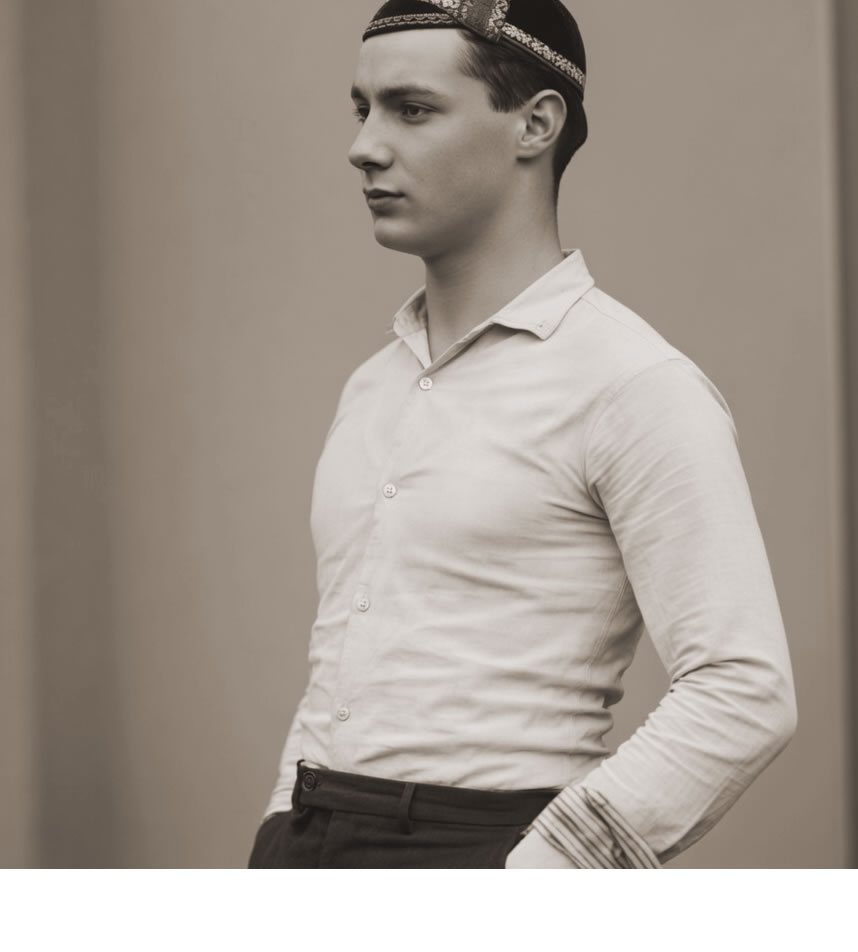
Once released onto English fields, the young Australian turned the old Rugby game on its head — and Oxford’s fortunes with it. Nearing 20 years old, Wade was fast and stalwart, relying on weight (around 80 kg), swerve and raw speed rather than trickiness, and a very solid tackler. Proud of his roots, he even wore a wallaroo silhouette emblazoned on his Oxford dark blue jersey.
Wade did not shine at Oxford because his confreres were weak. It was no coincidence that his debut marked the start of Oxford’s historic 58-match unbeaten streak. Wade never suffered a defeat in his Oxford career.
“Wade, once he got in the fifteen; never looked back, and he was never on a losing side against the Light Blues [of Cambridge].”
— by W.L.S. in the Athletic News, October 1916
“…on going to,Oxford University established a great name…He was a tremendously strong man, his contemporaries finding it almost impossible to bring him down. His body twist or hip shuffle proved too difficult for tacklers, who used to fly off him as he sped goalwards with the ball.”
— The Referee, 27 September 1922
Despite what many English contemporaries and later histories emphasise, Oxford’s success was not solely due to Vassall and half-back Alan Rotherham and their tactical innovations. The story is deeply intertwined with the deeds of Wade.
Starting with his debut game, Oxford introduced the innovation of three three-quarter backs instead of two, along with a system of rapid passing and combination. Backs began passing the ball with intent rather than kicking aimlessly. The modern running and passing game was born here. Did Wade simply thrive in the new system, or was the innovation partly adopted to get more ball to the powerful colonial?
A LEGENDARY STORY RE-TOLD
Wade continued to impress selection committees. He was chosen for the combined Universities against a combined London team, then for South of England v. North. His place for the South came about because Vassall wanted the Oxford passing game tested at a higher level.
“In 1882 a curious incident brought about the addition of a third three-quarter. P. Newton, the late Oxford forward, was to have played for the South but got injured and could not take his place. On hearing of this Harry Vassall at once wired to the committee, strongly urging the inclusion of C. G. Wade as a third three-quarter. The experiment was given a trial, though not without considerable misgiving, and proved so brilliantly successful that henceforth it was adopted.”
— by Harry Vassall in ‘Rugby Football’ published 1889
It was a rapid rise to fame, and there was more to come.
AN ENGLISH MAN OF THE DAY
Though the issue didn’t appear to bother anyone, Wade was eligible to play for England by custom: he was playing for an RFU member club, and his father was born in Shropshire. (Scotland in this era regularly fielded English-born players studying at Edinburgh University.)
In December 1882, Wade learned he had been selected for his debut cap against Wales. Chosen as one of three three-quarters, England adopted the Oxford system, dropping a forward.
It was a landmark game: Wade “ran in” three tries in England’s victory — the first hat-trick of tries in what is now the Six Nations Championship. He also featured in subsequent wins over Ireland and Scotland as England claimed the inaugural Home Nations Championship and Rugby’s first Triple Crown.
This great and exciting news reached all the way back to Aaron’s Exchange Hotel in Sydney, where the Wallaroos were holding their annual meeting.
“The chairman, in the course of his remarks,stated that C. Wade, an old Wallaroo man, had played with England in the great matches all through the season, and had always been mentioned with distinction, and on several occasions as the man of the day.”
— Wallaroo FC meeting, The Sydney Mail, 21 April 1883
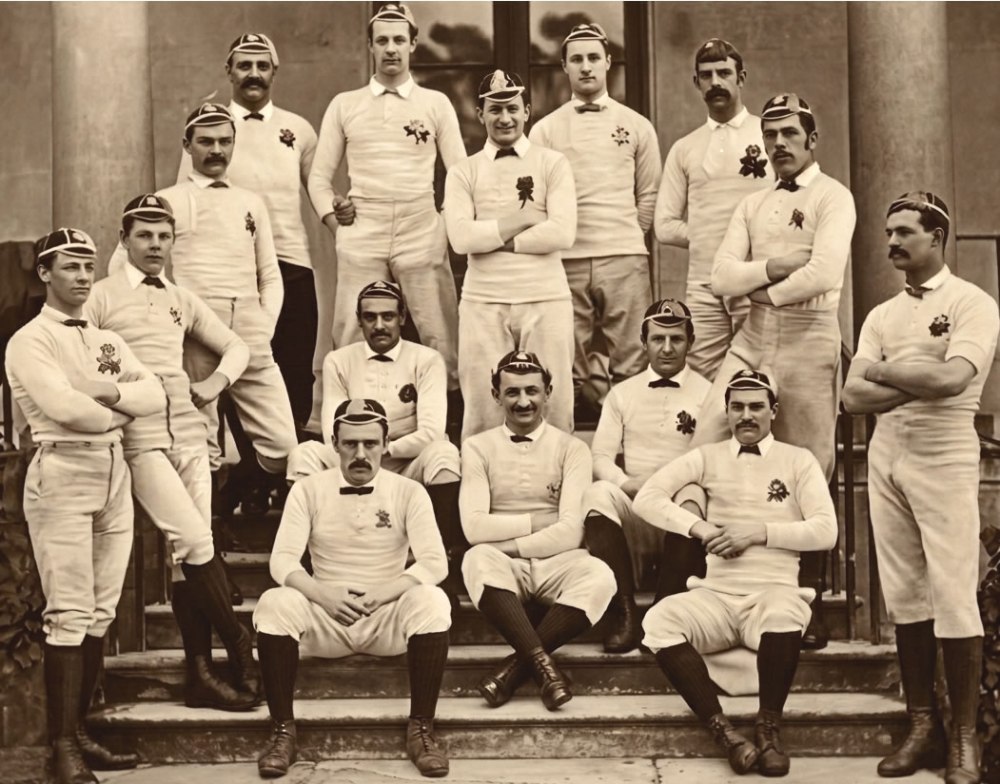
Wade was ever-present in the undefeated England team from 1882 to 1886, gaining eight caps in total.
“Moreover, the Australian was eight times in an English International team, and never once on a losing side. He was a powerful man who needed a lot of tackling, and he had not only pace, but an effective swerve. None who saw them at their best will ever forget.”
— by W.L.S. in the Athletic News, October 1916
“He [Wade] made his name at the time when H. Vassall, Alan Rotherham, A. G. G. Grant-Asher, H. B. Tristram, and Temple Gurdon were among the greatest players of the day, and he held his own among them all.”
— The Field (London), 6 January 1917
In early 1886 against Wales at Blackheath FC’s Rectory Field, he crossed for his seventh and final international try, becoming the sole holder of the record for most tries for England. That record stood into the twentieth century.
WALLAROO FOUND IN LONDON WEARING FAMILIAR COLOURS
On his journey to becoming a barrister, Wade completed his Oxford days in mid-1884 and moved to London to study at the Inner Temple. He joined Richmond FC, linking up again with his old Oxford half-back partner Rotherham.
They brought the revolutionary Oxford passing game directly to London club Rugby, keeping Richmond at the forefront. The Richmond colours and kit were also a happy coincidence — the same as those of the Wallaroos back home.
The only real criticism of Wade in his later English years would become typical for outside backs as they aged and bulked up. He sometimes relied more on his great strength, direct running and pure bluster, than the swerve and sidestep that had defined his earlier play.
“The only way to elude such a tackier is by passing just as you come to him, unless you have the power of turning when going at fall speed, such as was possessed by Don Wauchope of Cambridge, C. G. Wade of Oxford, or Stoddart of Blackheath, and by very few others….. But Wade was, in our opinion, the best of the lot until he took to trusting too much to his great strength. He ran very fast and straight, and had a wonderful swerve when going at full pace, by which he foiled the tackler, who only received a nasty one from his iron thigh. It is this power of turning at full speed which, in our opinion, makes players a class above their compeers.”
— by Harry Vassall in ‘Rugby Football’ published 1889
Wade officially wrapped up his Rugby time in England in early 1886. He was called to the London Bar in May 1886 and sailed back to Australia.
“We are rather inclined to think, however, that Wade, the Oxonian, was the best three-quarter we have seen.
— by Montague Shearman in ‘Athletics and Football’ published 1887
“THE MIGHTY WADE” ON HOME FIELD
Back on Australian soil in late August 1886, Wade was straight onto the Rugby field, turning out for TKS against a Wallaroo Seconds team in the final game of the season. In his first touch of the ball, he sent the kick-off flying over the cross-bar. So much for sea legs, huh?
“Mr. Charles Wade, one of the most famous footballers England has had this last six years, returned to his native land last week by the Iberia. He quite upheld his football reputation, playing with his old club, the King’s School, against the Wallaroos, as, on Saturday last, he scored 3 touch downs and kicked 4 place goals, which, considering he only landed the day before, is a very creditable performance. Mr. Wade will be a great acquisition to the Rugby game in Sydney, and a player we may well be proud of.”
— The Daily Telegraph, 1 September 1886
The next week he was admitted to the NSW Bar to practise as a barrister. His playing days were not quite over. He joined the Wallaroo end-of-season harbour cruise, and for the 1887 and 1888 seasons the club was “led on by the mighty Wade” as captain.
Wade’s final season held special interest with the visit of the first British Lions tourists (travelling as the “English Football Team”). There were hopes (especially from the promoters!) he might join them alongside former England three-quarter partners Andrew Stoddart and Charles Chapman (the latter was now residing in Melbourne).
“Stoddart and Wade will be towers of strength to the team and are decidedly higher class players than the majority of the team.”
— The Brisbane Courier, 17 April 1888
Wade remained patriotic to his birth-place though no doubt he looked forward immensely to meeting on and off the field many of his former foes. Other than Stoddart, as well as Willie Thomas, the remainder of the tourists were from outside of the London, Oxford and Cambridge triangle.
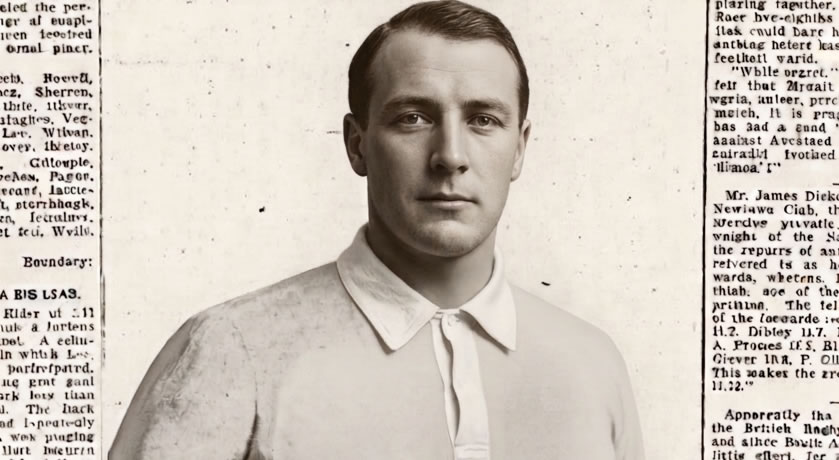
“Wade was very good and would be infinitely better if he would get under way at top sooner, instead of trotting till he comes to his man and then charging him instead of fending or dodging.”
— The Referee, 31 May 1888 – NSW trial game 26 May before NSW v England 2 June
On the field, Wade faced the British tourists in two games for NSW as captain at the SCG, and once for the TKS “Past & Present” team in front of a thousand spectators at the Parramatta Cricket Ground.* The tourists went undefeated in Australia under Rugby rules, but for a while, TKS appeared poised to finally force them to lower their colours.
In a legendary game for the ages, Wade led TKS as they raced out to a 10–0 advantage via two converted tries, until a late-game rally orchestrated by Stoddart saw the British score five unconverted tries to force a 10–10 draw.** Ironically, had the match been played in England under RFU laws, TKS would have been victors by two goals to nil. A moral win for Wade and TKS, eh?
Wade signed off from representative football with one last hurrah in July 1888 as captain of a maroon-clad NSW side in two wins over Queensland (in navy blue) at the SCG.
“Returning to Sydney, he played for N.S. Wales and for the Wallaroos with distinction.”
— The Referee, 27 September 1922
“C.Wade fairly came out of his shell last Saturday in the intercolonial match with Queensland, and those who had the good fortune to witness his play can quite understand how it was that he earned his English reputation. His play against the Britishers was nothing extraordinary, and, indeed, during the season his work was not such as to attract attention. Against Queensland, however, he was in magnificent form, and he practically earned the three tries for New South Wales, as it was he who carried the ball up to the line when Tange got over.”
— The Sydney Mail, 21 July 1888
“Wade, on Saturday, was head and shoulders over all his compeers; not one on his side approaching him.”
— The Australian Town and Country Journal, 21 July 1888
For Wade, the second match ended not long after half-time, when he was lamed by a serious leg injury and unable to carry on. As he hesitantly limped towards the gate of the Members’ Stand under the respectful applause of the teams and crowd, he and they knew his Rugby days were done.
THE FIRST WALLAROO KNIGHT & WADE’S FAT FIFTY
Wade remained involved with the Wallaroo club as vice-president and NSWRU delegate until 1899, when he became NSW’s acting solicitor-general. He forged a distinguished career as barrister, crown prosecutor, and politician, rising to become NSW State Premier from 1907 to 1910.
During this politically turbulent term as Premier, “old Charley” seems to have had his late-1870s Wallaroo forward pack colleagues in mind when he sent a legion of the state’s burliest police officers to keep Broken Hill mining strikers and their supporters in check. The “Blue Jackets,” though, were decried as more likely “good old fat bobbies” taken off foot-patrol duties in metropolitan Sydney, with each arriving deployment facetiously described as another “Wade’s Fat Fifty” and “Premier Wade’s Fatties.”
In the midst of the Great War, Wade was appointed Agent-General for NSW in London. For his vital wartime diplomatic and public service, he was twice bestowed a knighthood: first as a Knight Bachelor in the 1918 New Year Honours, and later elevated to a Knight Commander of the Order of St Michael and St George (KCMG) in 1920 to mark the successful conclusion of his term.
Sir Charles Gregory Wade returned home to Sydney, taking up a seat as a judge on the Supreme Court of NSW.
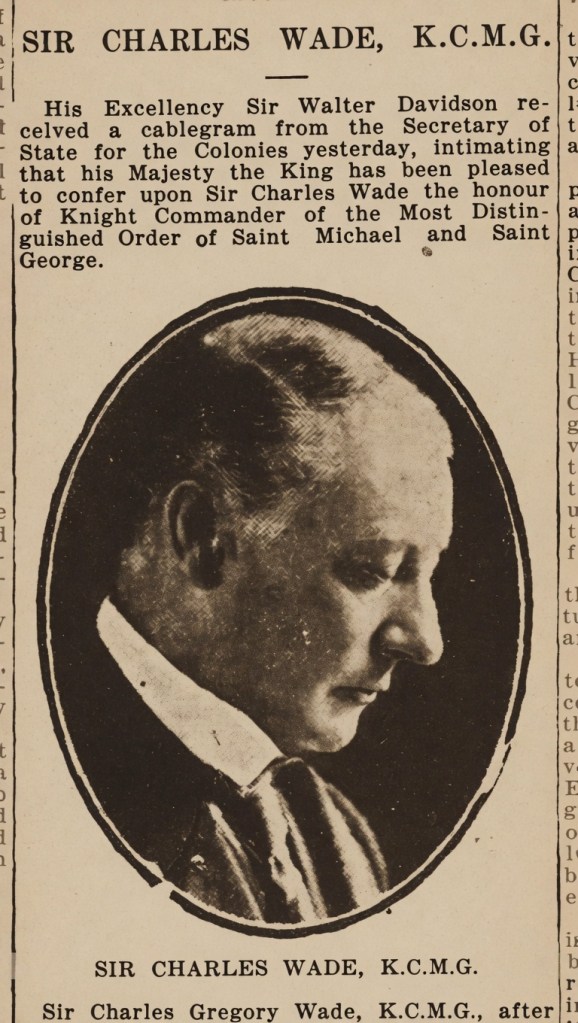
In September 1922, Wade suffered a sudden seizure in his judicial chambers, passing away at his Potts Point home a few days later. His unexpected death at just 59 years of age left the entire state in deep shock. A massive state funeral was held at St Andrew’s Cathedral to honour his enduring legacy as a premier, diplomat, and judge.
Even though three decades of players had come and gone since Wade’s final match, The Land was emphatic about Wade.
“Perhaps he should be classed with the greatest three Rugbyians Australia has produced.”
— The Land, 29 September 1922***
A year later The Referee looked back at Wade and hailed him as one of the greatest Rugby footballers the world had seen.
“Wade’s day in Rugger was marked more by striking individualism in the great footballers than it is today. Wade was the most robust runner of his time, and perhaps of any time. He simply ploughed through his foes, throwing them off his hips by a sort of twist or shuffle. He developed at The King’s School, and played for New South Wales as well as the Wallaroos. At Oxford they were slow to find him, but when at last they discovered he could play Rugger, they soon learnt that he was an extraordinary man. At times it was practically impossible to stop him.”
— The Referee, 19 September 1923
From the rough fields of Wallaroo and Sydney club Rugby, to the great grounds of Oxford and England, Charles Gregory Wade walked into the stiff old Rugby world and kicked it over.
The Wallaroo Knight proved that a raw-boned Australian boy, armed with strength, speed, and vision, could reshape an Empire’s favourite football game.
His legacy lives on in every fluent backline movement on Rugby fields today — a gift from the TKS, the Wallaroos and Oxford that changed the sport forever.
“At a recent ‘smoker’ Mr Wade said he played all three games of football — Rugby, Australian, and British Association — and there was no doubt whatever in his mind that Rugby was the greatest game, more especially in its educational influence as a builder-up of physique, manliness, and character in young men.”
— NZ Truth, 17 November 1906
[ADB bio – C.G. Wade]
Note 1 : Wade Park in Orange (NSW) is named in honour of C.G. Wade
Note 2 : Wade attended All Saints’ College, Bathurst (1874–76). He may have been present at the Wallaroo FC vs. Bathurst FC rugby match played on Wednesday 26 May 1876, a public holiday week fixture celebrating the birthday of Queen Victoria (‘Queen’s Birthday’). The visiting Wallaroos stayed at the Royal Hotel on William Street and assembled outside the building on the morning of the match. The game was played nearby at the Bathurst Cricket Ground (now the Bathurst Sportsground) on Howick Street, resulting in a memorable victory for the local team. While a modern myth claims the Wallaroos unexpectedly faced grown men instead of All Saints’ schoolboys, contemporary reports disprove this. The match was played three weeks before the Sydney season opened. As detailed in The Sydney Mail (3 June 1876), the Bathurst men triumphed because they had trained every evening for a fortnight, whereas persistent rain in Sydney had entirely prevented the Wallaroos from practicing. The dominant Bathurst line-up included adult town figures such as the captain, D. D. Middleton, and the future international Test cricketer George Bonnor (Bonner), famously known as the ‘Bathurst Giant’ or ‘Australian Hercules’.
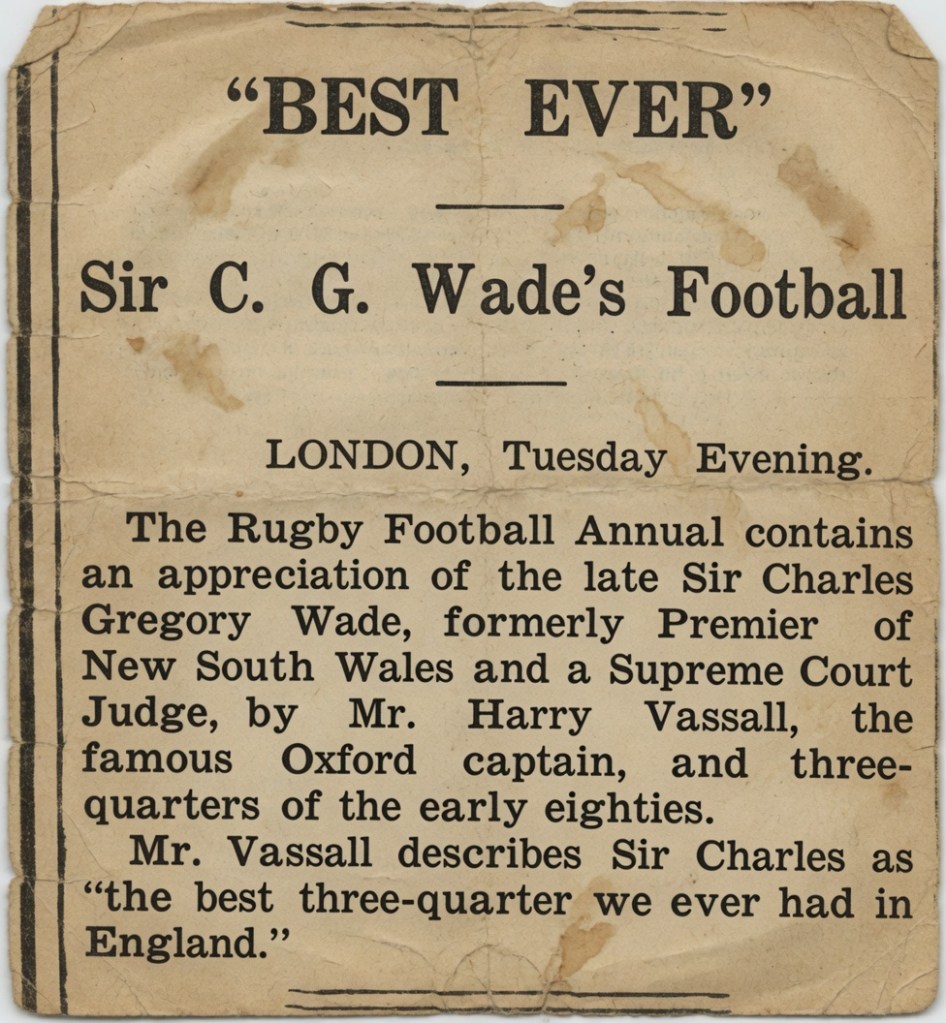
Note 3 : The 1923 newspaper cutting “Best Ever” with tribute from Vassall is from Evening News (Sydney) 12 September 1923. See another of same date in The Telegraph (Brisbane) under “Best We Ever Had” Sir Charles Wade, Footballer English Player’s Tribute.
Note 4: For further on Wade and The King’s School including nickname of ‘Charley’ and living at Elizabeth Farm House see The Cumberland Argus and Fruitgrowers Advocate of 30 September 1922
* The former Parramatta Cricket Ground was a short walk to the west of where The King’s School was at that time located. The field is now known as the “Old King’s Oval” and TKS is in North Parramatta towards Oatlands. TKS continues to play Rugby today in the “GPS” competition under the Athletic Association of the Great Public Schools of NSW (AAGPS).
** By 1888, the Southern Rugby Football Union (later the NSWRU) in Sydney had already adopted a numerical points system, assigning 2 points for a try and an additional 3 points for a successful conversion goal. At half-time, TKS led 10–0 via two converted tries. See “The English Footballers at Parramatta” in The Referee , 14 June 1888
*** The Land, 29 September 1922. The article doesn’t name who they believed were other two greatest Rugby players Australia has produced.
WallarooFC1870.com – All website text & content © Sean Fagan
[ site homepage ]

2 Comments
Comments are closed.