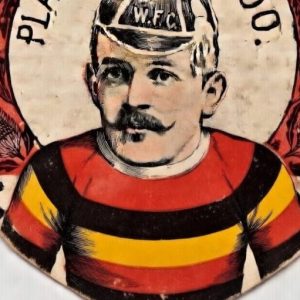
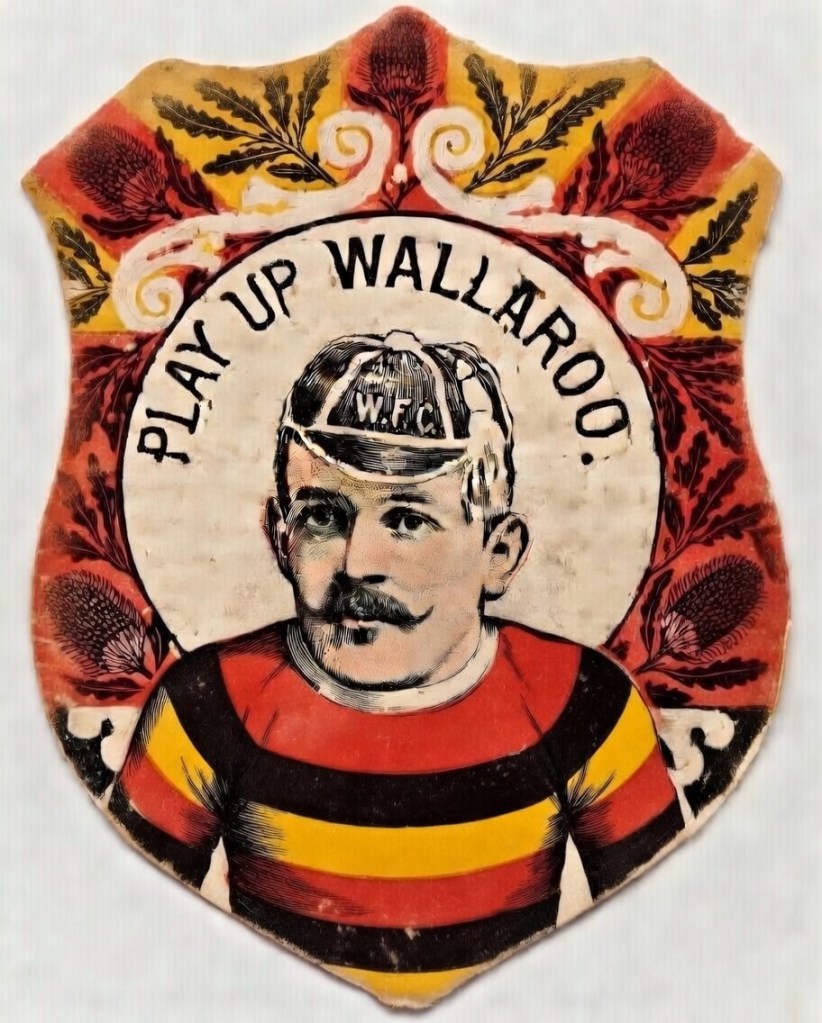
This is the story of the “monstrous injustice” that wiped out Wallaroo FC. The long campaign for “electorate football”—a system of strict residential rules driven by a mantra demanding that all the traditional clubs, drawing players from hither and thither, must be destroyed.
The fact that the Wallaroos had founded Rugby in Sydney in 1870, and then established the NSWRU itself in 1874, meant absolutely nothing to the reformers.
But oh, the irony: an excuse was found to keep the University club, and a century on, they and today’s other Shute Shield clubs (clinging to their suburban ghost names) recruit footballers from all points of the compass—the very practice Wallaroo was destroyed for.
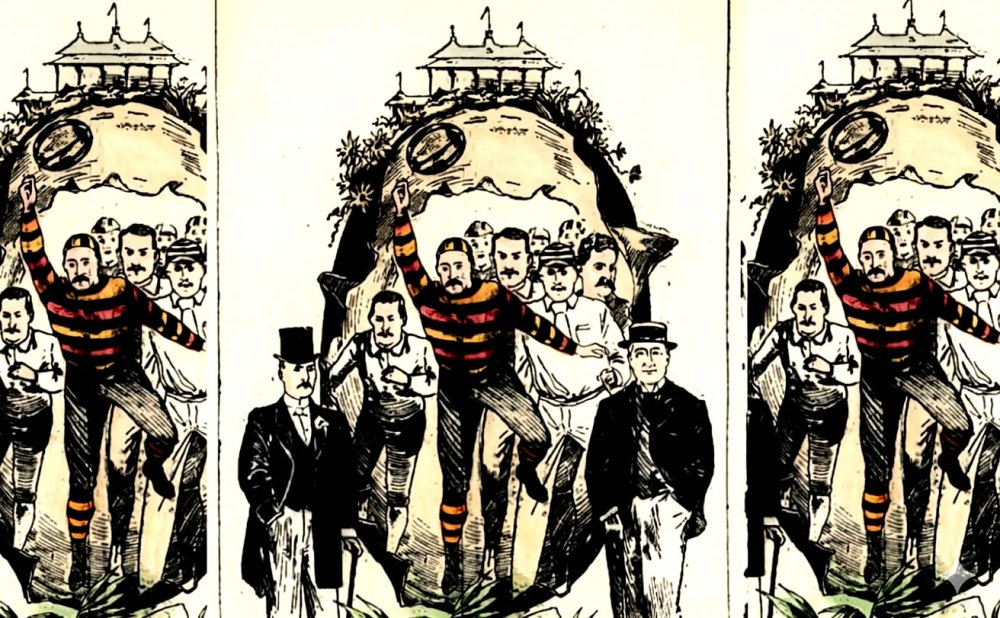
On the top of the mountain is the favourite haunt of the wallaroo. Unlike the kangaroo and wallaby — when hunted, instead of making for the scrub — the wallaroos invariably make for the extreme edge of a precipice, where they use their strong tail as a prop, and sit bolt upright; and when once they place themselves in that position, it is very hard to dislodge them, unless they are shot.
VOX POPULI WALLAROO
“It would be a sin to wipe out existing clubs. It would be a monstrous injustice.”
— W.M. ‘Monty’ Arnold, Vice-President, Wallaroo FC, 26 September 1898
“…the argument of electorate football agitators being that each club, by its very character, would have a strong local following, which would follow the 15 good men and true round wherever they played.”
— The Australian Star, 8 June 1897
“The district matches will be popular with the people from the simple fact that the localisation of the clubs must necessarily create a local interest. We have numbers of local grounds upon which the matches could be played, and these grounds will, I have not the slightest doubt, be filled with the partisans of both competing teams.”
—The Australian Star, 28 September 1898
“To clubs there is only attaching a purely club interest, as in cricket, but with a defined area from which to select players there is added a territorial interest. The average man does not care a dump whether the Warrigals or Wallaroos win, but he would have some little interest in a contest between his ward and another, just as he would in a struggle between his town and another.”
— Goulburn Evening Penny Post, 27 January 1900
“The old clubs, Randwick, Wallaroo, Pirates, etc., were quite content to pursue the even tenor of their way. They, along with University, were undoubtedly providing good football, and they asked why should not the controlling body leave well alone.”
— Saturday Referee and the Arrow, 28 June 1913
“…clubs which had been asked to allow themselves to be slaughtered…it was wrong to say that the clubs which had made the game, and which had behind them over twenty years’ experience, should die at once. They were calmly told that electorate football could not be instituted without the destruction of existing clubs. This was a mistake…”
— The Australian Town and Country Journal, 24 December 1898
“Had the larger and more influential clubs been more willing to disband we should have seen the new system in vogue years ago. There can be no question that the new system will be popular.“
—The Australian Star, 28 September 1898
“The old clubs have been broken up. and the players shuffled like a pack of cards.”
— The Sydney Morning Herald, 19 May 1900
THE STORIES & TALES OF ANCIENT WALLAROOS
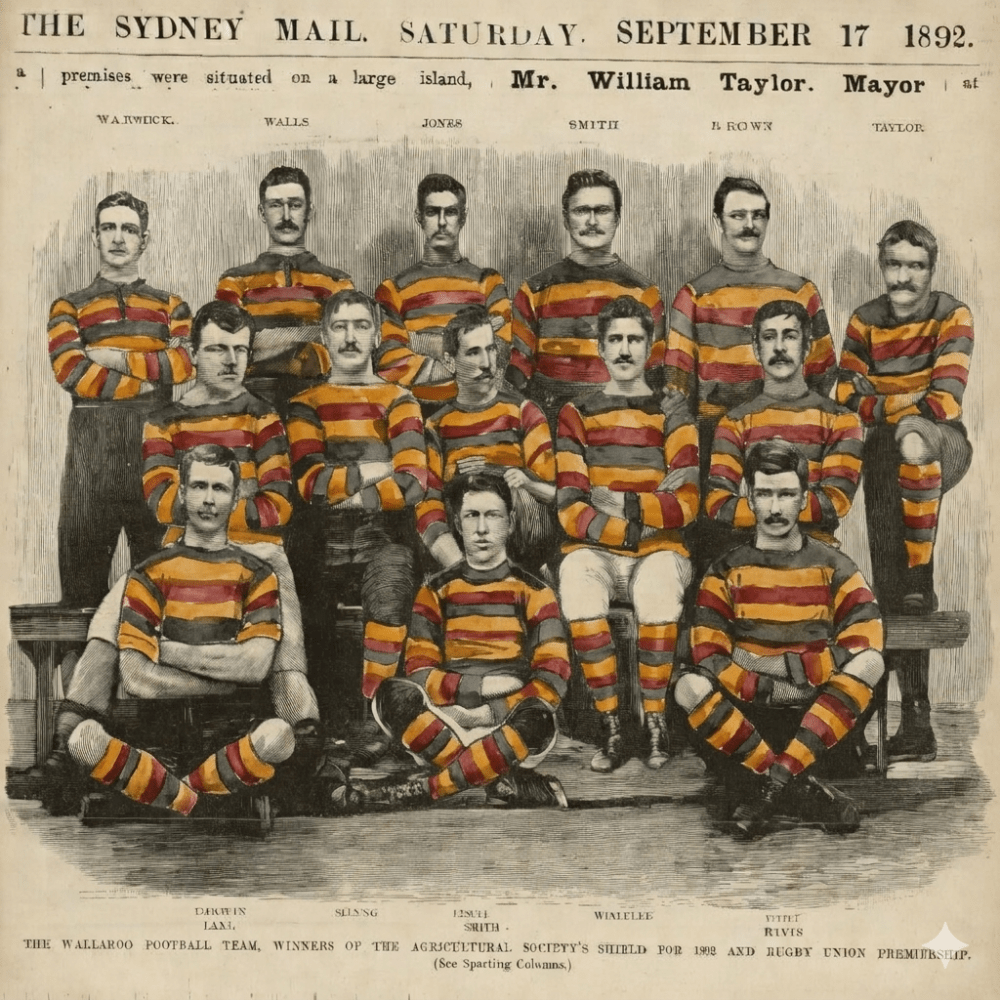
In October 1892, members of the Wallaroo Football Club gathered at Aaron’s Exchange Hotel in Sydney. Convening under the banner of the “Ancient Wallaroos,” club co-founder and president Richard Arnold hosted an evening of entertainment steeped in nostalgia.
These grey-bearded pioneers threw a dinner to honour the modern-day side, who had just secured the 1892 premiership—the club’s first since their legendary run from 1872 to 1880. After a weary decade of waiting for success to return, the room was buoyant and celebratory. There appeared to be nothing but clear horizons ahead.
TALISMANIC ATTRACTIONS & FREE TRADERS
In the 1893 football season in Sydney, the “Seniors” (first grade) competition clubs were Wallaroo, University, Pirates, Wentworth, Parramatta and Randwick. All of the clubs—even the University and the ones with suburban names—obtained players and members from wherever they liked. They were known as social or “cosmopolitan” clubs.
Provided you met a particular club’s membership rules and were duly selected, you could turn out for whichever First XV you pleased. It was Rugby on what Monty Arnold—the venerable patriarch of the Wallaroos and the tallest man to ever play the game—affectionately called a “free trade basis.”
The Wallaroos believed that a man’s sporting affiliation was an exercise in personal liberty. As a founding father of the NSWRU, Arnold spoke with absolute authority when he argued as far back as 1878 that the administration had no business dealing “in any way with matters that affected the internal management of clubs” or “interfering with men joining whatever club they might choose.”
In this respect, Sydney was organised no differently from London and the south of England, with its member-based Rugby clubs like Richmond, Blackheath, Harlequins, Wasps, and Bath. Similarly, mirroring English ‘Old Boys’ teams like the Marlborough Nomads or Old Merchant Taylors, certain Sydney clubs enjoyed a continuous pipeline of players from one specific school.
This was famously the case with The King’s School and Wallaroo FC, allowing schoolboys to transition into adulthood while continuing to play Rugby and socialise with peers of the same social standing and lifelong friends.
THE HOOLIGANS’ GAME PLAYED BY GENTLEMEN
As far as Wallaroo was concerned, the 1890s remained an era of chivalry that seems almost comedic to the modern, hyper-professional mind. When the Wentworth club found themselves missing two key players away on NSW team duty just before a crucial trophy final, Wallaroo captain ‘Paddy’ Lane did not celebrate his luck. Instead, he telegraphed the Wentworth captain—the legendary Māori footballer ‘Billy’ Warbrick—generously offering him “the choice of any two forwards in Sydney” to take their place.
Come match day at the SCG, when a Wallaroo forward pulled out on a doctor’s advice minutes before kick-off, Warbrick returned the favour, allowing a Pirates clubman out of the crowd to step into the Wallaroo ranks. Wallaroo lost the match 9–0, but they all shared drinks afterwards, secure in the knowledge that they were gentlemen. Yet the world was changing, and gentlemen with pliable rules were fast falling out of fashion.
TO MAKE A LITTLE SACRIFICE
The serpent in this free-trade Eden of Rugby was a gentleman named Louis G. Abrams, hailing from the bursting inner-city tenement suburb of Glebe. Abrams was the champion of “electorate football”—a so-called democratic system that shared the players around by demanding they only represent the club in whose electoral district they resided.
Abrams was a man of small physical stature but possessed the vocal stamina and sharp abruptness of an end-of-shift steam whistle. As The Sydney Mail put it, “Abrams is the pioneer and prophet of the new evangel of district football.” Reflecting on the era, The Saturday Referee later remembered him as “one of the most ardent—certainly the most vociferous—of these… the persistent Glebeite.”
Abrams was not a footballer and did not represent a club. While the NSWRU did not generally lock the public out of its meetings, it still felt like a piece of supreme presumption on Abrams’ part to dictate to a gathering of actual footballers what they must do.
The reformers’ argument was simple and seductive: humans are tribal. While the average citizen “does not care a dump whether the Warrigals or Wallaroos win,” he would scream himself hoarse for a contest “between his ward and another, just as he would in a struggle between his town and another.” Abrams was a walking illustration of this, desperate to see a successful “Glebe Electorate” club reign over the Seniors competition.
Determined to partition the city into strict football fiefdoms with residential qualifications, the reformers pushed a mantra to ensure their success: that the current occupants of the Seniors—the existing social clubs—needed to be permanently and irrevocably culled from the paddock. Well, all but the University, but we’ll get to that later!
Speaking to this thought, The Daily Telegraph in October 1893 lamented that despite dozens of clubs being affiliated with the NSWRU, only a “select few clubs” monopolised the Seniors competition, surviving on “a few supporters from anywhere and everywhere.” It added:
“If prominent players and supporters of cosmopolitan clubs will only make a little sacrifice and allow the movement to be initiated and have a fair trial, they need not fear for the future success of Rugby football. Competitions on a local basis would be the means of bringing a more satisfactory representation in intercolonial matches, doing away with all club party feeling, and in a short space of time New South Wales would be able to more than hold her own with any Rugby football combination in the world.”
To the Arnold brothers and the Wallaroos—both ancient and current—the whole scheme was “all bunkum” and “To force players to play for a certain club would do away with esprit de corps.”
Being asked to allow their two-decade-old club to be destroyed, to simply walk away from the very game they had nurtured, led, and built in NSW, did not feel like a “a little sacrifice.” Nor was it. It felt like an execution. No, they would fight. If club members accepted such a scheme, Monty Arnold declared, “I say we are not men.”
THE LURKING DEMOCRATIC SPIRIT
On the heels of the great shearers’ and maritime strikes, and with both Federation and the dawn of a new century fast approaching, the appetite for challenging the old order was high—especially in the working-class suburbs and among their football players and supporters.
If you truly wanted to see the democratic spirit of the age stripped of its Sunday manners and laid bare in all its raw enthusiasm, you did not look to parliament. You went straight to the evening meetings of the NSWRU management committee when the electorate football question was in session.
There, the grand old Empire game of Rugby was undergoing a revolution of its own. It pitted the old-world gentlemen of Wallaroo and the other metropolitan clubs against Abrams and a new breed of suburban football reformers.
The battle lines were drawn, and they would endure for six long seasons—the NSWRU meetings becoming less like administrative conferences and more like recurring riots.
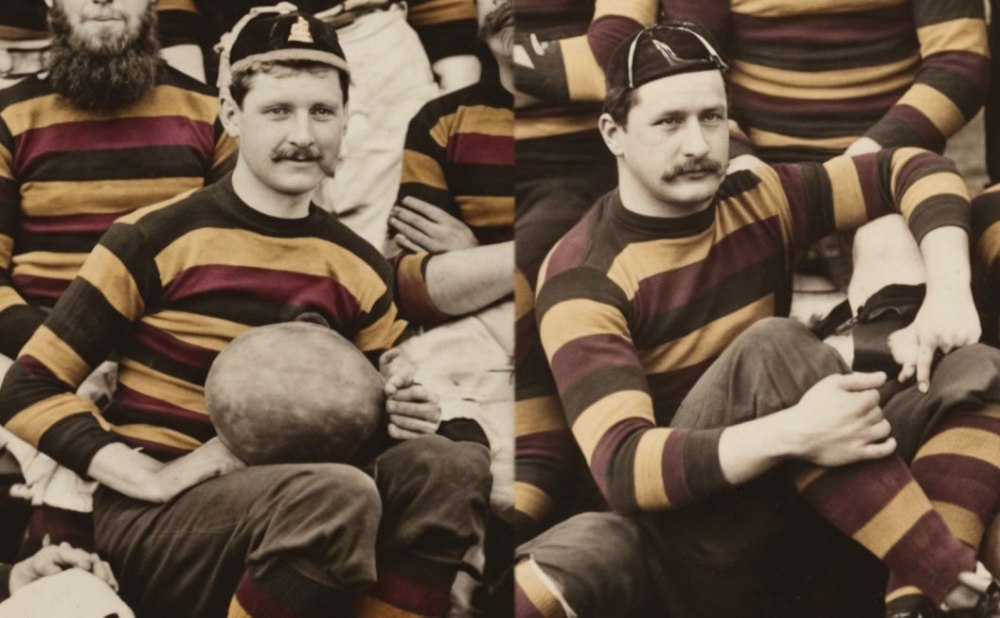
THE NEWFOUNDLAND FACED THE POODLE
The great showdown of April 1894 was so monumental it spanned two nights and went straight down into the city’s Rugby folklore.
The Referee described the NSWRU meeting venue as “a perfect pandemonium.” When Henry Stockham of Double Bay FC stood to propose the introduction of the electorate system, “interjections were hurled from all quarters, and at times the noise was deafening.”
Midway through the madness, the original chairman fled. As NSWRU vice-president, Monty Arnold was called upon to take the chair. When a show of hands was called, the reformers seemingly carried the day with sixty-odd votes to forty. But the old guard demanded a secret ballot. Mysteriously, when the slips of paper were counted, several men had swapped allegiance or vanished into thin air; the reform motion was announced by Arnold as defeated 47–46.
The room exploded into absolute disorder. Men shouted, waved fists, and demanded further votes.
Arnold, echoing Governor Bligh handling Sydney’s most boisterous Rum Corps soldiers, simply refused to put any more motions, stood up, and walked out of the building with the ballot papers re
marking, “The votes will be counted tomorrow and the result made known through the Press.” He later dryly claimed that he had no choice: the hotel landlord had informed him it was closing time, and a good sportsman always respects the licensing hours.
Two weeks later, the reformers hauled Arnold back into the room for the continuation of the meeting. They aimed not only to secure their electorate football, but to pass a motion of no-confidence in his chairing. The Referee’s scribe attended the night, noting he went down “anticipating some fun—to hear some wordy, bloodless tilts between the Radicals and the Conservatives.” He was not disappointed.
When Abrams rose to speak in favour of censuring the Wallaroo veteran, the gloves well and truly came off. As the debate then grew heated, Arnold’s calm deserted him. The Referee reported:
“The tall figure reared itself up to its tallest height, and he pointed with withering scorn at the object of his displeasure. The words he used were drowned in the tremendous uproar… The Wallaroo veteran poured out his inmost wrath and gesticulated with great vehemence.”
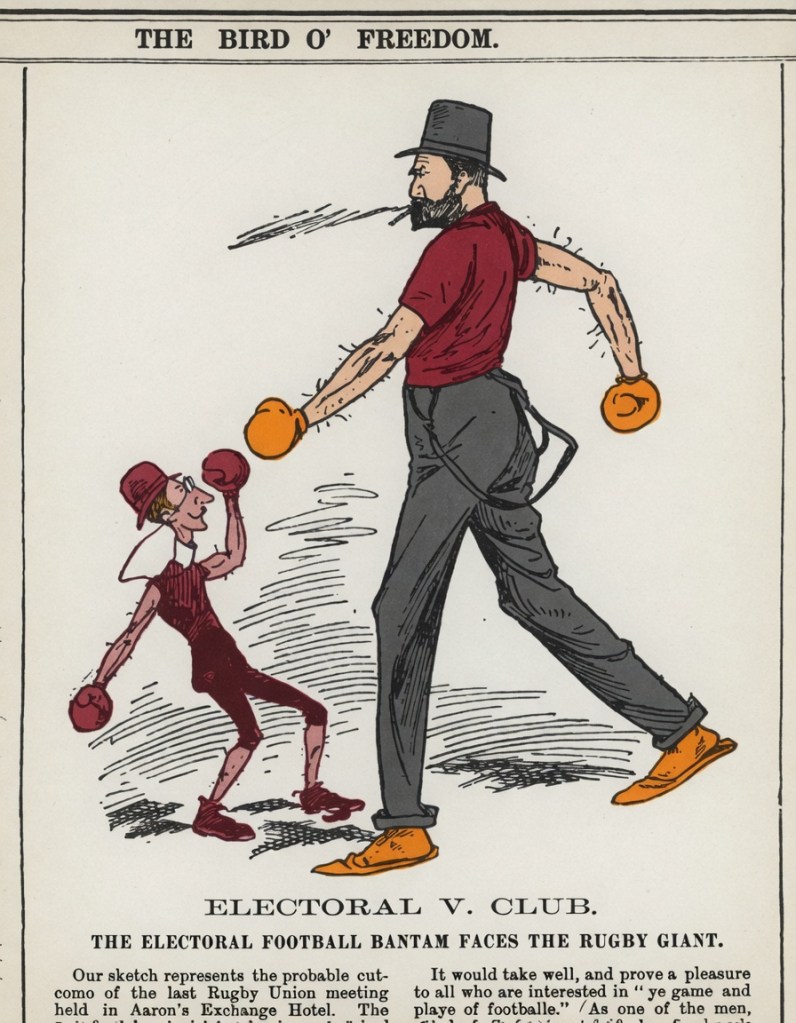
The Illawarra Mercury noted that Monty treated the small Abrams “as a Newfoundland [dog] would a poodle,” hinting that only Abrams’ diminutive size protected him from a physical thrashing. Yet Abrams stood his ground. The Bird O’ Freedom marvelled at the dramatic scene:
“…the breaking of a lance between the giant and the Lilliputian was quite dramatic in effect. Mr. Monty Arnold spoke so strongly and with such vehement dramatic action that one momentarily expected L. G. Abrams to sink through the floor.
“But the small advocate of Electoral football stood up against the onslaught with the chest of a Hercules. And after the big man’s onslaught, he quietly said he was not afraid to speak as he felt about the biggest man that ever breathed.
“‘Why, you can’t knock him out with a sledge-hammer,’ quoth one of the Wallaroo forwards, ‘even Monty can’t snuff him out.’”
When the smoke cleared, Arnold delivered an autobiographical defence of his twenty-five years of service, touching the hearts of the delegates. The no-confidence motion was soundly defeated four to one “amidst great cheering and much laughter.” The electorate football proposal was adopted, but its implementation was deferred until 1895 while a committee was formed to look at the rules.
MUD-SLINGING & PROFESSIONALISM
The forces favouring retention of the current system mustered enough numbers at the start of 1895 to overturn the planned start of electorate football. For a short while, it was a dead pigeon.
Well, it was for everyone but Abrams, who took to delivering city street corner speeches at lunchtime. The Arrow, 18 July 1896:
“Loo Abrams is working up a scheme for local football. He has all the teams already picked; the Glebe are to be champions. Loo holds an open-air meeting daily in King Street.“
The newspapers cautioned the old clubs to stay alert. The Daily Telegraph, 28 August 1896:
“The reformers possess another advantage, inasmuch as they have been carrying on a vigorous campaign, while, on the other hand, the advocates of the retention of the existing system of club football have exhibited a peculiar apathy. They seem to be making the mistake of underrating their opponents. It does not follow that, because Mr. Abrams has been twice defeated previously on this question, he will not secure a majority on the third time of asking. There is supposed to be luck in odd numbers.”
Soon enough, the reformers were back. This time they were on a Wallaroo hunt. The cry of the hunters and the yelping of their dogs were accusations of professionalism levelled against the Wallaroo club and its members. They whispered loudly that Wallaroo was improperly securing the best players by paying them monetary considerations—a scandalous charge in a game that prided itself on pure amateurism.
As the saying went at the time, there was a wide field between offering pounds and pennies and a footballer preferring the club that simply piled on the most “marmalade.”
The Australian Star, 8 June 1897:
“The advocates for electorate football have their argumentative gunpowder and shot ready, and the attack that they will be emboldened to make very soon on what they deem an effete and unsound institution should be a pretty warm one… There is another point about the existing state of affairs that will be emphasised to the detriment of the plea that things should be allowed to remain as they are. It is that professionalism is spreading its malign ramifications here, there, and everywhere. Some may try to blink the fact, but it is an open secret that some footballers receive monetary consideration for their services. Good men at the commencement of the season were sought after, and in many cases their services were lost to the districts for which they should legitimately have played.”
The Catholic Press, 14 May 1898:
“The best players in the Randwick Club are non-residents of the district. The same thing exists in all the clubs, and the sooner electorate or borough football is brought into practice, so soon will the game increase in popularity. It is no new subject, but the promoters should not let it slip. They should keep at it, and it is bound to come sooner or later. There are too many sentimental prejudices in the way. For instance, there are the old Wallaroos. What would football be without a Wallaroo club is argued by the sentimentalists. But the game suffers meantime.”
Meanwhile, Paddington FC, which strictly confined itself to a team of local men, collapsed entirely and failed to complete the 1897 and 1898 seasons. The hint was immediately thrown out by the reformers that this failure was a direct consequence of Wallaroo’s predatory recruitment practices.
The Australian Star, 11 June 1898:
“The failure of the Paddington Club to keep the remainder of its engagements for the season is owing to the number of men disabled and the inability to get first-class players to take their place. It is becoming more and more apparent that the introduction of electorate football is not far off. The crowding into the few big clubs of all the first-class players will have its effect sooner or later. The Paddington Club found that the mere offering of a place in their team was not a sufficient inducement for a good player to join them.”
At a special NSWRU meeting held in August 1896, Abrams and his allies arrived armed with Detroit-born American immigrant and former Labor MP for Canterbury, Cornelius James (C.J.) Danahey. In supporting the proposal for electorate football, Danahey boldly levelled the charge in the open, stating he “was aware that the Wallaroo Club improperly secured footballers to play for them.”
“It is not true!” shouted Monty Arnold, jumping to his feet.
“If that were said to me outside, I would take my own course,” Danahey retorted hotly—a thinly veiled threat of physical violence.
Arnold, now thoroughly excited, leaped up again: “I’ll say it anywhere!”
The chairman, shocked by the threat of an immediate fistfight, threatened to vacate the chair and end the meeting before Danahey finally offered a muttered apology.
Richard Arnold, in his role as president of Wallaroo, then stepped forward to flatly deny the slur. Amid much uproar, Danahey doubled down on his accusations, and the two traded verbal blow for blow.
After stating that Danahey had been making personal attacks against the Wallaroo club all along, Richard Arnold countered with a prophetic warning: it was the local electorate system that would breed true professionalism, as wealthy suburban syndicates would inevitably offer hidden board and lodgings to entice star footballers to live in their districts.
Danahey’s aggressive involvement failed to carry the room; the motion for electorate football was voted down by a large majority amidst loud cheers.
By now, the NSWRU—especially the country clubs—had had enough of the bickering. A newly created Metropolitan Rugby Union branch (MRU) was formed to deal specifically with Sydney football, and both of the Arnolds were appointed as vice-presidents.
IT MEANT THE KILLING OF EVERY CLUB IN THE UNION
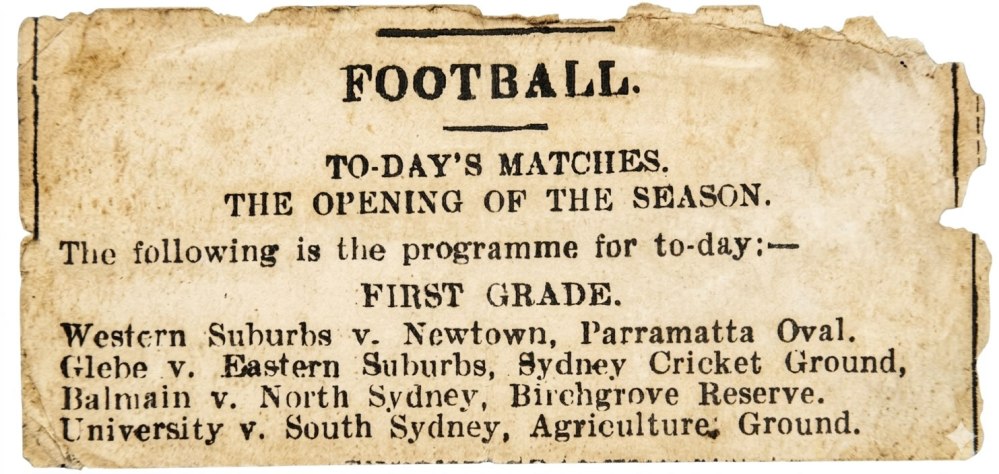
As the winter of 1898 moved into spring, the public mood was drifting away from the old clubs. Crowds at regular club matches dwindled to a depressing thousand spectators, while intercolonial clashes between NSW and New Zealand drew tens of thousands.
Evening News, 6 June 1898:
“The advocates of a system of electorate football might well have pointed to the vast array of empty benches at both the big grounds on Saturday—a glorious afternoon—as an irrefutable argument in support of the assertion that the sooner the existing form of senior club competition is dispensed with, the better it will be for the rugby game.
That the meeting of such giants as Wallaroo and Randwick should have attracted not more than 1,200 spectators to the Agricultural Ground, and that the two big matches at the Sydney Cricket Ground should have been played before an attendance fairly estimated at 1,000 (including members), affords proof positive that these senior club matches have no interest for the general public.
Each successive season sees a further falling off, but the Rugby Union, resting content with its snug bank balance—the result of intercolonial matches—prefers to leave things as they are. In matters of sport, the general public cannot be accused of hypocrisy. By rolling up in their tens of thousands to see the New Zealanders last year, they showed that, once their feelings are worked upon and their enthusiasm properly aroused, they are as keen as ever. By stopping away from senior club matches, they tell the Rugby Union plainly that something is wrong—that these fixtures no longer entertain them.
Certain clubs have an extraordinary fascination for a select few, chiefly for those who are personally acquainted with the players, or for old members whose long association with the one club weds them to it indissolubly, so that they revolt at the thought of disbanding—the one step necessary in inaugurating electorate football. But surely the men who love the game for its own sake, and who see it fast losing its grip of the people, are liberal-minded enough not to allow such a small thing as club sentiment to stand in the way of a reform which might be the means of lifting rugby back to its proper place in popular estimation.”
The Daily Telegraph, 27 September 1898:
A special general meeting of the metropolitan branch of the New South Wales Rugby Union was held last night to consider the question of introducing the local or electorate system into the football competitions of the metropolis … Mr. Abrams was glad to see that the question had emerged from the abstract stage. He did not, however, believe in running two competitions simultaneously. They would rob each other of interest. If local football were established, enthusiasm would grow, as it had grown in connection with cricket.
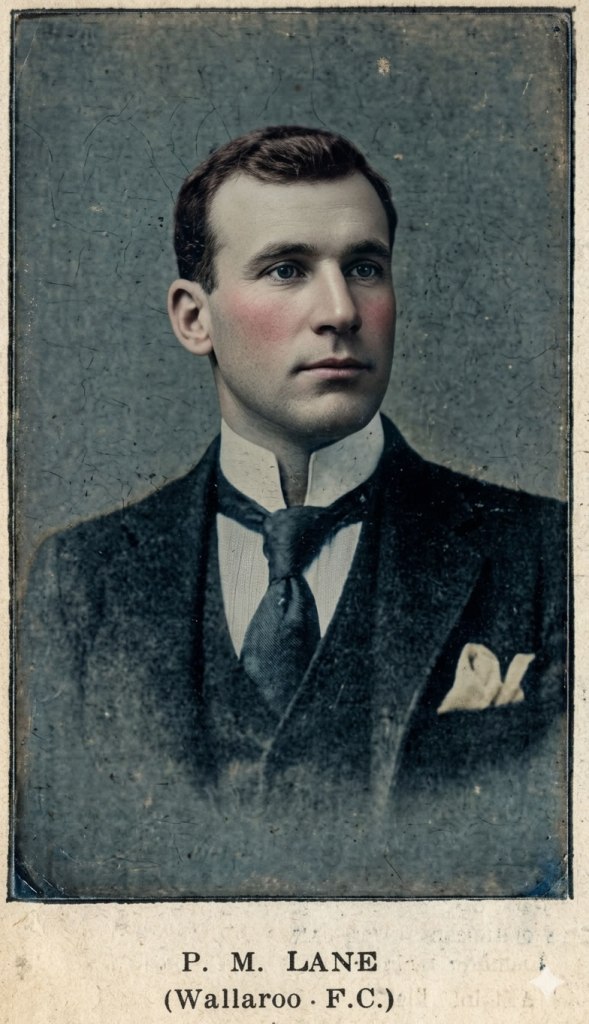
Mr. P. M. Lane [Paddy Lane, captain of Wallaroo] said that they were discussing a big resolution, and it should be very carefully considered. Mr. Abrams had not brought forward one single argument to show that local football would be better than club football. He had simply said—”Things would be better.” He himself was in favor of local football—on terms. Local football would not be such unless played on local grounds. There were not at present more than three grounds in Sydney where football could be decently played. Would anyone like to play at the Wentworth Park Oval? There were, as a matter of fact, no grounds; and therefore local football was as yet impracticable. It was not as if the existing system had not been a success. The union was one of the strongest in the world. This past season’s competition had been remarkably well contested, and if the local system came into force, most of the strength would be found to be centred in two or three electorates. A lot of players would not mind where they lived, so long as they were connected with the strongest clubs. Half of the fun of football was the social element, and that would be gone if electorate football were established. Players would meet only on Saturday afternoons, and on training nights, and would know nothing of one another. Supposing local football were introduced, things would inevitably be in chaos for a while, and with an English team here next season, the consequences would be disastrous.
Mr. H. D. Wood [Sydney University FC] … The sentimental argument had been ridiculed; but the old clubs were entitled to consideration. They had kept the Rugby game alive at a time when the Victorian game seemed to be getting a footing. If football were played on a residential basis, it would be impossible for the games to take place on the unenclosed suburban grounds. If local football came, the risks of professionalism would be enormously increased. At any rate, it would be better to adopt the suggestion of the committee [two competitions], and then it would be possible to see if there were, in reality, any virtue in the local system, as applied to Sydney.
Mr. W. M. M. [Monty] Arnold said he was in favor of any sort of football; but the amendment meant the killing of every club in the union. Offers would be made to players to live in certain districts, and have free board and lodging. The proposal of Mr. Abrams interfered with the liberty of the subject. It said, “You shan’t play with your brother or your friend, but with somebody else—somebody, perhaps, that you don’t know.” It would be a sin to wipe out existing clubs. It would be a monstrous injustice.
Mr. J. R. Henderson advocated the running of club and district competitions simultaneously at the outset, and then it would be a question of the survival of the fittest. It was not true to say that football was deteriorating in this colony. Neither was it true to say that public interest had abated, for last season the profits were £219 as against £80 the season before.
When the vote was finally called, the reformers won a stunning victory. The motion favouring an electorate football competition over the old Seniors won by a clear majority of 22 to 12. A committee was quickly appointed to iron out the details.
But their celebration was short-lived. In early January 1899, a special MRU meeting was hastily convened. Taking up Lane’s point that the British Lions were touring later in the year, an opportunity arose. Out of concern that a massive club reorganisation would wreck the chemistry of the NSW representative teams, officials decided to leave the old Seniors competition untouched.
Once again, the annual humbugging of the electorate scheme had succeeded. Wallaroo and the other social clubs had outlasted another coup.
A FAIR FIELD AND NO FAVOUR
All Wallaroo desired was to be left to carry on in the manner it had for three decades. Here, young and old comrades wished to continue to swing ‘Under the greenwood tree’, free of false friends and rivals. At no time did the club object to an electorate-based team entering the competition; they simply wanted to preserve their own existence under their own colours.
At the Wallaroo annual meeting in March 1899—with the enemy silenced once more and no immediate threat on the horizon—the life of the club went on as normal.
The Daily Telegraph, 4 March 1899:
“Once again, the report concluded, the cry of electorate football was raised, but, as before, it appeared likely that the old landmarks in the football of the colony would be in existence for some time yet.”
Wallaroo went on to win the 1899 premiership. They were so far ahead of the competition that they held an unassailable lead on the points table, allowing them to be declared premiers even before the trophy play-offs began.
The Australian Town and Country Journal, 23 September 1899:
“Metropolitan Premiership. As the last round in the competition for the metropolitan premiership could make no difference in the results, the committee have wisely determined to close the competition. Wallaroo is, therefore, declared the premier club of 1899, having played 13 matches, won 12, and lost 1.”
Despite their long history, Wallaroo had since 1880 only twice been crowned club premiers—with their 1892 victory and an 1894 title that was infamously overturned. Yet, this dominant 1899 result proved to be the breaking point for the establishment. The impartiality of the city’s premier sports newspaper, The Referee, vanished completely. Its chief football writer launched a polite but nevertheless aggressive campaign for change.
The Referee, 27 September 1899:
“In a chat on Monday with Mr. P. M. Lane, the captain of Wallaroo, I ventured to suggest that he might do football great good by helping to introduce the new system for next season. He seemed impressed, felt that there is great room for improvement, but it was natural that with such feelings as he has for Wallaroo, and such genial associations, he should also say: ‘I don’t care to say much at present on the subject.’ The future of the game of football is far dearer to us all- than the fate of one or two clubs, even though, as was the case in cricket, they should have once been the pioneers, the fighters in the early days when the sport was in its early childhood. ‘The Referee’ feels that the time for local football has come.”
The Referee, 15 November 1899:
“Are we not to have local football next season? Surely the Rugby Union is not prepared to allow the game to go on as it did last winter. It must be apparent to anyone who is not blind that our club football is open to vast improvement. Some great effort ought to be made to permanently improve it.”
AT DEATH’S DOOR
Early in 1900, Abrams was delighted when it became known that the alteration to district clubs was now favoured by the general committee of the MRU, making its acceptance by delegates at the upcoming annual meeting practically assured.
The transition was made much easier by the actions of Pirates FC. Despite its rich history and excellent record, the club decided to disband and support the new movement, deeming the change to be in the best interests of the game. The Pirates had turned mutineers!
The Pirates held their final club meeting on 7 March 1900, just two days before the Union gathered to decide on the district clubs model. By voting to disband, they hoped to encourage the Union to take the landmark leap. This was a fatal blow to the heart of Wallaroo, effectively leaving them entirely alone to fight for survival.
Returning to Aaron’s Exchange Hotel—the scene of their glorious 1892 celebrations—the Wallaroos died hard.
Endeavouring to offer an olive branch, Monty Arnold stated he would favour electorate football, but maintaining that a great injustice was taking place, he still fiercely opposed the forced disbandment of the Senior clubs. Wallaroo captain Paddy Lane put up a strategic fight that would have made the most astute parliamentarian envious.
When the resolution was finally put, the deafening “No!” that Lane uttered reverberated across the city.
Their only support in the room came from E.J. Howe of Buccaneer FC—a rising social club that had only just made its debut in the Seniors in 1899—and from the delegate of Warrigal FC, a junior club centred around Sydney Harbour’s southern shores at Double Bay and the only other outfit named after a native animal.
It was not enough. The vote in favour of electorate football passed “amidst loud cheers.”
In simple terms, Sydney was divided along electoral boundaries, with a new “district club” allocated to each area. All existing Senior and Junior clubs and competitions were dissolved, replaced by a strict three-grade system operating under each district banner. These district clubs, however, were not independent entities; they were mere sub-branches of the MRU.
THE CHARMED LIFE OF THE UNIVERSITY CLUB
As the reform movement gathered unstoppable momentum, the hypocrisy of its advocates became glaring. The proposed district rules were supposed to be absolute, yet an exception was quietly carved out for the Sydney University club to remain.
Soldiers stationed at Victoria Barracks in Paddington had their own ‘Permanent Artillery FC’ that competed at various levels of club Rugby in Sydney in the 1880s-90s, and like University they too played the New Zealand Natives team in 1889. No special clause was given for the military men, as they were all made join the new Eastern Suburbs district club if they wanted to keep playing.
University was no more an electorate club than Wallaroo. Contrary to the Oxford and Cambridge traditions, the first-grade team of Sydney University had not been confined to undergraduates for decades. This was a concern that not only rankled with some members of the football club, but also within the broader University community—including in Hermes, the university magazine—yet it was completely ignored.
And even then, not content with merely disregarding the customs of Oxbridge and Varsity sports, they openly recruited players who were neither students nor “old boys.” This included, in 1899, their non-student star player H.D. Braund—a major acquisition lured all the way from the regional city of Armidale.
True to his ethos, Abrams saw no place for the University club, telling The Sydney Mail:
“My own idea is that the University should not be considered at all in the district scheme, for if it is retained players may be playing for the University against their own districts, and where feeling is keen they probably would not do this.”
The Australian Star offered a remarkably flimsy, sentimental justification for this double standard in September 1898:
“The one regret in the new system is the fact that unless specially desired, the old University Club will be debarred… but the fact remains eternal that ’Varsity football has a charm of its own, and is immeasurably more popular with the people than any other.”
The Referee arrived with a bugle call of support that all but affirmed just how far the University had strayed from being a University sports team:
“And yet one of the first things proposed by the introducers of the new system is to abolish the University Club, for to restrict its representation to undergraduates means the practical extinction of the club.”
So, they let the University club remain. They granted them their survival and the means to continued success, settling on the soft-touch rule that eligibility “be restricted to undergraduates proceeding to their degree, or graduates of the University of Sydney.”
It was a mouthful of dry, bitter scrub for the Wallaroos to swallow. Sentiment, it seemed, was an excellent argument if you wore an academic gown, but an effete, obstructionist prejudice if you wore the tricolour stripes of the city’s first Rugby club.

THE SADDEST TROOPS OF FRIENDS
Just under a fortnight later, amongst the rush of news reports of district clubs being formed across the city’s suburbs, the Wallaroos gathered for their annual meeting.
The well-read among the Wallaroo members knew what lay ahead for the agitants. Through bloody ambition, the rebels had murdered their way to the throne. Like Macbeth, it will be their ruin. Sadly too, the game’s ruin. They will find out they have forfeited any hope of a long life.
The Sydney Morning Herald, 28 March 1900:
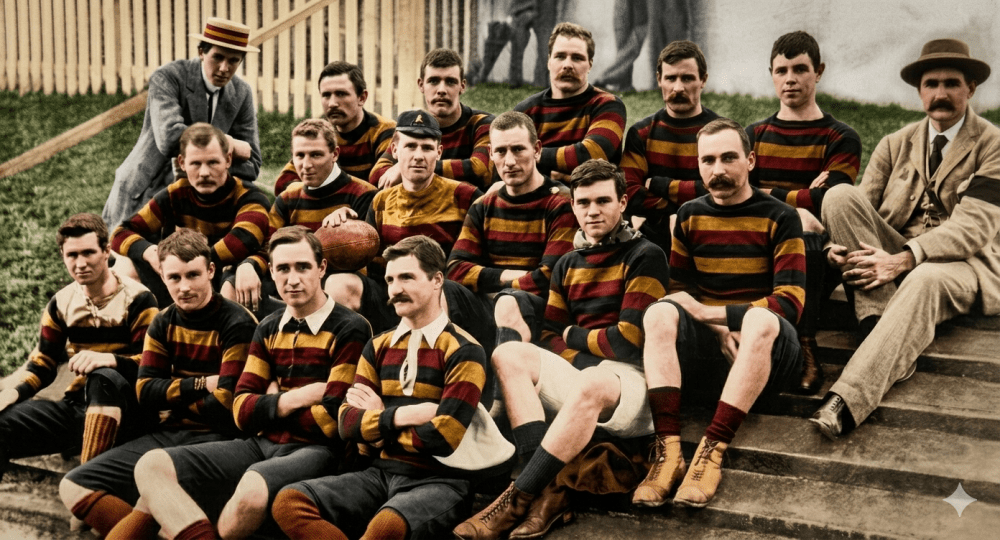
“The hope was expressed that, though the metropolitan branch of the union had decided upon the introduction of district football, the members would hold together, if only to play the annual match with The King’s School. As a memento of the club’s success the members had presented the secretary, Mr. P M. Lane, with a large photo of the playing members and officials of the club, suitably inscribed. Reference was made to the advent of district football, but the fact was regretted that many ties of friendship and fellowship would be severed. The recommendation was made that the old players should give the new system a fair trial.”
The Referee, 28 March 1900:
“It was decided to keep the old club in existence, so that the members might meet and play matches on holidays and other times when not engaged in competition fixtures. The players are all keen upon helping their new local clubs; still they are wise not to at once disband the old club, now in its 31st year of existence, seeing that its continuance on the lines mentioned above will not in any way hamper the development of local football.”
The Australian Town and Country Journal, 24 March 1900:
“…the sentiment that club football, while it had rendered good service to the game, has had its’ day. It is with football as it was with cricket. The old clubs, with mere names as talismanic attractions, have served their purpose. For a time, no doubt, a feeling of sentimental regret will attach to these clubs which have done such yeoman service to the cause of football as the Wallaroos, the Randwicks, the Pirates, etc. But the time has come for placing the game upon a more rational basis, and now that a beginning has been so auspiciously made.”
Stephen Spragg, Wallaroo FC 1899:
“I know, the old club players cannot give up their old teams without more than one deep sigh of regret.
Herbert ‘Paddy’ Moran, captain of the 1908 Wallabies, ‘Viewless Winds’:
“It remedied the old defect of the best young players flocking to the stronger clubs but it destroyed for ever something those clubs had; a corporative spirit and a tradition. What members can be loyal to a body when their only bond is vaguely territorial? The district system functioned well as a machine but it never distilled a spirit.”
Crucially, by preserving their structure, they kept an insurance policy in reserve, holding the club in readiness in case the new electorate system fractured under its own weight.
THE WHEEL OF IRONY
The warnings from the Arnolds, Lane, and others about the dangers of “localism” played out just as they had foretold.
A small band of ‘rebel’ cosmopolitan clubs started the City and Suburban Association, which via a tortuous path became ‘NSW Subbies Rugby’. This included the Warrigal FC, who had among them a youthful band of men still spoke about more than a century later, namely Herbert ‘Dally’ Messenger, Reg ‘Snowy’ Baker and Sid ‘Sandy’ Pearce.
Meanwhile at first grade level the hyper-local rivalries created a monster. Within just a few seasons, a single district clash at the Sydney Sports Ground drew an astonishing 25,000 fanatical supporters.
As early as the end of the 1900 season, Monty Arnold cautioned those in Brisbane “that he considered the electoral system in Sydney had introduced the betting element and a far greater amount of rough play than under the old regime.”
This localised fervour was volatile fuel, and certain footballers and financial speculators saw their opportunity. The rigid district scheme became a self-inflicted conflagration that ultimately consumed the amateur game, directly fueling the explosive arrival of Rugby League in 1908.
The Referee, 19 March 1919:
“Monty Arnold and his brother, Mr. Richard Arnold, were in at the genesis of Rugby in this country. They saw it thrive from a healthy seedling until it became a giant oak, then wither away a bit, the sequence of piled-up affluence following tremendous popularity, allied with a lack of vision among the men who were steering the wheel when it was on the highest waves of popular enthusiasm.”
League instantly seized upon these pre-packaged suburban tribal boundaries, the blue and maroon annual inter-state series, and an Australian team, then paid the working-class players, banked the profits, and cast Rugby Union into the shadows for the rest of the twentieth century.
When Union finally embraced open professionalism in 1995, the wheel of historical irony turned a full, mocking circle. Sydney University and the remaining Shute Shield clubs abandoned their founding principles to recruit players from all points of the compass. Their historic suburban names, once proudly worn, became mere cicada shells — hollow remnants of a discarded local identity.
Sydney’s sons and the Shield’s proud remnant forsook their sires’ stern creed,
Now summoning hirelings from every compass — mere shells where suburban names once had been.
Cicada-husks of a forgotten fealty, drifting light on the wind’s cold breath —
No Wallaroo esprit de corps in the shouting now, Ashes of charcoal fur and bone,
Just you with your rats, wooden wicks, pirate allopaths and other coin-catching beasts.
It was the exact system of open membership and “free trade” the Arnolds had fought to preserve—proving the grand old pioneers of Wallaroo entirely right, though nearly a century too late to save them.
[ site homepage ]
