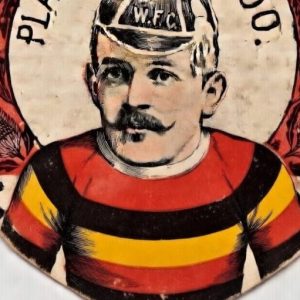
Kicking-off a Rugby club in 1870 required not just 20 willing young men as footballers. The pioneer Wallaroo FC players had to lug their own goalposts through Sydney and hide their precious Rugby ball from the police just to avoid a night in the lock-up.
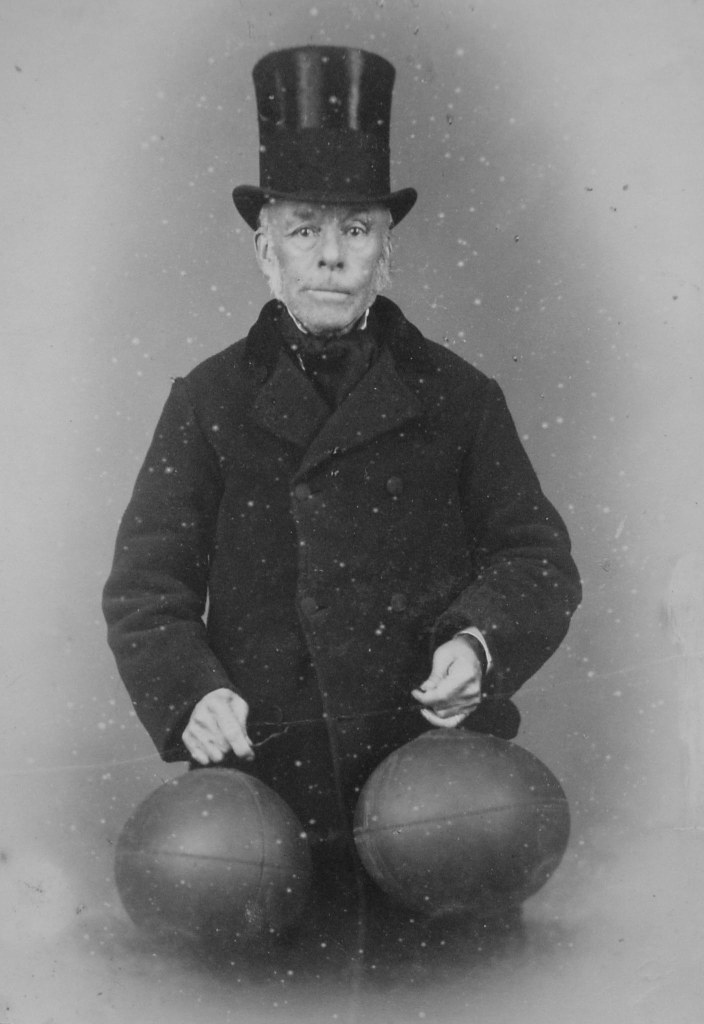
“Almost as soon as the football club was formed, the necessity for a ball with which to practise naturally arose. Here a difficulty was at once encountered, as, in those days, there were no proper footballs obtainable in the colony.”
— ‘Monty’ Arnold, ‘Old Times’, July 1903
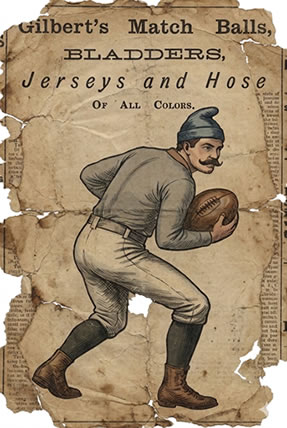
GILBERT’S & LINDON’S RUGBY BALLS
In 1870, the playing laws of the Wallaroo Football Club, those of their London peers, and even those of Rugby School itself, did not specify the size and shape of the ball. All anyone knew was a simple tradition: “The game is played with the Rugby ball.”
The principal manufacturers were, unsurprisingly, in Warwickshire county in England. The local Rugby town cobblers Richard Lindon and William Gilbert supplied the bulk of the balls used by early clubs worldwide.
Manufactured Rugby footballs had been arriving in the colonies from England since at least the late 1850s. In July 1859, the advertisement columns of The Argus announced the arrival of a British shipment containing 32 large leather footballs “manufactured to order from Gilbert, of Rugby.” Gilbert had famously showcased his Rugby footballs at The Great Exhibition in London in 1851.
Football under Melbourne rules was also played with a Rugby ball. In 1877, its laws prescribed that “The ball to be used shall be the No. 2 size Rugby (26in. in circumference).” Meanwhile, the Rugby Union in England did not officially mandate the ball’s maximum size—26 inches wide by 31 inches long—until 1892. Today, the statue of Tom Wills outside the MCG includes a reasonably accurate approximation of a c.1858 “leathern spheroid.”
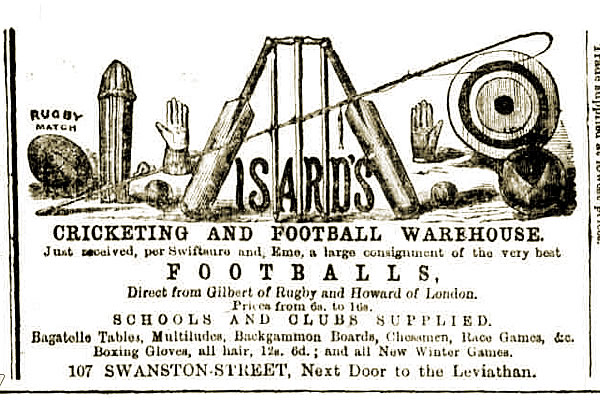
Heading into the 1870 season, Isard’s Cricketing and Football Warehouse, touted as “Melbourne’s most reputable cricket and football goods store,” advertised “Rugby match” balls sold “Direct from Gilbert, of Rugby.”
Either these stockists had completely sold out, or this vital sporting intelligence simply had not reached Sydney.
A WALLAROO SADDLER
The old boys of Rugby School such as the Arnold brothers at Wallaroo, of course would recognise the customary size and shape of the sacred symbol of Rugby. With a knowing nod, they would say “A Rugby football is more of an oblate spheroid than an oval.”
The club’s co-founder ‘Monty’ Arnold continues with the story.
“Almost as soon as the football club was formed, the necessity for a ball with which to practise naturally arose. Here a difficulty was at once encountered, as, in those days, there were no proper footballs obtainable in the colony.”
“The proper Rugby ball, known as the Gilbert No. 2, was an unknown quantity amongst the tradesmen of the City, so that, if any play was to be had that season, the only course the club could adopt was to have a ball made by one of the local firms. This was not such an easy job as it at first appeared.”
“An oval shaped ball was wanted, but the local saddler, on being appealed to, was fearful that if he turned out a product which bore such a palpable resemblance to the patented work of Gilbert, of Rugby, he might be called upon to defend himself against an action at law. This, however, may have been used as a subterfuge to cover an inability to turn out an article closely imitating the ‘real thing’.”
“At any rate, he did furnish an oval ball, but one that was of ponderous proportions, which, as soon as it had been the recipient of a few kicks about the field, lost its shape, becoming weighty and cumbrous.”
“However, as we were in the habit of playing twenty a side, and had plenty of big, strong fellows to draw upon, a few pounds in the weight of the ball was a mere trifle. There was abundance of muscle and vim to make the sphere travel, and, despite its clumsiness, it was hustled about the field in a manner which left no doubt in the minds of the spectators as to the earnestness and determination of the players.”
“It was an extraordinary looking thing … They played twenty a side, so fortunately the kicking was passed round, for it required the hoof of a draught horse to make any impression upon the ball. However, they persevered.”
— The Age, 11 August 1934
“Mr. T. Brown, captain of the Wallaroos, won the toss, and elected to kick with the wind from the northern goal, and the advantage of this was early evidenced by the affection displayed by the ball for the University men, who, despite all their efforts, were unable for any length of time to drive it back.”
— The Australian Town and Country Journal, 27 August 1870
By 1874 the club records report of “a dozen balls have been ordered direct from Gilbert (of Rugby) and it is hoped … they will arrive about the beginning of June”.
ROPES AS CROSS-BARS & SPECTATOR BARRIERS
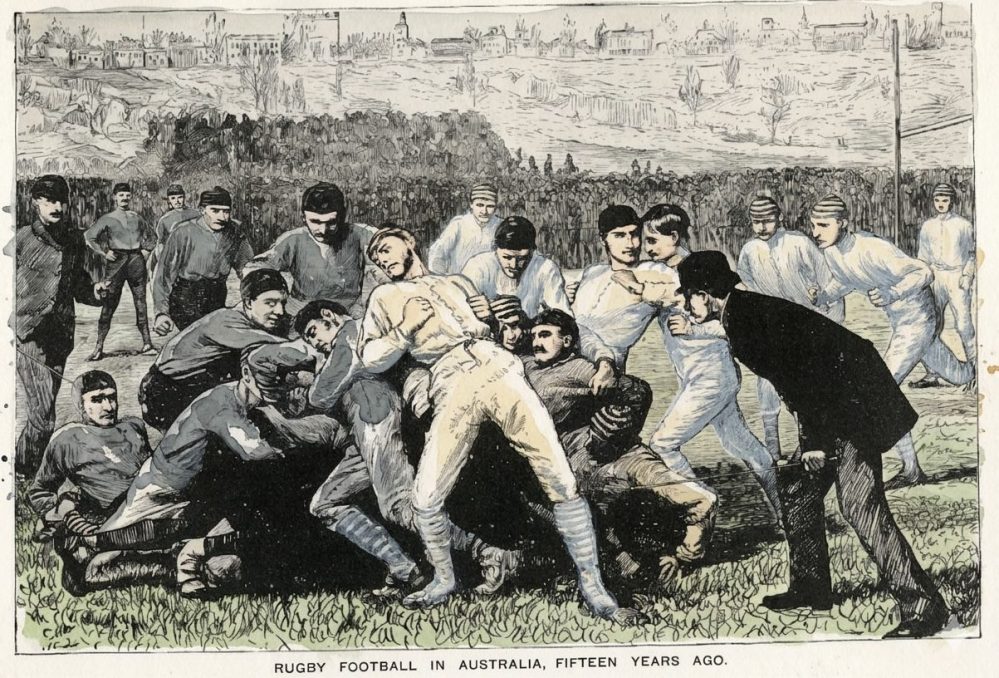
Apart from the club’s historic inaugural 1870 matches, held at the future Sydney Cricket Ground (SCG) when it was known as the Military and Civil Ground, the majority of the club’s games during its first decade were played on the adjacent open fields of Moore Park. Hard to fathom now, but these unfenced grasslands were far preferable to footballers than the winter water-logged SCG in its early days.
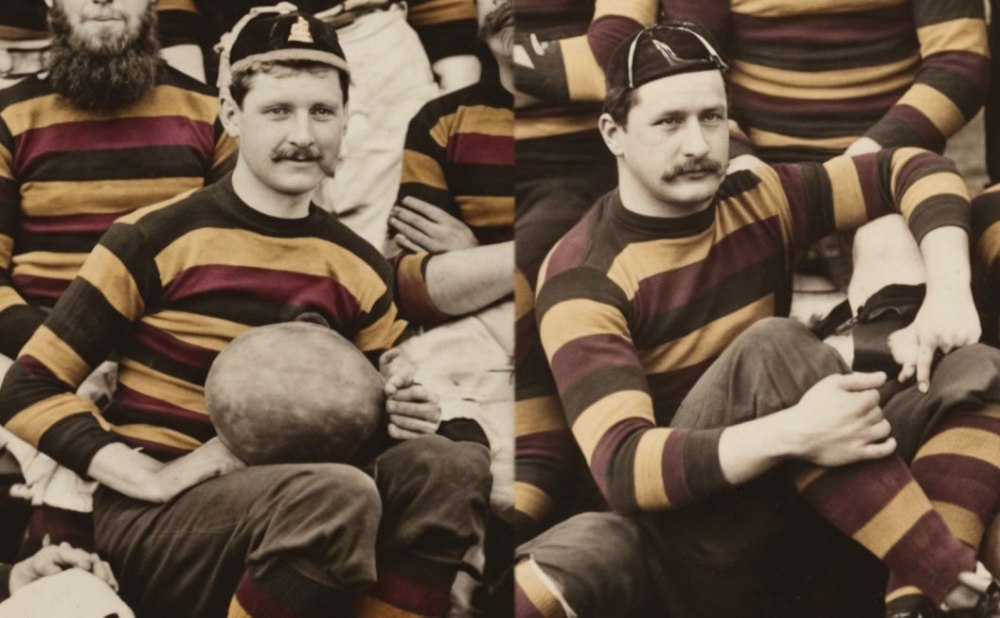
“We played 20-a-side in those days at Moore Park,” said Arnold. “We would walk out and home all the way from North Sydney, carrying our goal-posts with us, and the ropes and posts to enclose the playing pitch. Fancy the players of nowadays lugging all their stuff about like that!”
The players walking home in the winter dark, injured, bloodied and weary, with the goalposts, ropes and flags on their backs, the entire spectacle speaks of a biblical ordeal from the mind of Hieronymus Bosch!
Decades later, Walter E. Bethel, a young boy at those 1870s games, reminisced in The Sun newspaper:
“The Wallaroo Club had its playing-ground on Moore Park. It was in the north-eastern corner [Moore Park West], just as you come in the gates opposite the Captain Cook Hotel [Paddington], running parallel to the Randwick Road [now Anzac Pde].”
“To keep the crowds back the Wallaroos had iron stanchions with holes for rope at the top, and the playing field was thus roped in; but as the game progressed the rope was soon trampled down by the eager crowds.”
The goals at each end were two upright posts, fourteen feet high and spaced six yards apart. A cross-rope served as the horizontal bar between them, tied ten feet above the ground.
“The big club matches were played upon the boundless Moore Park. With surging, and sometimes yelling crowds hemming in the players, as though the battle were one of fisticuffs instead of a friendly game of football. This was Sydney club rugby in the late 1870s. Spectators freely entered the open parkland outside the Sydney Cricket Ground (SCG) and stood along the touchlines marked out by low cut grass.”
— from ‘The Rugby Rebellion’ by Sean Fagan, 2005
A FOOTBALL WEAPON
Even the journey to the match carried peril. Contrary to what we might think today, this was not an imaginary risk dreamt up by a genteel society. In an era where horses were still everywhere, and any sudden injury could prove fatal, playing football or even a loose football in the street was an invitation to disaster. One startled horse on the run could easily knock down a pedestrian or two, injure itself, or overturn a heavy dray and scatter chaos for half a block.
“There are the football maniacs, rampant in our streets. Only this week I had a football landed on my horse’s head, much to my alarm and annoyance… Where are our police?”
— Barrier Miner (Broken Hill), 28 April 1902
Consequently, carrying a Rugby football to the grounds often caused more alarm—and posed more risk to a person’s well-being—than actually playing the game. It was best hidden away in a canvas bag. Carrying it loose tempted players to pass it to a colleague, or risked it accidentally dropping into the path of traffic.
Well into the 20th century, local statutes declared playing football in the street a public nuisance. Police stood ready to haul offenders before the local magistrate, where they faced steep fines or a night in the lock-up. Even young schoolboys knew that the risk of playing a casual game of “street football” could see them face the magistrate’s frown.
LION-HEARTED WALLAROOS
The outlook clear for Wallaroo’s first twenty day,
A saddler’s ovoid ball of ponderous shape to play;
Robust fellows hauled their posts to stake the historic claim,
Dodged the traps and city laws to let the spirits untame,
Now there’s joy in Sydney town — Rugby is the game!
Note 1 : None of the very brief news reports of the first games by Wallaroo in 1870 digress to make reference to the shape or condition of the football.
Note 2: While the Arnold brothers resided in North Sydney, there is no evidence that all of the club’s 1870s members were. The club held no meetings or played any matches on the northern side of Sydney Harbour, which beyond the North Sydney village was sparsely populated until the completion of the Sydney Harbour Bridge (1932).
Note 3: A long-held myth suggests that in the mid-1860s, a member of the New South Wales Parliament named Eldred Harmer introduced a law to ban Rugby football. In truth, there is zero historical evidence to support this story, and no parliamentarian by the name of Harmer ever served in the NSW Legislature. The legend likely stems from colonial summary offence laws that prohibited playing football in public spaces—such as streets—where it was deemed a “public nuisance” or annoyance. While the sport itself was never outlawed, the strictly enforced bans on street-playing likely birthed the mistaken belief that the government had banned the entire game.
Note 4: The term “jerry-built” arrived in Australia in the 1870s from England and roughly equated to “scamped”. To scamp means to do a job quickly, poorly, or without paying close attention to details.
Note 5: Hieronymus Bosch’s Christ Carrying the Cross (San Lorenzo de El Escorial), created between 1498 and 1507.
WallarooFC1870.com – All website text & content © Sean Fagan
[ site homepage ]
