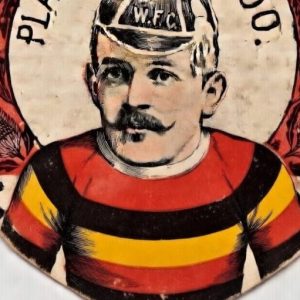
The Wallaroo FC was essentially patented Rugby prestige in the late 1800s. Its high reputation served as a blueprint for a score of new brother-marsupials to rise up across the Rugby-playing colonies and call themselves “the Wallaroo Football Club”.
From Goulburn’s Sunday photo sins and Brisbane’s escape from Melbourne rules, to Maryborough’s rough side of the street welcome, all were Wallaroos.
WALLAROOS: A RARE BREED
When Wallaroo FC was founded in Sydney in 1870, they faced an empty landscape and could choose any name they liked. At their first meeting, keeping in mind the “black heathen” of London’s Blackheath FC, the club adopted the local, charcoal-coated “devil of the rocks”—the wallaroo.
Yet despite this exotic example, the majority of Rugby clubs that followed over the remainder of the 19th century opted for a more literal route, simply appending “FC” or “RFC” to the name of their town or suburb. The most colourfully titled clubs were tucked away in larger towns that supported multiple teams, or in local borough competitions hidden far from the notice of anyone but the players and their friends.
Even among these clubs, not one took the name of the kangaroo or wallaby; in fact, very few turned to native fauna at all. Instead, names like Waratahs (the native flower), Albions (for England), or the swashbuckling Pirates, Buccaneers and Wanderers were common—yet there were those with a keener eye for class and prestige, and they chose to call themselves “the Wallaroo Football Club.”
The Wallaroo FC had no direct or even guiding hand in starting any of the new mimic Wallaroo clubs; these far-flung namesakes arose entirely from the power of their example. In a twist of poetic justice, two of these clubs went on to win their respective premierships in the year the original Wallaroo FC was excluded from the Sydney competition.
“When the question arose as to what name should be chosen for the embryo club, W.H (Bill) Goodwin suggested that it be called the Wallaroo Football Club, in honour of the famous Sydney (N.S.W.) team. The suggestion was adopted by the meeting and the Wallaroos came into being.”
— 1894 founding of Wallaroo FC of Maryborough (QLD); Maryborough Chronicle, 1 October 1953
WALLAROO FC (MARYBOROUGH, QLD)
founded c.1893
This is the only surviving football club today that bears the “Wallaroo” moniker adopted while the famous Wallaroo FC was still playing in Sydney.
After holding its formal founding meeting in 1894, the club was quick to gain success, winning the local Seniors (first-grade) competition in 1895. From the outset, they were referred to as “the ‘Roos” by both the club and Maryborough newspapers, and adopted the colours of blue and white.
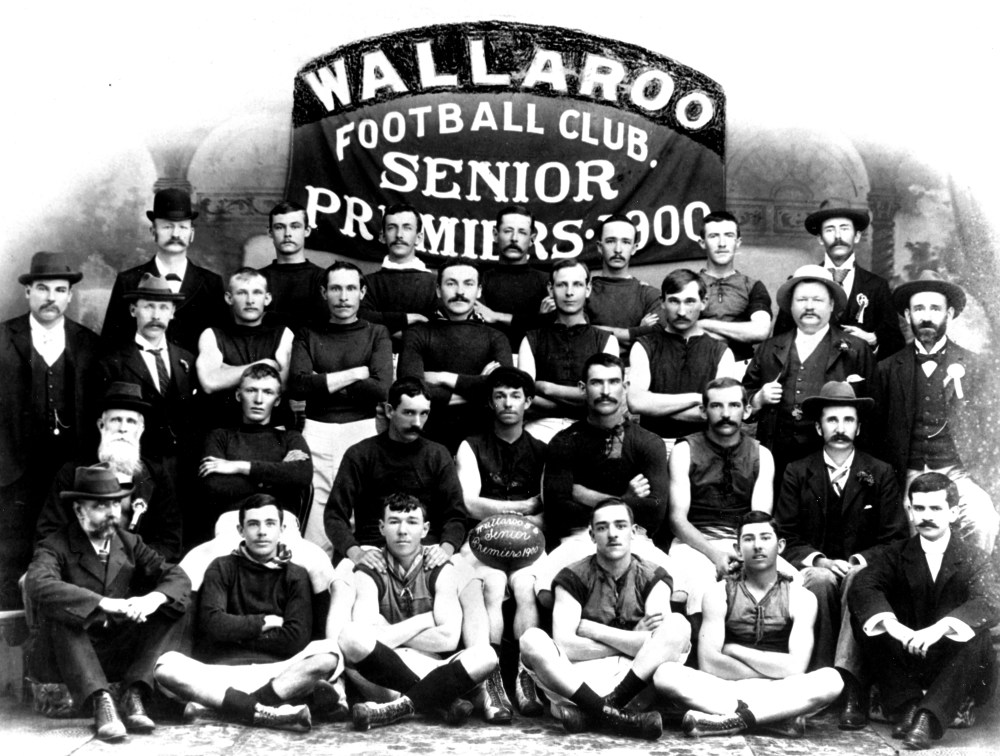
Before the kick-off of the 1910 season, Wallaroo and their local rivals collectively code-swapped to rugby league. Today, the club trades as the Wallaroo RLFC, though they continued to take the field under the traditional Wallaroo FC banner well into the 1960s.
The base for the club and its primary support during its rugby union days was in blue-collar Newtown (Maryborough West). The ad hoc range of jersey styles and conditions visible in early 1900s team photos (including above) reflects the men’s working-class background. Buying a new set of jerseys was for many clubs a big expense. Their sleeveless vest jerseys speak of the influence Melbourne rules and its VFA clubs once had over football in Brisbane and the regional centres, alongside perhaps a preferred clothing adaptation to playing Rugby in Queensland’s warmer winter climate.
The Wallaroos of Maryborough also hold the distinct honour of being the only still-active, 19th-century-founded rugby union club in Australia to have played every single season since its inception, notwithstanding they jumped codes.
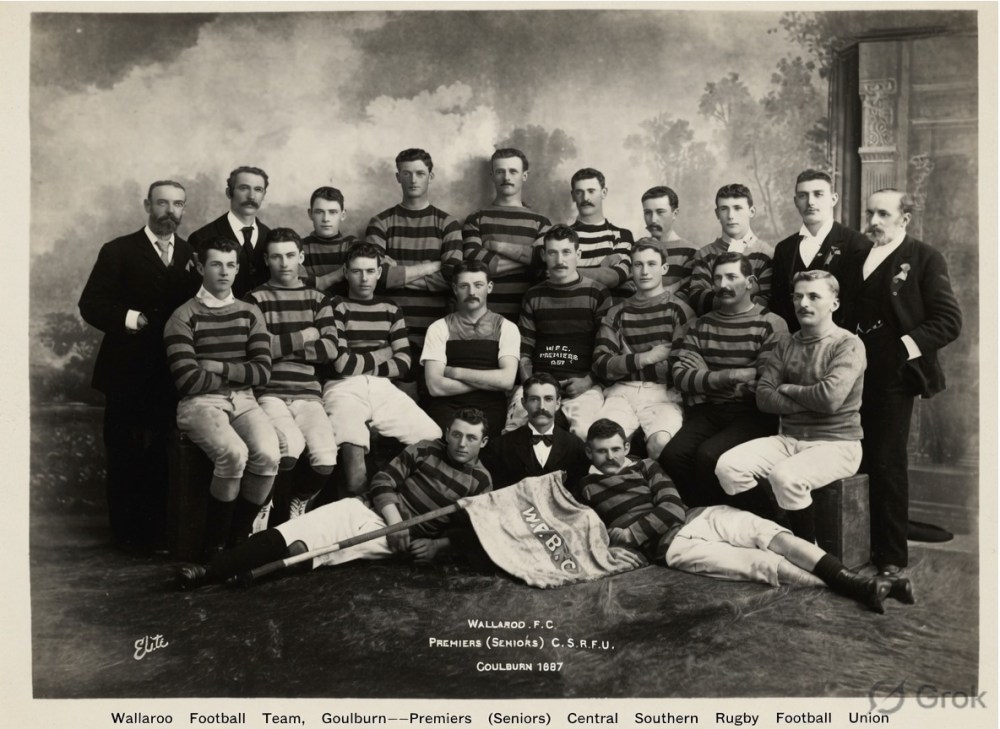
WALLAROO FC (GOULBURN, NSW)
founded 1890
Goulburn’s Wallaroo Football Club was formed in 1890, adopting a bright uniform of blue and gold. The club’s playing ranks swelled with such rapid vigour that by 1893 it was strong enough to field two separate entrants—’Wallaroo A’ and ‘Wallaroo B’—in the town’s primary club competition.
This abundance frequently saw both the A and B combinations performing on the one Wallaroo bill-of-fare afternoon, playing in front of the exact same cohort of supporters. Such a house divided could not stand indefinitely; ahead of the 1894 kickoff, the ‘Wallaroo B’ faction broke away to form the Warrigal FC, naming themselves after the native dingo. Before long, the two rival operations expanded further, each spawning its own second-grade team in ‘Wallaroo B’ and ‘Warrigal B’.
The standard of athleticism maintained by the blue-and-golds was formidable. In 1893, the Queanbeyan Age observed that “Amongst the Wallaroos are to be found the strongest athletes” of Goulburn. It was a physical dominance that bore championship fruit in 1897, when they secured their first premiership. They sealed the title with a tense, single drop-goal to nil victory over St Patrick’s College at “the deanery paddock,” situated alongside St Saviour’s Anglican Cathedral.
By 1900, The Sydney Mail recognised the Wallaroos as the oldest club in Goulburn. They defended that prestige fiercely that winter, dismissing in the final a new Goulburn FC by 9 points to 3. The original Goulburn FC—founded back in 1872 by former Sydney University FC captain Valentine Blomfield Riley—had long since folded, disbanding at the close of 1892.
The 1900 premier’s team photograph sparked a mild newspaper controversy when a studio session was booked by the Wallaroo captain for 10:00 AM on Sunday. Clashing with church services, it prompted an outcry “to enter a protest against this public disregard of the day of rest and worship,” especially since the team held “a great influence among our young men and lads.”
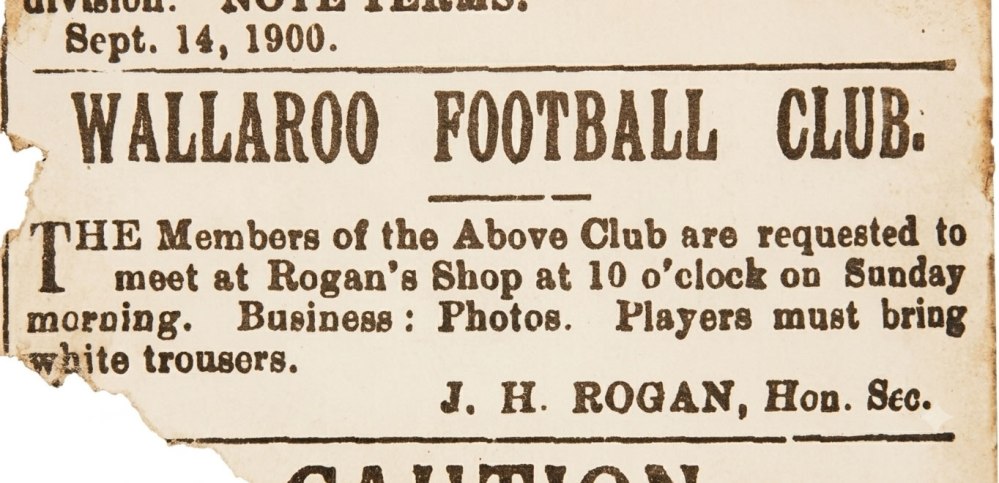
The hullabaloo was ignored as the shoot went ahead with more than a full XV compliment of Wallaroo footballers present.
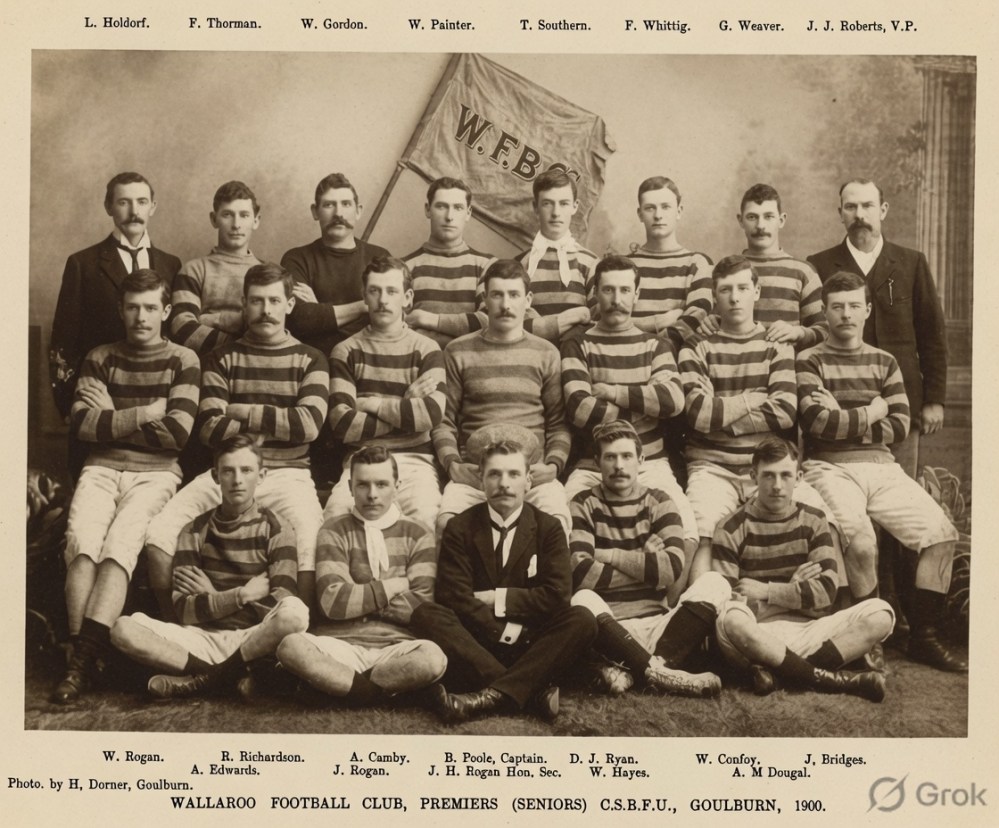
The blue-and-golds remained a proud anchor of the local game for nearly a quarter of a century, engaging in classic home-and-away country derbies against clubs representing Yass, Gunning, Young, Cootamundra and Crookwell before the Wallaroos finally disappeared from the football scene in 1913.
WALLAROO FC (BRISBANE, QLD)
founded 1879
Founded as a Melbourne rules club in 1879, Brisbane’s Wallaroo Football Club lived a fascinating dual life before it was buried with full honours in its Rugby colours at the end of 1893. It was truly a wallaroo that had changed its coat—though from the outset, its club name had always signalled its true allegiance.
At the time of the club’s birth, football in Brisbane and Ipswich was dominated by Melbourne rules under the governance of the Queensland Football Association (QFA). Though the local football scene had switched codes a number of times over the 1870s, it looked as though the entire colony was firmly committed to Victoria’s game.
Facing this reality, the Wallaroo club was formed by H. St. Paul and other “veterans of many a Rugby match in the home country.” Completely unfamiliar with Melbourne rules, the founders were simply desperate to play any form of football. When they took the field, the new club did so wearing amber (yellow) and black as its signature colours.
In 1880, the Wallaroos negotiated an indulgence with the QFA to schedule a single, end-of-season match under Rugby rules against their rivals, Brisbane FC. The Brisbane side featured future key figures in Queensland’s Rugby allegiance, such as Pring Roberts, Thomas Welsby, and former Blackheath FC player Fred Lea. By 1882, this arrangement had expanded to a series of three Rugby matches. The QFA at the time did not bar its clubs from playing rival codes, unlike the Southern Rugby Union (later the NSWRU) in Sydney—thus allowing Brisbane’s Wallaroo club to operate as a unique dual-code entity.
Historical accounts often credit the Brisbane Wallaroos with firing the opening shot of inter-colonial Rugby in 1882 by writing to the Sydney Wallaroos to arrange a pioneering cross-border tour. While that legendary visit did eventuate, it was actually Brisbane FC that initiated the correspondence [see ‘The Great Wallaroo Land Swindle‘].
Nevertheless, with no single club in Queensland yet devoted exclusively to Rugby, the Brisbane Wallaroos were absolutely pivotal to the foundation and rise of the code in the colony. They ensured Rugby matches were played every year, even as their own membership grew deeply divided—yet surprisingly harmonious—between those who preferred Melbourne rules, those who played both, and the purists who only turned out for Rugby (“the Rugbyers”).
In mid-July 1882, the Wallaroos’ scheduled Rugby match drew out a fresh arrival from Britain: Arthur “Jumbo” Hickson. A Scotsman who had played top-tier Rugby in Dublin for both the University and Wanderers clubs, Hickson did not care a jot for Melbourne rules and had kept out. In his first and only appearance in Brisbane football that season, he was described by The Queenslander as “an exceedingly well-developed specimen of a Wallaroo.”
On the strength of that single game and his extensive overseas experience, Hickson was named captain of the very first Queensland Rugby team chosen to visit Sydney. The 17-man party included six other Wallaroos in T. Bond, J.C. Boyd, H. Macintosh, Frederick Hardgrave, Edward Markwell and J. Townson.
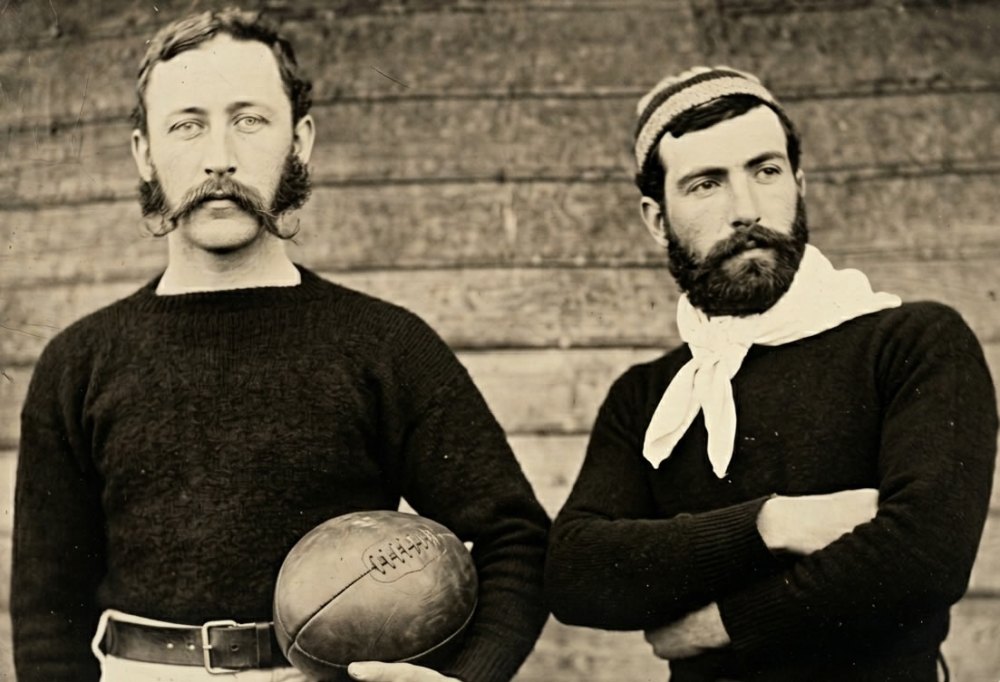
Hickson’s leadership kept the code alive in Queensland, maintaining a competitive nucleus of talent that ultimately supported the inter-colonial campaigns of 1882 and 1883. In August 1883, The Toowoomba Chronicle declared that “the Wallaroo Club possesses the best Rugby team of any single club in Brisbane.”
That same year, the club showcased its dual-code brilliance by winning the QFA’s first trophy, the Shaw Cup—introduced in 1882 for the first club to win nine consecutive Melbourne rules games. By securing the streak in 1883, Wallaroo took permanent possession of the silverware.
When the Northern Rugby Union (NRU, now the QRU) was founded in late 1883, Hickson was a leading architect. Although Wallaroo was widely recognised as the colony’s premier Rugby powerhouse, its members resisted joining the new union exclusively. They chose to remain a dual-code club, knowing that if their Rugby players all left, the club would lack the numbers to field a competitive team in the QFA Melbourne rules competition.
Conversely, the other three local clubs turned the QFA into a Melbourne rules-only body, dictating that any member who took part in a Rugby game would be barred for the season if it happened on a day their club had a scheduled Melbourne rules match. In April 1884, the Daily Observer noted: “Three prominent local clubs have now declared against Rugby, and the Wallaroos, unless they are anxious to be left out in the cold, had better follow suit.” To drive in the wedge, the QFA scheduled Wallaroo to play Melbourne rules every Saturday, leaving no room for Rugby fixtures.
Although Wallaroo remained a member of the QFA and chose not to officially join the NRU, the club sent a delegate to NRU meetings and maintained highly friendly terms. The NRU regularly arranged fixtures against Wallaroo for its two newly formed in-house “clubs”, the Wanderers and Fireflies. Furthermore, the union selected Wallaroo players for Queensland representative teams and even scheduled matches between Wallaroo and visiting NSW teams in 1883 and 1885.
When not playing for their own club and wanting a Rugby game, the Wallaroo men were scattered among the Wanderers and Fireflies. They were so numerous that whenever Wallaroo took the field as a single Rugby XV, their opponents had to merge into a combined Wanderers-Fireflies team just to ensure an even contest.
At a tense Wallaroo club meeting in May 1884, it was acknowledged that the majority of members personally favoured Rugby. However, a strategic vote carried a substantial majority stating “that the club allow its members to play both Melbourne and Rugby style” and “that the Victorian Association game be the recognised game of the club.”
This compromise put them at odds with the strict stance of the QFA. Fielding two separate teams with many crossover players also took a heavy toll on and off the field. Debates about the merits or otherwise of each code were energy-sapping. A commentator warned: “There will likely be a split in their camp this season re the Rugby matter. But there need be no reason why their ranks should be so thinned, that their Melbourne team will have to play second fiddle.”
The breaking point arrived in July 1885. The popularity of Rugby was growing rapidly, reflected in the emergence of Queensland’s first independent Rugby club, Wasps FC. At a heavily attended special general meeting, the Wallaroo members were asked to finally decide whether the club should continue attempting to play both games.
The majority argued that experience proved the Wallaroo club could no longer logistically or physically support both. A motion to become an exclusive Rugby club passed convincingly by 18 votes to 6. The Wallaroos had successfully changed their coat. The secretary was promptly instructed to notify the QFA of the club’s immediate secession.
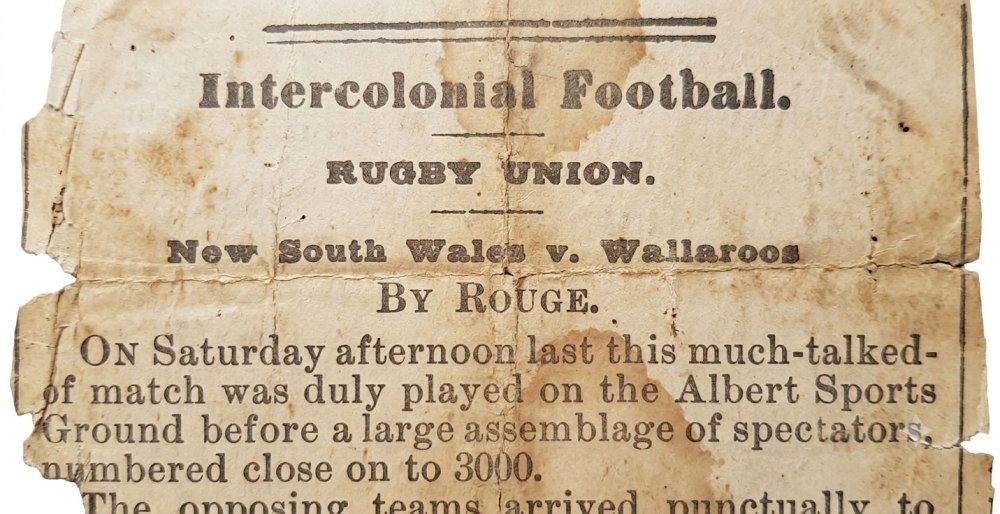
Within weeks the now Rugby-devoted Wallaroos went on to secure an historic 5 points (converted try) to 4 (two unconverted tries) victory over NSW.
This club having decided to throw in its lot with the Northern Rugby Union, your committee trust that every effort will be made by the members to keep up the old reputation of the Wallaroos.
— 1886 Wallaroo FC annual meeting, Daily Observer (Ipswich), 22 April 1886
The Wallaroos maintained their fierce reputation as a Rugby powerhouse for near on another decade. In 1889, the club was captained by Harry Speakman (ex-Runcorn FC in Cheshire), a standout player from the historic 1888 British Lions touring team who chose to stay behind and settle permanently in Australia.
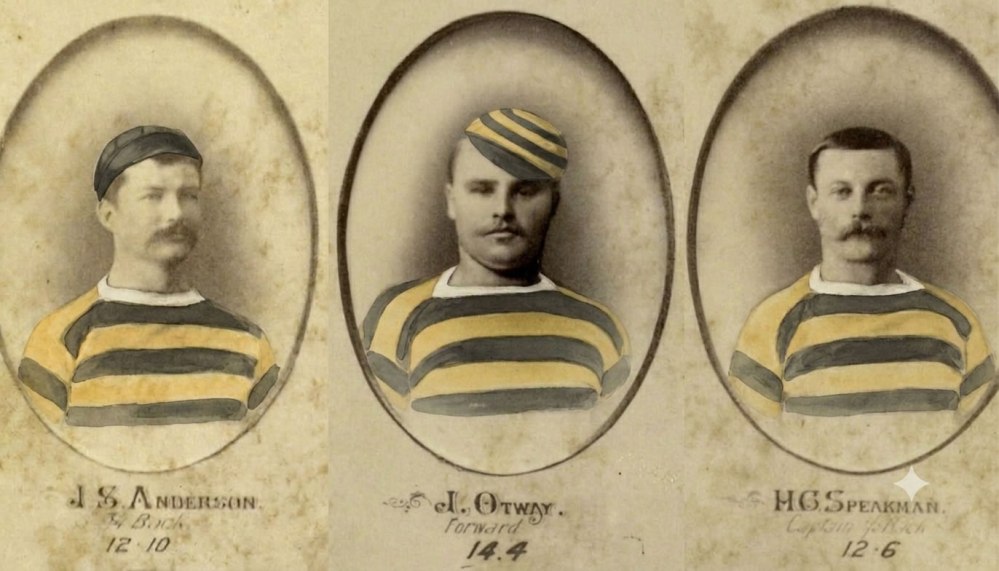
Alongside their foundation Melbourne rules trophy, the club soon boasted the inaugural Queensland rugby union club silverware by winning the Hardgrave Challenge Cup in 1890. This handsome trophy was presented by Wallaroo FC’s Rugby pioneer Frederick Hardgrave, for a club knockout competition, to be given permanently to the first club to win it twice. It was initially won by the Ipswich Rangers in 1887 and the Union Harriers in 1888. The Wallaroos claimed consecutive titles in 1889 and 1890, securing absolute ownership.
In the late 19th century, it was no easy task to keep a football club alive and to field a team once the core group of players and supporters moved on—whether by retirement, relocating for work, or joining the newly popular district, suburban, or school ‘old boys’ clubs
Ultimately, the Wallaroos outlasted all of their friends and foes. The pioneering Rugby clubs, Wanderers and Fireflies, both played their final matches in 1889, while the Wasps were done after the 1891 season. Meanwhile, Brisbane FC chose to stay loyal to Melbourne rules, a decision that led to their demise in 1886 as the code slid backwards. The QFA itself folded entirely after the 1890 season.
After the 1893 season, with no fanfare or newspaper reports, the historic Wallaroo club faded away. They had departed with Rugby now as the undisputed football code in Queensland and Melbourne rules extinct—a feat unlikely to have been achieved had St. Paul, Hickson, Hardgrave, and the others not pushed for their Melbourne rules Wallaroos “to have a little bit of Rugby”.
MORE WALLAROO FOOTBALL CLUBS
Other lesser known Rugby clubs that in the era up to World War One were called Wallaroo FC include NSW town’s Wickham c.1888, Dumaresq c.1895, Newcastle c.1900, Lithgow c.1902, Orange c.1912 and Braidwood c.1913, and in Queensland with Rockhampton c.1889 and Roma c.1906.
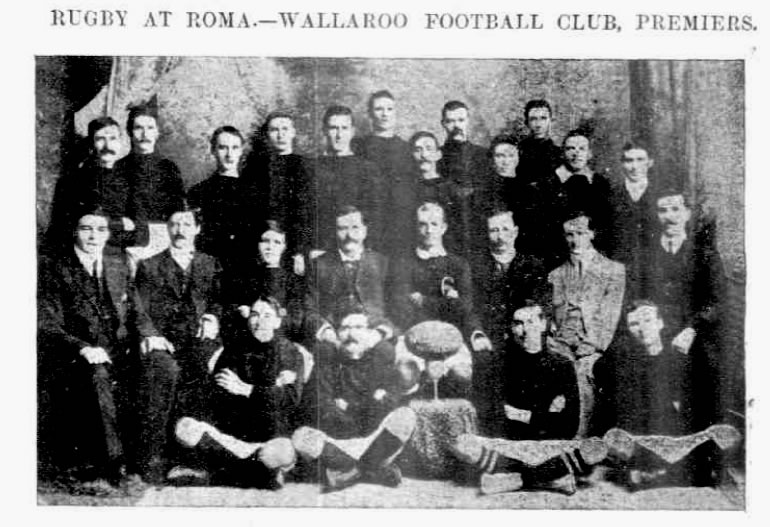
Very little records exist of any of these clubs, although in the case of Rockhampton, a six-way battle for the club’s name came down to two, as reported by The Morning Bulletin:
“Several propositions were made for naming the new club, and eventually they were narrowed down to two— the Mohawks and the Wallaroos. A vote resulted in the adoption of the latter, and this concluded the business.”
The Mohawks FC? The old boys of London’s famed Mohicans FC would have applauded that one!
HAIL, FELLOW WALLAROO! WELL MET!
- The present-day ‘Wallaroo FC’ (AFL) in South Australia was originally titled the ‘Wallaroo Bay Football Club’ until at least 1880 (The Wallaroo Times, 2 June 1880). Regrettably, the club long ago scuttled its Spencer Gulf smugglers-era title, trading the picturesque bay-wide name for simply that of the town alone. The local geographical meaning of the anglicised indigenous word ‘wallaroo’ has no connection to the Australian wallaroo marsupial, and the club’s mascot is a bulldog. The first clubs formally named ‘Wallaroo FC’ were founded in Sydney (1870) and Brisbane (1879).
- In 1905 the British crew of the Royal Navy vessel HMS Wallaroo, named after the town, played Rugby games at the Sydney Showground (against the Eastern Suburbs Juniors) and the Victoria Barracks (military teams).
- In the very first NSW (now Waratahs) vs Queensland (now Reds) match ever held in 1882, the opposing skippers were from the Sydney and Brisbane Wallaroo FCs—James Brodie and Arthur Hickson respectively. The Sydney Wallaroo FC co-founder, Richard Arnold, acted as the game’s sole umpire.
- In the match in Sydney in 1882 between the Wallaroo FC and the Queensland team, the visiting captain was from Brisbane’s Wallaroo FC (Arthur Hickson). In the two matches played in Brisbane between the local Wallaroo FC and the touring NSW team, the visiting NSW captain was from Sydney’s Wallaroo FC (James Brodie in 1883 and George Graham in 1885).
- The Rev. Matthew Mullineux (“the football-clergyman”) captained 1899 English football team (now the British & Irish Lions) faced members of at least three Wallaroo FCs in matches played in Goulburn, Maryborough, and Sydney. More than half of the Central Southern Rugby Union XV were men from Goulburn’s Wallaroo FC (who lost 11-3), while three players from Maryborough’s Wallaroo FC lined up for the city’s combined side (beaten 27–8).
- In the summer of 1870/71 a Wallaroo Cricket Club was founded in Sydney. The club endured until 1893. There is no known cross-over of personnel with the Wallaroo FC.
WallarooFC1870.com – All website text & content © Sean Fagan
[ site homepage ]

One Comment
Comments are closed.