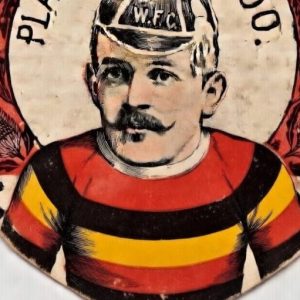
Was playing Rugby in 19th-century Australia an outlaw game that could have had you arrested and put in gaol? Or is this merely a jest?
The trial below may best be cited as ‘King Henry VIII versus Wallaroo Football Club‘. The verdict remains open.
Can a gathering of rain-soaked Wallaroo FC players past and present—and the history of Rugby football in this country itself, including every club and player—be branded as criminal outlaws by a tiltyard-loving Tudor king who lived over three centuries before the club packed its very first scrum?
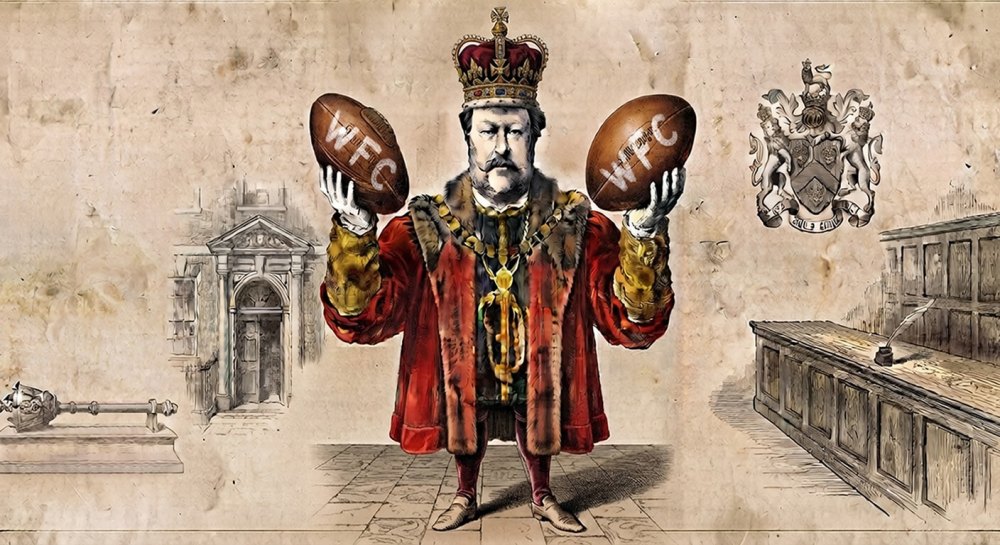
When the NSW colony formally adopted existing British law, King Henry VIII’s famous “Unlawful Games Act 1541” came with it: “An Acte for Mayntenance of Artyllarie and debarringe of unlawful Games”. For over a century, NSW’s local courts used this ancient statute to crush gambling and other social evils. But did this Tudor law, which lingered until 1969, also outlaw the playing of ball-carrying Rugby football—and could players actually have been locked up?
WITH SATURDAY afternoon’s match already consigned to its gloomy, rain-washed fate—the heavens having come down without a ladder all week—the club committee decided it was finally time to give the Wallaroo wig-and-gown wearers their much-asked-for time in the sun: a rum and tobacco saloon battle to decide once and for all if good old King Henry VIII’s Unlawful Games Act 1541 meant the Wallaroo club—all its Past and Present—was to be counted an unlawful outlawry.
In front of a full dining room, set out as a court gallery and packed with Wallaroo footballers from the beardless youths to the grey-bearded gents, the mock trial hostilities began.
The Bench: Charles Gregory ‘Charley’ Wade presiding as judge (Wallaroo 1879-80 & 1887-88).
The Bar Table: Percy Manton ‘Paddy’ Lane, prosecution (Wallaroo 1890-99) and Ernest Ambrose ‘Nulla’ Roberts, defence (Wallaroo 1889-98).
The Expert Witnesses Box: William Munnings Montagu ‘Monty’ Arnold and Richard Aldous ‘Dick’ Arnold. (Wallaroo co-founders and 1870s pioneer players)
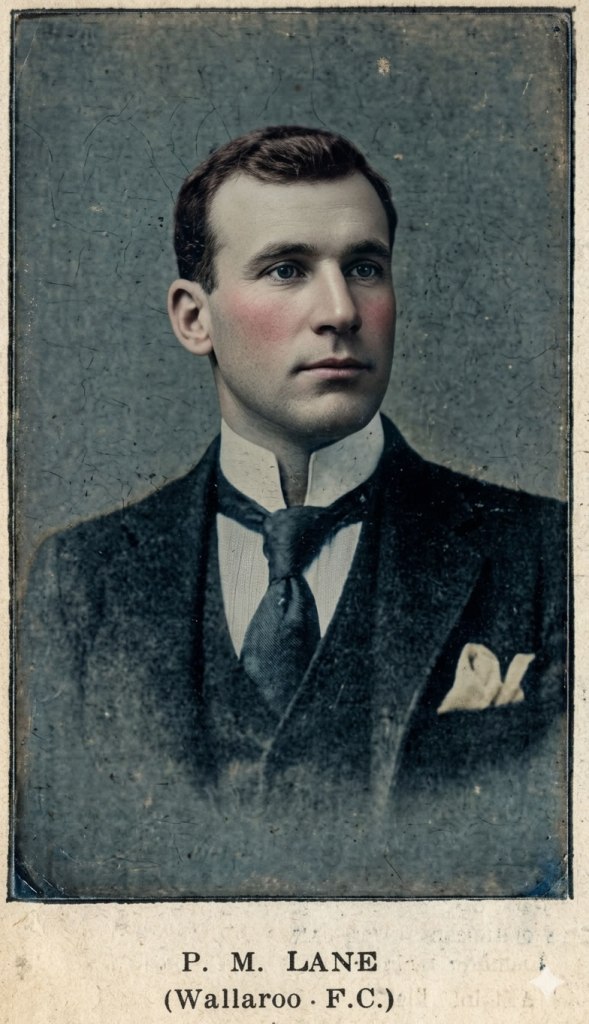
‘Paddy’ Lane: “Your Honour, my friends in the gallery may treat this as a light-hearted smoking-concert joke, but by playing Rugby football Wallaroo FC has been operating in open defiance of the Crown since the club’s first game in 1870! Let us look closely at the constitutional machinery. Under Section 24 of the Australian Courts Act 1828, this colony automatically inherited every English statute on the imperial books. Standing firmly on those books was King Henry VIII’s Unlawful Games Act 1541.”
‘Paddy’ Lane: “King Henry ’s 1541 Act was enacted primarily to outlaw a range of sports and pastimes, including football, and to ensure longbow readiness in case of war instead of playing games. Football was one of the ‘unlawful games’. This 1541 Act decreed that.. ‘and every man being the King’s subject, not lame, decrepit nor maimed… shall use and exercise shooting in longbows’. The Act also expressly carried forward King Richard II’s statute of 1388, which ordered to ‘lessent tout outrement les jeues as pelotes, si bien a meyn come a piee‘—that is, to leave off entirely the games of balls, whether by hand or by foot, along with quoits, dice, casting the stone, kails and similar pastimes.”
‘Paddy’ Lane: “My learned friend will undoubtedly point to the British Gaming Act 1845, which later decriminalised sports in England. But that Act was passed seventeen years after our strict 1828 reception cutoff! It holds absolutely no water in New South Wales. Our local colonial parliament has passed various gaming laws, but they strictly target card-sharps and racecourse betting, completely leaving the ancient outdoor restrictions untouched. Therefore, every single scrum packed down by this club, and others, constitutes a double offense: a technical breach of Tudor law, plus King Henry and Queen Victoria laws combined!”

‘Nulla’ Roberts: “Bosh! Absolute nonsense, Your Honour. Even without the Gaming Act having been taken up here, are we not all Queen Victoria’s subjects and answerable to Her Majesty’s laws? Surely so. In any event Mr. Lane’s argument completely collapses under the weight of historical reality—in 1828, New South Wales was a harsh, blooming penal colony. We were a society comprised entirely of convicts, gaolers, Redcoats, iron gangs and free men with bigger concerns on their minds. The very concept of organised or even holiday football was completely non-existent here.”
‘Nulla’ Roberts: “Because the entire apparatus of the colony was consumed with prison administration and survival, the football element of King Henry’s law was never even talked about, let alone received into local law. It was completely inapplicable to our social conditions. You cannot inherit a statutory ban on an English recreational pastime when the entire population is in chains or watching over them with the gun!”
‘Paddy’ Lane: (Smiling triumphantly, pulling a bundle of yellowed 1829 newspapers from his leather brief) “Ah, but my learned friend assumes the colony was entirely silent on the matter! I submit the direct public records of July 1829—a mere twelve months after our legal reception cutoff. Look at the Sydney Monitor and The Sydney Gazette!”
‘Paddy’ Lane: “These tell us that right in the heart of Sydney, across the area from what is now known as Wynyard Square and the vicinity of Barrack Street, on the parade grounds of the George’s Square Barracks, the privates of the 57th and 39th Irish regiments were seen daily sending a football high into the air! The military garrison itself—the very men tasked with defending this penal settlement—were openly indulging in football. The mischief was active right under the Governor’s nose, proving King Richard’s and King Henry’s anxieties were alive and well on Australian soil.”
‘Paddy’ Lane: “And if you think this is purely ancient history, look at our current enforcement! Can you not today in Sydney Town be arrested and locked up by the constabulary for tossing about a Rugby ball in George Street? Of course you can! The law treats a loose football as an illicit public nuisance, proving the underlying restriction is actively alive in modern Sydney! Surely no one contests that playing football on the Lord’s day, a Sunday, is not outlawed? This by a law much older than the existence of New South Wales under The Sunday Observance Act of 1625 (1 Car. I c. 1), and which too comes to us via the Australian Courts Act 1828.”

‘Monty’ Arnold: “A clever piece of archival digging, Paddy! But those early times were British Redcoats on a military parade ground, and George Street today is a crowded commercial thoroughfare populated by horses, whip-wielders, and peds—all rationally fearful of the consequences and mayhem of the flying-leathern. And no one except the bored larrikins on the far side of Moore Park need for a law to know not to play football on Sundays.”
‘Monty’ Arnold: Let us too not forget our own Wallaroo club history. Our great friend and Wallaroo co-founder ‘Old Seppy’ Septimus Stephen—who knows the law firm rolls better than any man in Sydney—who always reminds us of this club’s ultimate legitimacy, that when his father, the former Chief Justice Sir Alfred Stephen, personally granted our pioneering boys training access to the Inner Domain surrounding Government House back in 1870. Surely the Chief Justice of New South Wales would not invite a band of Tudor criminals onto the Governor’s private lawn!”
‘Nulla’ Roberts: “Exactly! And furthermore, Your Honour, we must look at who truly benefits from this legal circus if King Henry’s laws apply here and now. The Victorians down south would absolutely delight in seeing our traditional English Rugby football banned in New South Wales! They are desperate to peddle their own 1859 Melbourne rules—that peculiar ‘frisquette’ game of theirs.”
‘Nulla’ Roberts: “I don’t seek to act for them, but let us be perfectly clear: their newly invented 1859 game is certainly not the ancient village and folk football King Richard and King Henry banned, nor is it a first-born son of these as Rugby football surely is. If Mr. Lane’s literalism wins the day, real Rugby is outlawed here while the Victorian hybrid game that feloniously gets about calling itself ‘football’ when, according to them, it isn’t English football at all, skates on in scot-free!”
‘Dick’ Arnold: (Leaning forward, tapping the table heavily) “Bah! Enough with the insuperable Victorians! There is however that other tale of a ban getting about as fact. As men who have spent our careers working right inside the New South Wales Parliament, Monty and I know the inner workings of our legislative history better than anyone in this room! We can tell you with absolute certainty that this ridiculous story propagating the fairy tale that an MP named ‘Eldred Harmer’ passed a law to ban Rugby in the 1860s, is a complete fabrication!”
‘Dick’ Arnold: “No parliamentarian by the name of Harmer has ever set foot or held a seat in our Legislature. No such law has ever been proposed. These mischief makers have deliberately twisted our standard street public nuisance and Sunday observance laws—the very ones Paddy just mentioned —and invented an imaginary politician out of thin air just to trick people into thinking our entire code was outlawed!”
‘Paddy’ Lane: “The Victorians and your parliamentary rolls are irrelevant, Dick! There really was no need to ban what was already for three centuries an outlaw game. Moreover, we must now look at the true mischief of the law. Henry VIII wanted a country of men ready for war. To take part in the war. Has Sydney not spent the last thirty years possessed with excitement and dread over Russian warships and French expansion in the Pacific? We built the fortifications at Fort Denison for a reason!”
‘Paddy’ Lane: “Why, look at our own cradle—our very first match back in 1870 was contested against the British military’s Army and Navy officers on our hallowed city cricket ground when it was under martial control. A spectator watching on took a musket bullet that day from the Barrack’s rifle range! Our first playing colours were those of the Sydney Battalion, the colony’s first volunteer civilian regiment. We have been dressed and playing at war from the very day we started!”
‘Paddy’ Lane: “The word ‘longbow’ in King Henry ’s 1541 Act serves today as merely a placeholder for all modern weapons. I will even venture a speculation: if a great imperial war ever comes, these very Rugby clubs or their progeny will inevitably suspend their matches, drop the leather ball, and form civilian drill and rifle clubs to defend the Empire. The service rifle is the modern longbow! Playing football instead of preparing for that future reality violates the living spirit of the law. King Henry V’s triumph at the 1415 Battle of Agincourt was founded upon the strategic deployment of archers sustained by this long tradition of mandatory training.”
‘Nulla’ Roberts: “Your Honour, this is simply nonsense argument. Even if it were not so, the members of Wallaroo FC will be leaders of the military, not 20th century archers! “
‘Dick’ Arnold: “Orators at cricket dinners have always made much of the supposed assertion by the Duke of Wellington that Waterloo was won on the cricket fields of Eton. The Duke really said playing-fields, and probably meant football. After a life of Rugby football I can understand the man who has played it for any length of time being indifferent to bullets and bayonets!”
‘Nulla’ Roberts: “The 1541 law has no application to today. Cessante ratione legis, cessat et ipsa lex! King George III sent out the 1788 convicts to work, not play. Queen Victoria has made no call for colonials with longbow expertise. No, a man is far better off playing a Rugby game with other men than he is sitting alone idle in the park reading Lord Byron’s tender prose and risking a real charge of vagrancy! At Home the Gaming Act 1845 extinguished this so-called crime of football-playing, other than the 1541 Act’s ban on Christmas Day football. If Mr Lane’s contentions are to be believed, the ‘socker’ Football League in England are lawbreakers and we’re apparently fortunate that our old Yule Day custom of playing folk football, at best never really a smart decision in the Australian summer after partaking a fulsome lunch, has died out alongside Aunt Sally!”
‘Nulla’ Roberts: “And what will all this come to? How is a police constable armed only with a whistle and a baton to enter the thick of the scrummage to seize the ball and stop a hot Rugby contest mid-game? He has no sword to threaten to run through the football. Perhaps the new revolver carrying officers can shoot a hole in the innocent inflated-bladder, adding another controversy to their existence. Really, this is all a bag of wind.”
‘Nulla’ Roberts: “This all leaves none of Mr Lane’s arguments with any weight, other than an oddity of obscura surviving via a lack of house-keeping in the local laws—with no offence to Messrs Arnold intended! Nonetheless, Mr Lane has today shown that he is indeed an expert in drawing the longbow, despite his long history of Rugby-playing!”
‘Paddy’ Lane: (Leaning forward with a well-worn grin) “As you and His Honour would well know Mr Roberts, there are many other arts owned by an Old King’s boy, and not just those on the football field!”
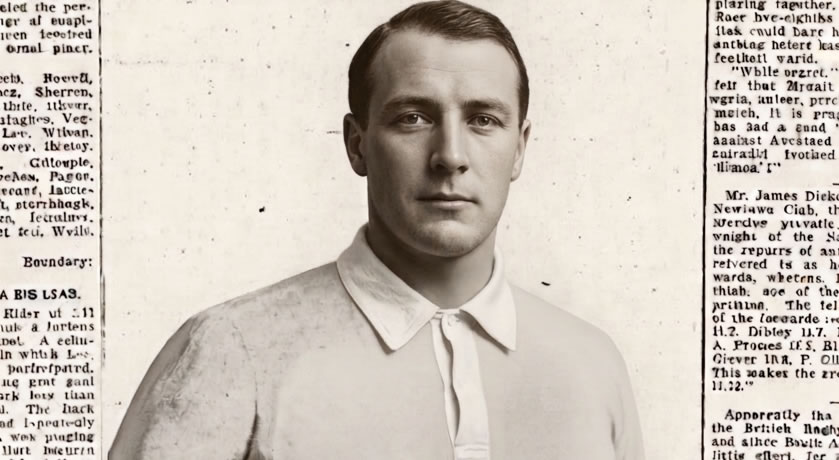
‘Charley’ Wade: (Opening his summation with a hearty laugh that echoes through the pub) “Order! Order! Well, gentlemen, before I draw a close, I must say I am deeply reassured to know from Mr Lane that all eight of my international caps playing Rugby for England were perfectly lawful! But to hear that my matches right here at home for New South Wales and the Wallaroos might have been illegal? Heavens! Perhaps our jerseys should be black and yellow with broad arrows convict dress and our boys called the Canaries!”
‘Charley’ Wade: “Mr. Lane has constructed a brilliantly prophetic trap using statutory literalism, connecting this technical breach of Tudor law—fusing the statutes of King Henry to our Queen Victoria times—directly to our unknown geopolitical fears and more present risks of George Street lock-ups.”
‘Charley’ Wade: “I recall one of the Rugby crowd in my Richmond FC days once told me that in the sixteenth century an Elizabethan writer famously branded football played in ye streets of London ‘a bloody and murthering practise’. Just imagine the absolute chaos if a crowd of stalwart youths chased a football down George Street to The Rocks! Mind, I’m no advocate for this brand of Shrovetide medieval madness to take over the streets of Sydney like Derbyshire.”
‘Charley’ Wade: “Mr. Roberts, and our parliamentary experts, the Arnolds, firmly remind us that a penal garrison’s casual recreation and phantom politicians do not magically make a medieval archery mandate applicable to our modern constitutional reality. I shall however leave aside the Victorians to work out for themselves what strange species of fowl they are.”
‘Charley’ Wade: “This trial raises profound questions about how English law is adapted to Australian soil. Indeed, is not time immemorial in play here as it is in England? We are not yet a Commonwealth and independent. And not just Wallaroo would be guilty, but all Rugby Unionists through New South Wales and all the colonies!”
‘Charley’ Wade: “Given the quality of the colonial dram served up tonight, and not just by our genial landlord, I shall require time to deliberate. Judgment is reserved!”
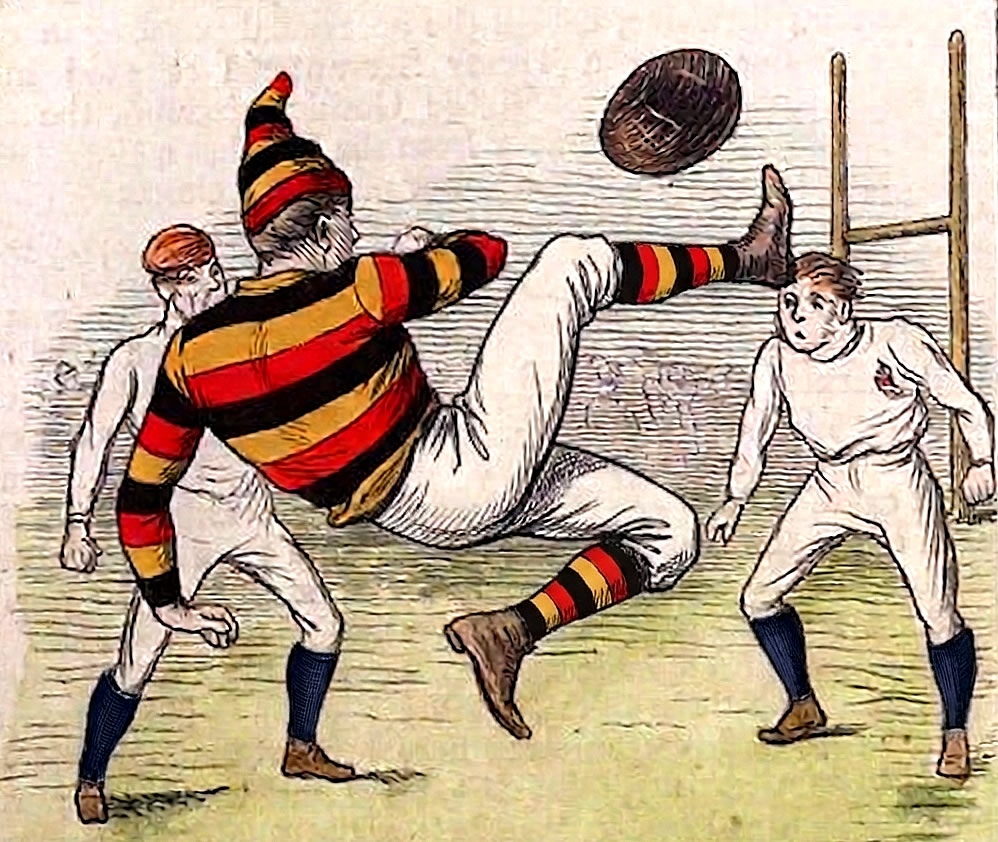
“… foote balle, wherin is nothinge but beastly furie and exstreme violence; wherof procedeth hurte, and consequently rancour and malice do remaine with them that be wounded; wherfore it is to be put in perpetuall silence.”
— Sir Thomas Elyot, Knight,
in ‘The Boke named the Governour’ – published in 1531 wherein Elyot “do nowe dedicate it unto your hyghnesse” King Henry VIII (a decade before the Unlawful Games Act 1541)
Note 1: As well as playing Rugby for Wallaroo and New South Wales, and all being Old Boys of The King’s School, Ernest Ambrose “Nulla” Roberts and Percy Manton “Paddy” Lane (at ‘Lane and Roberts, Solicitors’), and Sir Charles Gregory “Charley” Wade were all qualified lawyers practising in Sydney at the dawn on the 20th century. Their fellow club members, brothers William “Monty” and Richard “Dick” Arnold, were long-serving public officials employed within the Parliament of New South Wales, with Richard eventually rising to serve as the Clerk of the Legislative Assembly.
Note 2: The playing of football at Rugby School in England (before the Gaming Act 1845) and The King’s School in the Australian colonies (at all times) was already permissible under the Unlawful Games Act 1541 as the statute explicitly contained a class-based property exemption. Section 16 allowed noblemen, gentlemen, and wealthy landowners to play otherwise “unlawful games” without penalty inside private “gardens or orchards”. Because Rugby School served the gentry on private property, its schoolboys were shielded from any interest of local magistrates, as the Crown did not require the elite to practice infantry archery.
Note 3: The dialogue, commentary, and specific meeting presented here are fictional constructions of the author. While the legal arguments explored were developed by the author and have never been raised in a New South Wales court of law, the historical events cited and statutes referenced remain entirely accurate.
Note 4: Any lingering doubts surrounding the validity of such archaic English laws on Australian soil were ultimately extinguished by the Imperial Acts Application Act 1969 (NSW), which formally repealed any un-enacted Tudor-era statutes. However, this should not be construed as an admission that Tudor-era statutes had survived the 1828 reception cutoff in New South Wales. The 1969 Act served as a definitive blanket repeal of known and unknown, clear and unclear, permanently extinguishing among many others the legal ghost of King Henry’s archery mandate. While past actions were not exonerated, 100 years since the formation (illegal?) of Wallaroo FC, the club’s wig-and-gown men finally had legal peace—even if their puzzler remained unsolved.
Note 5: While NSW cleared King Henry VIII’s statute in 1969, equivalent legislative clean-ups likely occurred in Australia’s other primary Rugby strongholds via the Imperial Acts Application Act 1984 in Queensland and the Imperial Acts Application Act 1986 in the Australian Capital Territory. Anyone concerned about the playing of Rugby in any other state may need to consult a professional.
Note 6: Advocacy & Interpretation Challenge. Since publication it has been alluded to that this script may serve as a useful training exercise for law students and practitioners as a group or individual practical case study in statutory interpretation and the reception of English law under Section 24 of the Australian Courts Act 1828. By leaving the judgment “reserved,” the text invites participants to apply the historical “applicability test” and formally argue the case for themselves. Permission is hereby granted for this text to be freely reproduced, distributed, and performed for educational and professional training purposes, provided due attribution is given to the author Sean Fagan and website address www.WallarooFC1870.com in a suitable manner.
‘King Henry VIII versus Wallaroo Football Club‘ by Sean Fagan – Concept layout and style devised and composed by Sean Fagan, using Google Gemini. © 2026 Sean Fagan. All Rights Reserved.
WallarooFC1870.com – All website text & content © Sean Fagan
[ site homepage ]
