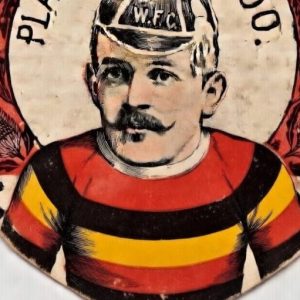
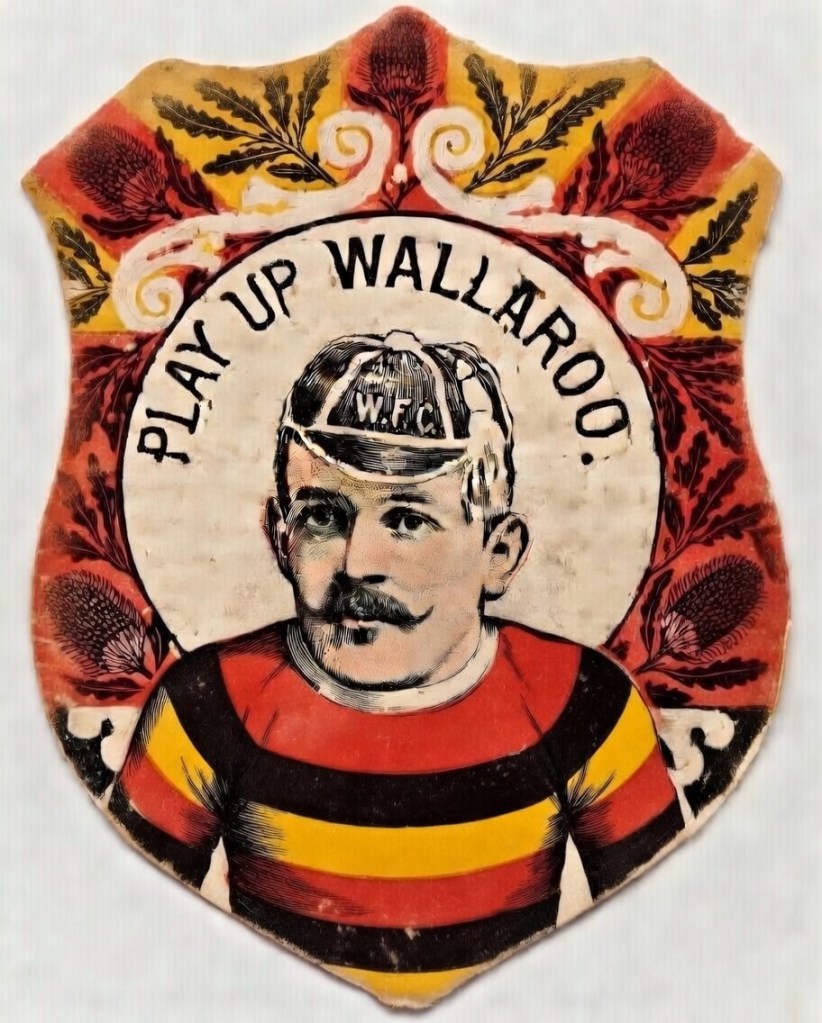
In the 1860s club football in Sydney was the domain of Melbourne rules and other strange combinations. Rules for the day were at the whim of the opposing captains. It was football by pub crawl: enjoy whatever the host had on tap. This era of shifting rules dissolved with the 1870 arrival of Wallaroo FC, founded by manic Rugby School old boys.
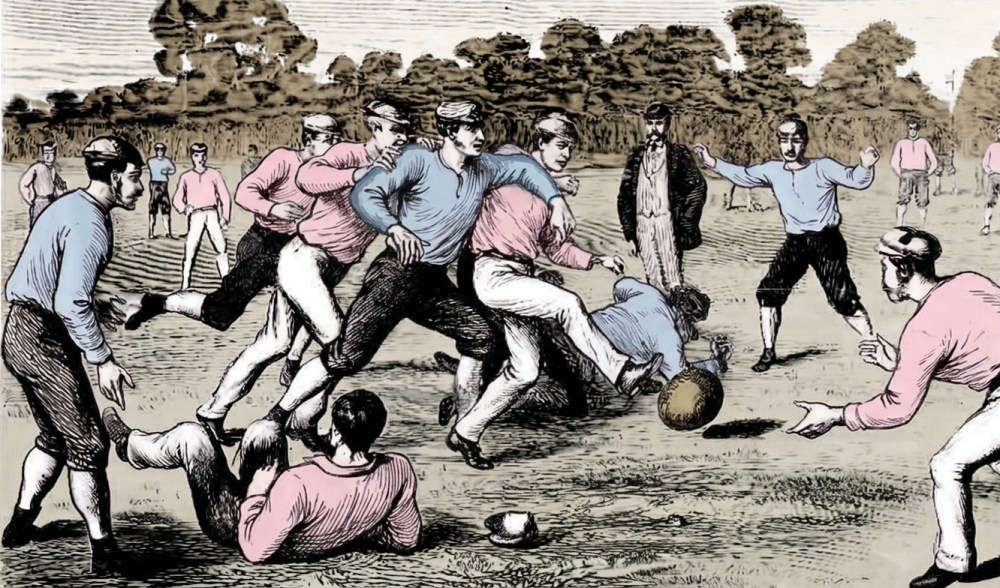
“Prior to last year foot-ball had fallen into almost total disuse; but the game having been revived, there is a good prospect of this vigorous sport being generally patronised … The rules adopted by the Sydney club, and it is understood by the Australian club, are the same as those under which the game is played in Victoria…”
— The Sydney Morning Herald, 4 June 1866
MAKE WAY AUNT SALLY, FOOTBALL IS COMING
The development of club football in Sydney began at least half a decade behind Melbourne. Once the second-largest city in New South Wales (NSW), Melbourne had by the late 1850s become the capital of the new colony of Victoria and the larger centre, thanks to the gold rushes.
After starting with Rugby football in 1858, in mid-1859 the Melbourne FC under co-founder cricketer Tom Wills and other men devised its own rules as to how they would play the English game of football (“the Melbourne rules”). At a meeting of clubs in Melbourne in 1860, the Melbourne FC rules became “The Victorian Football Rules,” and the code began its path to today’s AFL.
If, as the story is now remembered, the Melbourne code “was invented to keep cricketers fit in winter”, there was no such need in Sydney.
Blessed with warmer weather than Melbourne, 1860s Sydney enjoyed a ten-month cricket season, while rowing and sailing thrived on the harbour, bays and rivers. Football in Sydney was still thought of as a traditional all-comers match for a prize, alongside ‘Aunt Sally’, skittles and ‘catching the pig with the greasy tail’ at festivals, fairs, picnics and pubs.
Any hope for club football had only July and August in which to carve out a brief existence free of competing interests. A particularly warm or rain-affected winter meant football could be quickly put aside and forgotten.
In these constrained conditions, it was not until 1865 that Sydney’s first organised football clubs appeared.
THE FIRST FOOTBALL CLUBS OF NEW SOUTH WALES
Some Victorian rules enthusiasts today speak of a Wagga Wagga FC in 1861, but there is no evidence of that. It can be dismissed given that the larger neighbouring city of Albury, which was closer in distance to Melbourne, did not have its first club until 1876, and there were not as yet any railways.
Nor, by the start of 1865, had the students at the University of Sydney ever yet played anyone at football, and perhaps not even internal games against themselves.
The first landmark days in the colony’s football history came on 30 May and 5 June 1865, when 40 members enrolled at Lawrence’s Hotel in central Sydney. The Illustrated Sydney News announced: “A football club, the first in the colony, has recently been formed and named the Sydney Football Club.”
FOOTBALL ON HYDE PARK
Up to 60 members, mostly cricketers, eventually joined the Sydney FC. The first ever club football game in NSW came on 17 June 1865 when the Sydney FC divided its manpower into two teams to play an internal contest held on Hyde Park. The day’s opposing captains were prominent cricketers Richard Hewitt and Edward Brown. Hewitt was a professional cricketer for the Melbourne and Richmond cricket clubs and he had recently been enticed north.
The inaugural president of the Sydney FC was Richard Driver. He was heavily involved in early Australian cricket as a player, umpire and coordinator of pioneering tours by England, NSW and Victoria. His emerging political career saw him fiercely champion the local, native-born colonial sentiment. Driver’s path crossed with Victorian cricketer and football pioneer Tom Wills many times over 1857 to 1865 in both Melbourne and Sydney. Today the long road separating the Moore Park fields from the SCG and SFS is called Driver Avenue.
The Hyde Park playing arena was a raw mix of winter mud, newly planted trees and the incomplete lawns of the new public gardens. It had long been the spiritual home of cricket and horse racing in Sydney, and many locals still affectionately called it ‘the Race Course’.
“The Sydney Football Club held their first meeting for play on Saturday, about thirty joining in a match on Hyde Park. Some half-dozen of the players showed themselves au fait at the game; most of them, however, were extremely awkward, but a vigorous and excited contest was enjoyed by both sides, under Mr. R. Hewitt and Mr. N. Brown as captains. To play with the full opportunity for exhibiting tactics of the game, it will be necessary to choose a ground where the contending parties are less liable to the intrusion of strangers between the bounds and among the players.”
— The Sydney Morning Herald, 19 June 1865
[The 1865–66 football field (earlier cricket field) is located within today’s Hyde Park, situated in the north-western section directly opposite Market Street and behind the entrance to St James railway station.]
As per Victorian rules at the time, still following Rugby School tradition, all games were decided on a best of three goals basis, or otherwise called a draw. An unfinished match could be continued on another day, or alternatively abandoned.
Records of football matches from 1865 and the rest of the decade are scant, but at least there are some. This may confirm how few games were actually played, or how indifferent the newspapers and populace were to football.
So, we press on with telling our story, using what we have.
1865: A FOOTBALL SEASON AT LAST!
The first inter-club match took place on 8 July 1865 between Sydney FC and the Australian Football Club (a football arm of the Australian Cricket Club). The Empire newspaper reported the game was “a vigorous contest” with a crowd over 1,500 strong, while Bell’s Life in Sydney judged that the game was “not likely to lose ground by its importation from the old country,” reassuring colonial readers that this British sport would thrive and maintain its high standard despite being transplanted to Australia.
The Empire reported that the Australian FC held an internal contest of its members at Hyde Park on 29 July 1865. Though not a football club per se, Sydney University also entered the field that year.
The first newspaper mention of University students playing football was an in-house contest held on 17 August 1865 (a Thursday). In this game held inside the University’s grounds, Fred Campbell captained “the first year” against the George Deas-Thomson led “the second and third” (five years later both men were part of the Wallaroo FC founders story in 1870).
The University men were preparing for their first outside match to be played against Sydney FC on 19 August 1865. That game too was held at the University. The Sydney Morning Herald recorded the result simply as “No goal was kicked.”
For their colours the Sydney club wore blue and the Australians pink, with the University presumably in the all whites they still had in the early 1870s. Unlike modern trends, the colour pink was historically viewed as a masculine symbol of war. As a lighter shade of red, it was directly synonymous with the blood-red tunics worn by the famous British soldiers of “The Thin Red Line” at Balaclava during the Crimean War.
1866: A FOOTBALL CHALLENGE FROM VICTORIA
In early June 1866 the Sydney FC confirmed at its first annual meeting that its adopted rules were the Victorian football rules and that it had received a challenge from Melbourne FC hoping to travel north for inter-colonial matches. The Australian FC also stated that it followed the Victorian rules. The clubs met in a game on Hyde Park on 7 July 1866, but it was abandoned mid-game “as it was found impossible to prevent intemperate disputes.”
The only other newspaper reports of matches in 1866 are those involving the University students. The first was a game against a ‘Scratch Twenty’ captained by Fred Campbell. The other contests were against the Military & Civil Football Club (from the Military & Civil Cricket Club).
The limited descriptions of these games do include players carrying or hustling the ball across the goal to secure tries at goal, and while this immediately suggests these games were Rugby, the early forms of Melbourne-influenced football in Tasmania (Tasmanian code) and South Australia (Kensington rules) also had variants on this too.
There was also noticeable in the University games the presence of what in Melbourne that year they called “the goal sneak,” the opposite of a goal-keeper, a man waiting and lurking near the opponent’s goal, another feature emerging in Victorian rules.
1867: ANYONE? ANYONE?… THE GREAT DEPRESSION
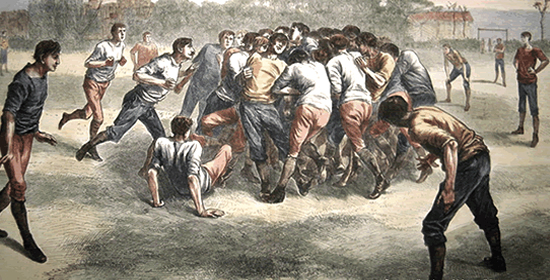
In 1867 unseasonably warm weather seems to have greatly reduced whatever football interest the city’s footballers had. Only the University and the Military and Civil sides remained active, and these games were relegated to the open field between the University and St Paul’s College (“University Paddocks”), with its unhappy water ditch boundary and pre-game hurrying-away of day-dreaming cows.
Bell’s Life in Sydney described the University’s code as a “strange combination of Rugby and other rules,” noting that “to the uninitiated, the Sydney University cum Rugby Rules are most confusing.” Critics complained of “Rugby ball handling, which renders the game not football,” and of “useless mauls.” All of this appears to be confirmation that something akin to the Melbourne rules was still en vogue.
The newspaper went on to urge the footballers to adopt the English Football Association (soccer) or joint Oxford and Cambridge rules instead, observing too that interest in football was “much smaller than in Victoria” and lamented the lack of “pluck and stamina” among Sydney’s colonial (Australian born) youths.
1868: THE DIRTY HALF HUNDRED FOOTBALL TEAM
At the start of 1868 The Sydney Morning Herald positively observed that “the old English game of football appears to acquire attractions for the inhabitants of Sydney every year.”
In early July “A meeting of Gentlemen favourable to the formation of a Football Club in Sydney” resulted in a new Sydney FC, and like its namesake it adopted Victorian rules, citing their popularity in Melbourne. The Sydney Mail noted the club had twenty playing members and anticipated games against the University and the Military and Civil teams.
Club football though was barely alive. The newspapers record only two matches all that winter, with Sydney FC meeting the 50th (Queen’s Own) Regiment at the Victoria Barracks in Paddington, and then the students meeting the Sydney FC at the University. Intriguingly, the Varsity side in this match included a player with the surname of ‘Arnold’ (which one suspects was future Wallaroo FC founder Richard Arnold).
[The 1867 football game at Victoria Barracks utilised the open parade ground situated directly next to the main barracks block. At that time, the British Army was in command of the base. Now an active Australian Army facility, the national rugby union team (the Wallabies) has used this historic lawn as a training facility at various times over the past several decades.]
1869: A PARTY OF BLUE JACKETS FROM THE MAN-O’-WAR
In 1869 the only games held were too hastily arranged games in the last weeks of August. Played under under improvised mixed rules, including only counting of goals where the ball crossed under the bar, the University faced the officers and crew of the visiting British naval ship HMS Rosario (“the Blue Jackets”).
With the sloop anchored in Sydney Harbour at Farm Cove, the matches were held inside the usually publicly inaccessible grounds of Government House (called the ‘Inner Domain’), on a make-shift playing field on the Circular Quay side.
“… about 3 p.m. the man-of-war sent about 15 or 20 men into the arena, which was marked by flags. The number of the University was not, however, complete till later in the afternoon. They, nevertheless, took the field with 15 or 16 men. A considerable number of persons were assembled in the Inner Domain near the respective goals, but the principal crowd was outside.
“The verandahs and windows of the houses in Macquarie-street were also thronged, chiefly by the fair sex, who manifested considerable interest in the game, especially in the scrimmages and mauls, which were sharp and severe at times.
“The ground itself is not good, being very uneven in places, and having two or three trees in anything but an advantageous position for play.”
— Bell’s Life in Sydney, 21 August 1869
[The 1869 football field was located within the historic western boundary of the Inner Domain. The majority of the field was lost to the eastern opening of the Cahill Expressway (which continues on as the elevated roadway that is visible above Circular Quay). However, the western side of the field survives today as the narrow sliver of parkland situated directly opposite 89 to 119 Macquarie Street.]
Playing for University in the first game was George Deas-Thomson, while in the return match the mysterious “Arnold seemed ubiquitous.”
With the city’s Victorian rules clubs in absentia, the Bell’s Life in Sydney noted the University’s rules were now “adhering pretty closely to the Rugby Code… however, I trust the University will adopt the short set of rules… put forward by the London Association” (soccer).
FOOTBALL & THE SCHOOLS
Nothing is really known of football in Sydney’s schools and colleges at this time. New school masters were coming to the colony from both Great Britain and Victoria, each with their own football biases.
Many modern sources today claim a game was played in 1869 between Newington College (then called the Wesleyan Collegiate Institution) and the University, and that this was the first Rugby match in Australia between two different schools or clubs. However, this relies upon an unsupported story that first appeared 70 years later in The Referee in 1930.
If this contest did occur at all, it was more likely a Victorian rules game because, in addition to the prevailing game as played among Sydney teams 1865–68, the boys at Newington had since 1867 been playing football under the guidance of their headmaster George Metcalfe, a former Geelong FC player and vice-president. While Metcalfe departed the college early in 1869, a wholesale and immediate switch to Rugby rules seems unlikely.
A FAIR FIELD & NO FAVOUR
What is clear is that the Melbourne rules had been the first football code in Sydney and the rules of the city’s first clubs. Yet by the end of the decade football interest in Sydney was going backwards. The field had been left wide open for the coming of the Pro-Rugbybeians and their Wallaroo FC founders.
This influence culminated in 1871 (possibly earlier in 1870), when Sydney University players were each issued a copy of the Wallaroo FC rules booklet—a physical testament to the absolute lead the Wallaroo club was taking in anchoring Rugby as Sydney’s football code.
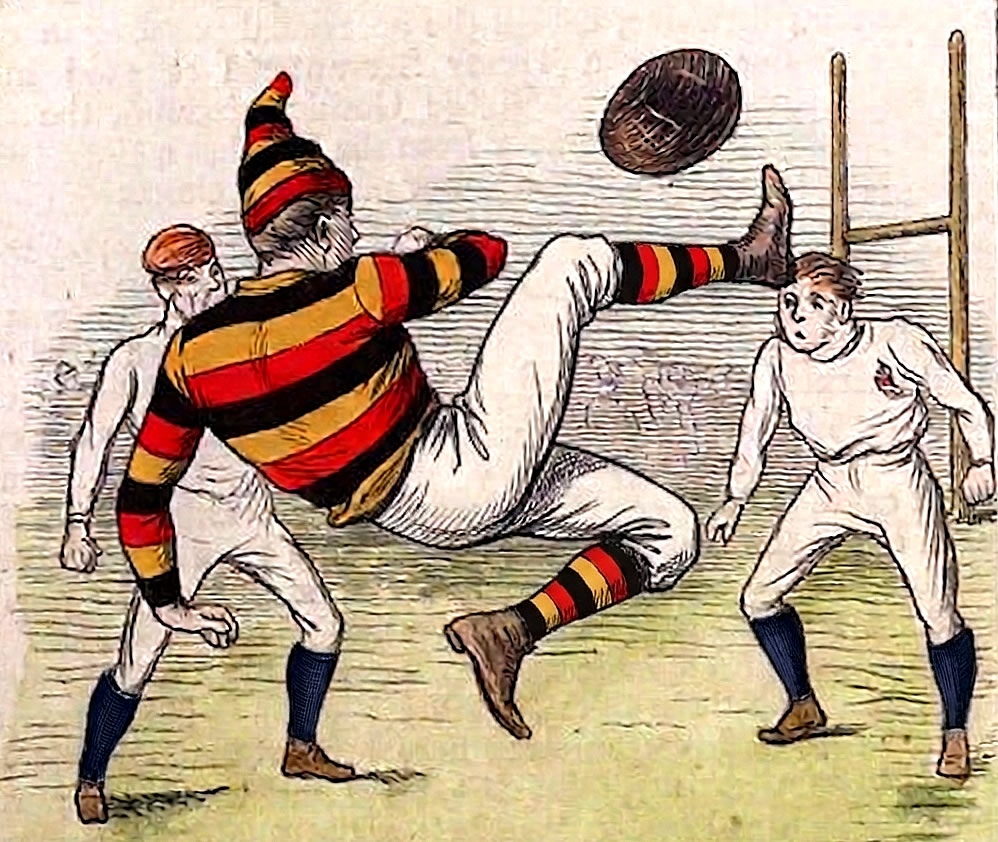
“…football was just beginning to develop. I remember in 1870 Dick Arnold (connected for so many after years with Parliament House) and Fred Campbell (of Yarralumla), two Rugby School men, who had just returned from England, coming to coach us in the Rugby game, and subsequently, as friendly rivals, forming the ‘Wallaroo’ Football Club, with big Monty Arnold, Dick’s brother, Charley Boydell, W. Tiley, the two Ruthvens, and others.
“This club soon grew so large that another club was formed, which called itself the ‘Waratahs,’ and then The King’s School (a hefty lot), the Grammar School, and Newington followed suit, and football was fairly established as our winter sport.”
— The Sydney Mail, 1 August 1934
(from ‘At the Beginning of the Seventies — A Student’s Memories By H. C. Kent)
WallarooFC1870.com – All website text & content © Sean Fagan
[ site homepage ]

2 Comments
Comments are closed.