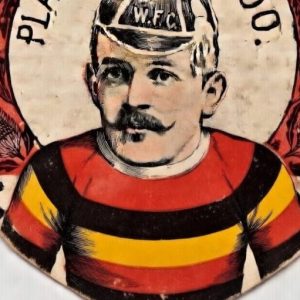
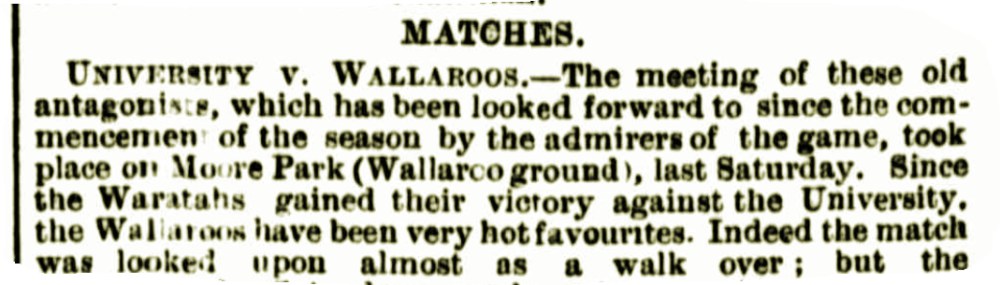
The Wallaroo Club had its playing-ground on Moore Park. Today this precinct is the home field of the Waratahs, Sydney Roosters, Sydney FC and Swans. For generations, it has been the scene of untold club and representative football memories for Sydneysiders. All thanks to the Wallaroo FC, who first imagined and made Moore Park a football citadel.
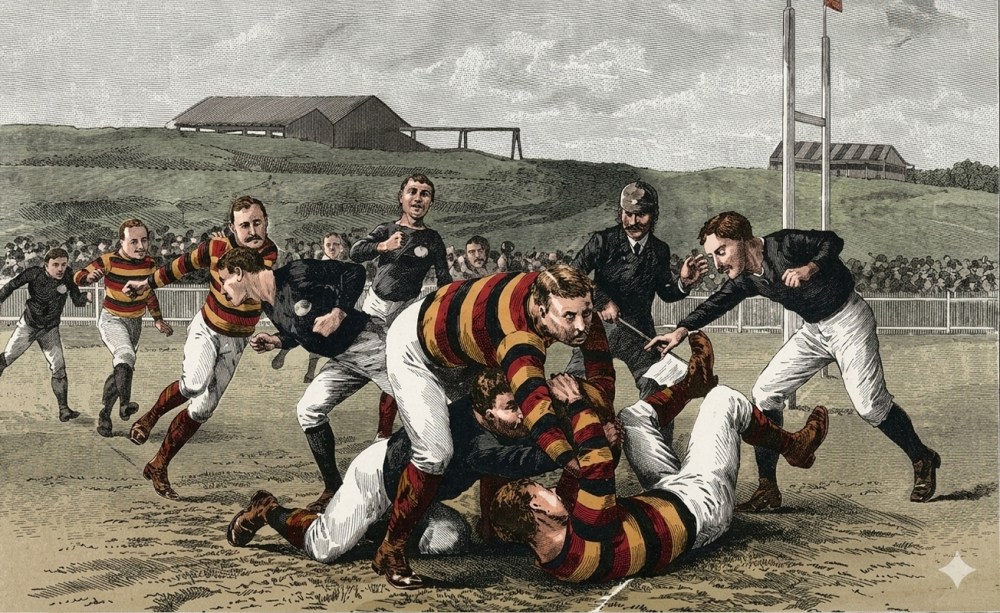
“The Wallaroo Club had its playing-ground on Moore Park. It was in the north-eastern corner, just as you come in the gates opposite the Captain Cook Hotel, running parallel to the Randwick Road.
— Walter Bethel, “Footballers of the ‘Seventies”, The Sun, 17 August 1940
MOORE PARK: EPICENTRE OF FOOTBALL
Moore Park in Sydney stands as the undisputed grand epicentre of Australian sport — a vibrant precinct where the headquarters of the NRL, Rugby Australia and Football Australia sit alongside three of the nation’s most iconic arenas: the historic Sydney Cricket Ground (SCG), the world-class Sydney Football Stadium (SFS), and the old Sydney Showground.
Walk along Driver Avenue or through the Entertainment Quarter and you pass the high-tech nerve centres of those codes and the home grounds of the Sydney Roosters, Sydney Swans and Sydney FC.
The Moore Park precinct is the stage upon which many of the greatest Wallabies, Kangaroos and Socceroos have worn the green and gold (and other colours before that). It has hosted a lifetime of grand finals across all codes, inter-state rugby union and rugby league matches, and the first decades of State of Origin. Of course, The Ashes cricket and other internationals too.
Yet long before the towering grandstands and elite franchises, this was open, unused common land. In the late 1860s the future SCG — then known as the Military and Civil Ground — was there, but little else.
FOR THE COMMON PEOPLE
This story begins in 1811, when NSW Governor Lachlan Macquarie dedicated a vast expanse of land as the Sydney Common “in trust for the benefit of the present and all succeeding inhabitants of Sydney”. Broadly speaking, this “inheritance of the city” is collectively today’s Centennial’s Parklands (Moore Park, Centennial Park and Queen’s Park), the SCG, SFS and Victoria Barracks.
In the early 1840s the portion of the Common that comprises Victoria Barracks and its grounds was granted by the Board of Ordnance in London for the British Army Garrison. The decision was made to relocate the Garrison out of downtown Sydney, where its buildings and parade grounds occupied valuable real estate and the soldiers were too close to local temptations. What remains of their original barracks site is Wynyard Square in York Street.
After Victoria Barracks opened, the Garrison received further lands to the south, which they developed into a rifle range (now the site of the SFS) and a cricket ground (now the SCG). By the time of Federation, only the Barracks site itself remained under military use; it was transferred to the new nation’s Department of Defence and remains so today.
HILLS OF WHITE SAND
By the late 1860s the City Council had become custodians of the western half of the Common (the eastern side later became Centennial Park). It was a long way from a pleasure ground — an eyesore of uneven land, sand hills and drifts, swamps and largely unusable ground.
Commencing at the nearest end on the southern outskirts of the city, under Mayor Charles Moore the Council began a long programme of improvement to create grassed and tree-lined parkland for the recreational use of citizens.
“Sydney’s Mayor, in 1867-8-9, was Mr. Charles Moore, and this public-spirited citizen made the discovery of documents that revealed the fact that the Common had been actually vested in the municipal corporation. Up to this time the prevailing idea was that the Common was simply Crown land.
…
No time was lost by Mr. Moore in rehabilitating this waste. Fences were erected, trees were planted, the new name of Moore Park conferred, and Mr. Moore himself appointed to the Legislative Council for his civic achievement.”
— The Sun, 17 October 1931
In April 1867 this part of the Common was re-named Moore Park in honour of the Mayor under whose stewardship the improvement works were begun, after other names — including Sydney Common, ‘People’s Park’ and ‘The Olympic Park’ — had been considered.

THE SCG’S FIRST FOOTBALL TEAM
In their debut matches of 1870 the pioneer gentlemen of Wallaroo FC played on the Garrison’s cricket ground (now the SCG). The first year of the Wallaroos coincided with the last of the British “redcoats” in Australia, who had held control and protection over Sydney since the 1788 First Fleet landings.
But years before it was hallowed turf in form and tradition, the SCG had proven a winter-long bogged meadow for the footballers. This added to the risks of slip falls and injuries. The playing area was also far too small for Rugby football.
The SCG was not an enclosed ground and had nothing else but a rudimentary pavilion. With the last of the British Army men having departed NSW, any immediate prospect of the ground being improved was doubtful.
While Sydney was not short of parkland, authorities had warned footballers off Hyde Park and The Domain in the late 1860s; attempts to play there had been shut down.
ON THE WALLAROO GROUND, MOORE PARK
On their way to and from the SCG in 1870 the Wallaroos walked past the first completed renovated section of Moore Park. This new parkland was the part running between the Surry Hills terraces on South Dowling Street and the long stretch of Randwick Road (now Anzac Parade). It offered sufficient space and evenly grassed ground for a football field. Today it is known as Moore Park West.
The Wallaroos contacted the city’s mayor, Michael Chapman, and gained approval to play on the new parklands. They laid out the Rugby field north-south, with the eastern touchline running alongside Randwick Road. There were no changing facilities, but through “the courtesy and kindness” of Rugby School old boy Lieutenant-Colonel John Soame Richardson — NSW’s military commander now in charge of the former British Army facilities — the team was allowed continued use of the SCG’s modest pavilion.
Football in Sydney was not yet a spectator sport, and no one contemplated the Wallaroo FC taking a lease over the SCG and turning it into a Rugby facility. The NSW government had given no consideration to the future of the ground, and the club had no money even if such grand schemes had been voiced.
The first game of the Wallaroo FC on Moore Park was a 15-a-side match held on 7 July 1871 against the “citizen soldiers” of the No. 10 Battery of Volunteer Artillery, based at Victoria Barracks.
“…the days of the wide-open fenceless fields at Moore Park, where the rugged Wallaroo giants of old used to tackle…”
— The Labor Daily, 17 February 1938
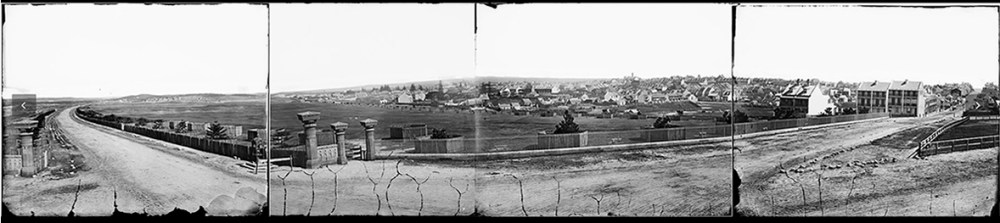
Viewed from cnr Flinders St & Moore Park Rd (present day Captain Cook Hotel), looking in south-western direction. The first panel shows Randwick Rd (now Anzac Pde). The Wallaroo’s field with un-roped goal posts is seen in the first panel, with the eastern touchline therefore running along the Randwick Road side. The northern goal posts are approximately where the Moore Park Rotunda is now situated.
Source: https://en.wikipedia.org/wiki/File:Panorama_of_Moore_Park_c1875_slnsw.jpg
After showing the way in 1871 and 1872, other Rugby clubs such as Waratah FC began holding matches at Moore Park too, pitching a field further south near the Nanny Goat Swamp. The other prominent clubs appearing on these grounds were Sydney University, St Leonards (North Shore) Waratah and Balmain. The University did not play on its fields any games against rival clubs.
RUGBY VIEWED AT CLOSE QUARTERS
At first, the Wallaroos carried their own goalposts, ropes, and flags to and from the ground each Saturday, putting them up before kickoff and dismantling them in the dim light of winter sunsets. The goals at each end consisted of two upright posts, fourteen feet high and spaced six yards apart.
It was soon found easier to leave the uprights standing all winter. These gallow posts were hard to run off with anyway, especially within plain sight of the NSW volunteer militia who had moved into Victoria Barracks. A match-day cross-rope served as the horizontal bar, tied ten feet above the ground, while a handful of flags marked the touchlines and dead-ball lines. Many of these first matches were still played under the old 20-a-side rules, taking place well before Wallaroo settled on their famous colours of black, crimson and gold.
With no fee for watching, crowds keenly gathered from the outset. The very first game in July 1871 was held “in the presence of a large mustering of spectators”. Their enthusiasm though to follow the action caused difficulties for the players as the crowd swayed and surged onto the field. The disinterested park visitors too were problematic, exercising their right to freely walk where they pleased.
In 1872 the club greatly increased the number of “standards” — upright wooden posts with small flags — along the touchlines and dead-ball lines, hoping to discourage people from entering the playing area.
When Wallaroo and University met for the first time in 1872 the crowd was described as “a fair concourse of spectators, numbering, during the afternoon, from 1,000 to 1,500; amongst them a number of ladies, most of whom sported the colours of their favourite players.” The spectators “appeared to take the liveliest interest in the competition, especially when it came to close quarters”.
When the same teams met again in August “the number of spectators was larger than usual. In fact, at times the crowd encroached so much upon the match ground that play had to be suspended and the ground cleared.” So many children ran on the field that “the nuisance of falling foul of the small fry who prevailed to such an extent on the match ground as to severely tax the temper of the players”.
“…even in the years when the great club matches were decided on the open Moore Park, and when Wallaroo and University were walled in by crowds which heeded not the touch-line…”
— The Referee, 19 March 1919
The club continued to use the SCG for the odd game, in-house scratch contests and the Second XV over 1871–75. The newly founded East Sydney Cricket Club had summer use from 1872/73 onward.
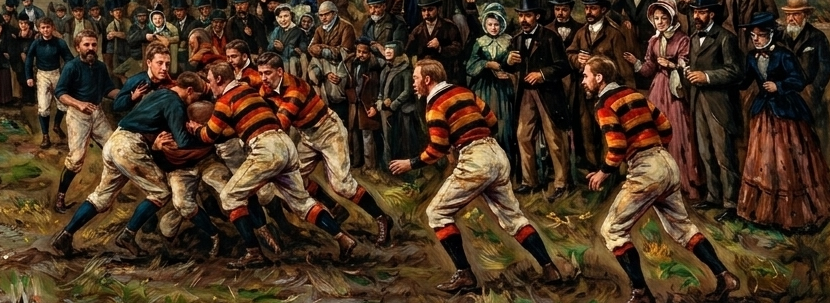
“The big club matches were played upon the boundless Moore Park. With surging, and sometimes yelling crowds hemming in the players, as though the battle were one of fisticuffs instead of a friendly game of football. This was Sydney club rugby in the late 1870s. Spectators freely entered the open parkland outside the Sydney Cricket Ground and stood along the touchlines marked out by low cut grass.”
— from ‘The Rugby Rebellion’ by Sean Fagan, 2005
A CROWD OF SCRUMMAGERS
In the 1875 season the Wallaroos sought the assistance of the NSW Police Force to manage crowds. This proved futile: the Police administration replied that they “had no power to interfere with the rights of the public on Moore Park”, even the part occupied by a football match. The club ran a rope round the ground, but the plan was only partially successful.
“To keep the crowds back the Wallaroos had iron stanchions with holes for rope at the top, and the playing field was thus roped in; but as the game progressed the rope was soon trampled down by the eager crowds.”
— Walter Bethel, “Footballers of the ‘Seventies”, The Sun, 17 August 1940
So as it was, the players enjoyment was interfered with, spectators were hindered from seeing the game by people crowding within the lines of play, and other hi-jinks continued unabated.
“…for not only do certain people encroach on the players’ ground, but they get up ‘scrummages’ among themselves sometimes, and consequently create disorder.”
— Letter writer to The Sydney Mail, 10 June 1876
Over the summer of 1875/76 the Wallaroo officials made a futile search “to obtain a private ground, where matches might be carried on without hindrance from onlookers”. The club still only had limited means provided by yearly subscriptions of the players and members; a private ground could only be secured by great outlay.
Entirely frustrated, the club let it be widely known that it would co-operate with any willing investor or ground owner “in order that they might avoid the inconvenience of the intrusion of the public upon the playing ground during matches”.
The management of the city’s only two major sporting grounds — the Albert Cricket Ground (near present-day Redfern Oval) and the now-renovated SCG — feared that football would destroy their cricket pitch and grassed oval.
A SHORT DALLIANCE WITH ALBERT
In 1877 the club gained use of the Albert Ground, “thus securing to the players an immunity from interruption by the crowd of onlookers encroaching within the boundaries”. This “quite a novelty” arrangement well satisfied the Wallaroo footballers.
However, the sixpence entry ticket (and sixpence more for the grandstand) and distance from the city centre vastly reduced crowd numbers. A Wallaroo game against University drew around 150 spectators, even though ladies were not charged. The club was not a money-making venture and had no concern so long as hiring fees and other costs were covered.
The Albert Ground though was a commercial entity and it had hosted the only Sydney matches of the 1873–74 WG Grace–captained England cricket team. It had gone to great lengths to allay concerns that the Rugby footballers would cut up the cricket ground, and gone to the trouble of installing much larger and sturdier goal posts and marking the touchlines and goals in clearly distinguishable white instead of cutting them out of the grass as on Moore Park.
The other big clubs, Waratah and University, kept their games at Moore Park except when invited by Wallaroo to meet at the Albert Ground.
The 1879 season arrived with news that the Albert Ground had lost its battle with the SCG for the big cricket games and the site was to be subdivided and sold. There was no case that fee-paying interest in football offered an alternative business opportunity.
“The Albert Ground and Inner Domain [for training] being no longer available for football, and the trustees of the Association Cricket Ground [SCG] having refused to allow football on that ground, your committee fear the club will be reduced to Moore Park and the grounds of other clubs during the ensuing season; but efforts are being made to secure a more suitable ground in the vicinity of Sydney.”
— WFC annual meeting, The Sydney Mail, 10 May 1879
Ever the plucky optimists, the Wallaroos returned to the open fields of the western side of Moore Park.
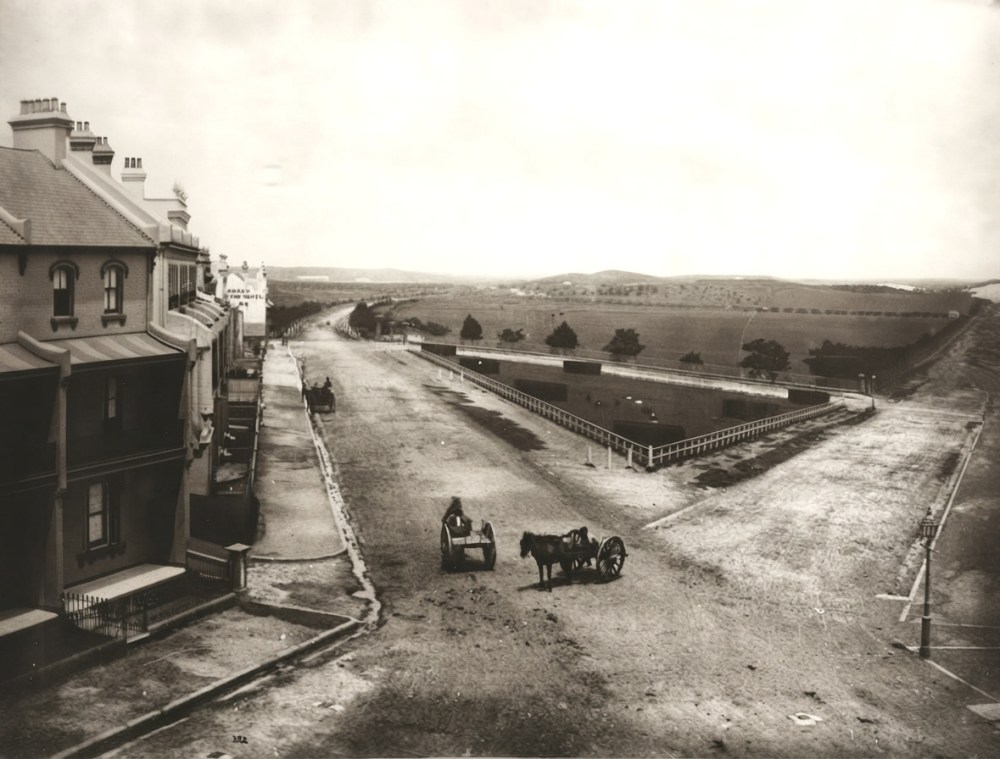
Viewed from cnr Flinders Street & Seymour Place vicinity. South Dowling St veering away to the right. Flinders St veering to the left and in the distance becoming Randwick Rd (now Anzac Pde). Another football field used by Toxtheth and Glenhead clubs is visible alongside South Dowling St.
Source: https://ourstory.randwick.nsw.gov.au/nodes/view/2267
“Monty Arnold and his Rugbeians up Moore Park way.”
— Table Talk (Melbourne), 14 May 1897
“KEEP BACK, WILL YOU!”
Late in the 1879 winter, when it became known that Wallaroo and Waratah FC would field very strong teams, a very big crowd gathered at Moore Park. It was a tense time in Sydney sport. The previous summer had seen a crowd riot and pitch invasion at the SCG during the cricket match between NSW and the England side captained by Lord Harris.
“A repetition of the much-talked-of and written about ‘cricket fracas,’ although on a lesser scale, occurred on Moore Park on Saturday afternoon during the football match between the Wallaroo and Waratah clubs.
“An intense amount of interest was excited by the lengthened struggle and good play of both teams, and partisan feeling ran high. Every scrimmage was attended by a rush of spectators from the opposite side of the ground, the larrikin element, both well-dressed and ragged, initiating the movement, which was followed up by those who must have known better—football players themselves.
“The remonstrance of the single policeman in attendance, of ‘Keep back, will you,’ was not of the slightest avail, and the players were several times incommoded at critical periods of the game.
“Mr. Arnold, the captain of the Wallaroos, was specially singled out by the supporters of the Waratah colours for opprobrium, and at the conclusion of the play, after the customary round of cheers had been exchanged between the teams, he was greeted—whether for a fault of omission or commission it is impossible to say—with a burst of those groans which a Sydney mob are never at a loss to produce, and which so grated upon the ears of Lord Harris.
“It is to be hoped that before next season the trustees of the park, or, failing them, the football clubs, by combined action, will devise some means by which spectators may be restricted to their proper side of the boundary lines, and the play be not so frequently interfered with as has been the case of late.”
— The Sydney Daily Telegraph, 11 August 1879
THE WALLAROOS ENCLOSURE
Finally in 1881 the Trustees of the SCG consented to trialling football games. Wallaroo matches “attracted a large and fashionable audience” over the first two seasons against University, ‘The Detached Squadron’ (Royal Navy), Queensland and Balmain.
In 1881 too the Council leased the NSW Agricultural Society ten acres for the Sydney Showground and pavilions (now the Entertainment Quarter). In 1883 a further seven acres south of the Wallaroo ground were leased by the Zoological Society of NSW (relocated during World War I and becoming Taronga Zoo).
In 1883 the Agricultural Society added its showground to the options for club matches. Wallaroo played on both grounds during 1883, while the Wallaroo second XV continued to use the Moore Park fields.
“Footballers will be pleased to learn that there is a probability of an enclosed ground being placed at their disposal during the coming season. The match, Wallaroo v. Newcastle, will be played on the Agricultural Society’s Ground on the Queen’s Birthday, and it is hoped that a first-class match may take place there on every following Saturday. First-class football on the park is impossible owing to the encroachment of the spectators. The considerate action of the Agricultural Society in allowing the use of their ground should therefore be hailed with satisfaction by the public.”
— The Sydney Morning Herald, 23 May 1883
The final appearances of the Wallaroos on the open fields at Moore Park came with a pre-season trial game in 1886 and a friendly match under Association rules (soccer) against the Wanderers FC in 1887.
The Wallaroos’ last competition fixture on the park had been on 13 June 1885 against Balmain, watched by some 3,000 supporters. A familiar friend made one last appearance.
“It is to be regretted that the game was to a great extent spoiled by the usual encroachment of the spectators on to the playing ground.”
— The Sydney Morning Herald, 15 June 1885
By contrast, attendances at the newly enclosed grounds were still measured only in the low hundreds. The public had been accustomed to watching without the necessity of paying.
A modest beginning, yet through the 1890s crowds at club matches on the SCG and the Agricultural Ground steadily improved. Both venues offered major knock-out cup trophies each season, which added fresh appeal and sharpened interest in club Rugby across Sydney.
In 1899 the first Australia (now Wallabies) versus the British (Lions) Test at the SCG drew 30,000 to Moore Park. The captain that day was Frank Row of Wallaroo FC.

HOME FIELD
Older than the Australian cricket team, older than the Wallabies and the Kangaroos, the Wallaroos were the first team to call the SCG home and to use its earliest pavilion as a dressing room.
The Wallaroos themselves were soon left behind in the nineteenth century, but their perseverance and foresight had helped found what is today the nation’s greatest sporting precinct.
Moore Park was now our world.
FOOTBALL RHYME.
— Australian Town and Country Journal, 6 September 1873
Still is the air, the day as fair and cold as in June found,
The goals wide laid, and posts arrayed with bunting mark the ground;
Around its bounds in varied hues a living cordon runs,
Whose eyes to-day urge on the fray which angry malice shuns.
In middle field two bands apart await with hearts aglow
The given sign, each muscle braced for first spring on the foe.
Hurrah, the ball is started off, now “forwards” to your work,
And drive it back the selfsame track, nor “mauls” nor “bulldogs” shirk.
In “scrimmage” fierce a writhing mass a passage through essay,
Then fall apart, in “halfbacks” dart, and lift the ball away;
“For goal look out” rings out the shout, a “touchdown” and a “try.”
While “Wallaroo” or “Varsity,” or “North Shore” is the cry.
Or warnings meet “off-side,” now greet vile rebel to the law,
Who sneaks ahead, and fair catch takes, midst mingling hues galore—
“Red, white, and blue” of Wallaroo—or University
Blue cap; or “Leonards’” stockings blue, meeting in rivalry.
The sun descends towards Surry Hill, no side doth vantage gain;
Fierce grows the strife, as if for life, each inch won to maintain.
In desperate rush right thro’ the crush the ball the “forwards” run.
Upon the “backs”—a dash—a “drop”—a pause—and goal is won.
YE MORALE.
Moore Park’s the world, our life the ball, each plays it as he will;
Though “hacked” by foes, or blindly bent by friendships supplest skill.
Some have no aim, some dawdle on, while some their hopes obtain;
Whate’er the goal—pluck, self-control, and energy will gain.
Note: In 1890 the Wallaroo FC played a game on the parade ground at the Victoria Barracks against the Permanent Artillery FC. The NSW Permanent Artillery was the colony’s first full-time military unit. Wallaroo’s Second XV also played on the ground a number of times.
WallarooFC1870.com – All website text & content © Sean Fagan
[ site homepage ]
