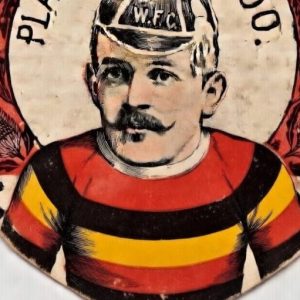
Nearly a decade after their final competition game, the Wallaroo Football Club was denied lasting immortality as the name of Australia’s rugby union team—and with it an Olympic gold medal—thanks in part to a long-retired Randwick fullback still instinctively fighting the Wallaroo colours.
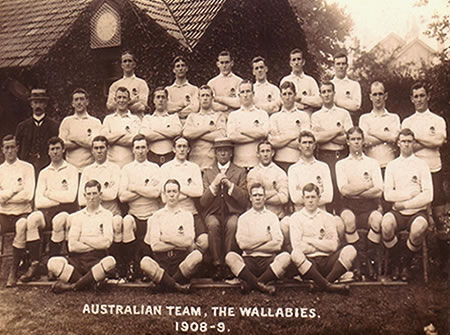
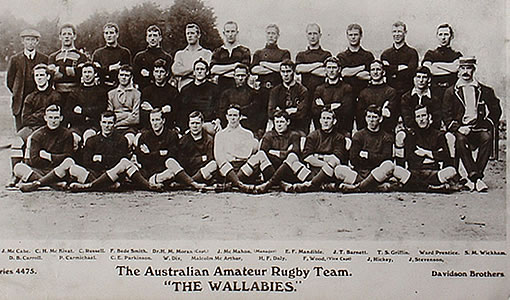
The team manager James McMahon sitting in the centre wearing a suit. Next to McMahon’s right arm is captain Herbert ‘Paddy’ Moran: “We, who for six weeks had been Rabbits.”
“If only the Australian team of footballers had been Christened Wallaroo, instead of Wallaby, Monty would have made good…“
— The Sydney Sportsman, 26 May 1909
EACH WITH THEIR EPIC VAUNT
In turn, in the first decade of the 1900s, as each campaign party arrived from the Southern Hemisphere to conquer Britain at Rugby, they fell into a kind of global vaunting. Battle-ready, they proclaimed who they were: “the All Blacks of New Zealand”, “the Springboks of South Africa”, and surely, “the Wallaroos of Australia”.
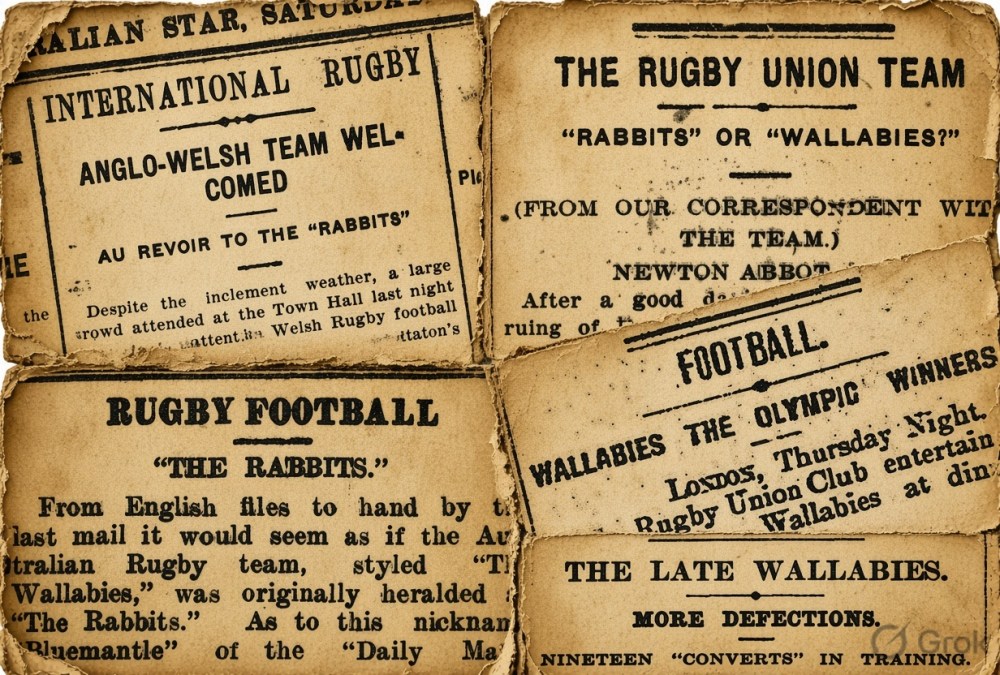
Well, no. The Australian team actually left our shores as “The Rabbits”. It was an obvious drop in grace and rank from All Blacks to Springboks to, what—Rabbits? The imported pest that infests the country!
A TOWN HALL RABBIT TRAP
The origin of “The Rabbits” cognomen (nickname) lays at the feet of politician and sheep farmer Sir Francis Bathurst Suttor. He had stepped in at the last moment to replace the State Premier Charles Wade (a Wallaroo FC man) as host at a welcome dinner in Sydney at the end of July 1908. It was held at the Sydney Town Hall in honour of the visiting British Lions team.
Suttor suggested in his speech that, following New Zealand sending Home (to England) the All Blacks, Australia was now likewise setting forth “The Rabbits”, supposedly because the men making up the team were all Australian-born and thereby had been “reared among the rabbits”.
George Harnett, manager of the British team, in responding to the welcome from Suttor, said : “We will call them, the ‘Rabbits’,” at which there was an outburst of cheering, bearing witness to the popular endorsement of the name.
The Australian team’s manager, James McMahon, was present at the reception and said nothing against the name in his speech.
Reg ‘Snowy’ Baker, who played for Australia in 1904, said:
“…the team has been nicknamed by English folk the ‘Rabbits’. I only wish they prove as much trouble on British and Continental football fields as ‘bunny’ does in the fields of Australia.”
Meanwhile, The Sydney Mail pointed out:
“A more unseemly name than rabbit conferred upon a footballer could hardly be imagined. In Rugby a ‘rabbiter’ is one who tackles his opponents unfairly by diving at their legs below the knees.”
Calling the Australian team “the Wallaroos” was the obvious and most appropriate choice. It was the name of a native animal, but it was also the name of the club that had practically alone brought Rugby into life and dominance in Sydney, New South Wales and Queensland (a like-minded Wallaroo club had reigned in Brisbane, too).
To place the Wallaroo name in posterity was the right and only call, especially for a team going to the original home fields of Rugby football.
But the NSWRU—the organisers of the team and the tour—were no longer under the heavy influence of the Wallaroos. They remained silent. It was left a matter for the team themselves.
Like the trickster Br’er Rabbit, McMahon was staying low. He continued to say nothing of it.
THE DEAD RABBITS HEADING TO ENGLAND
On 8 August 1908, amidst pouring rain at Circular Quay the tourists boarded the ocean steamer, R.M.S. Omrah, ready to leave Sydney Harbour. The Referee:
“On the wharf were Rugby Union footballers in hundreds, and as the tourists breasted the rails of the vessel they were given hearty cheers and good wishes galore.”
Once the ship cleared The Heads and left Port Jackson, McMahon became the NSWRU’s absolute plenipotentiary. Other than between the touchlines on the playing field where the captain reigned, the manager’s power was boundless.
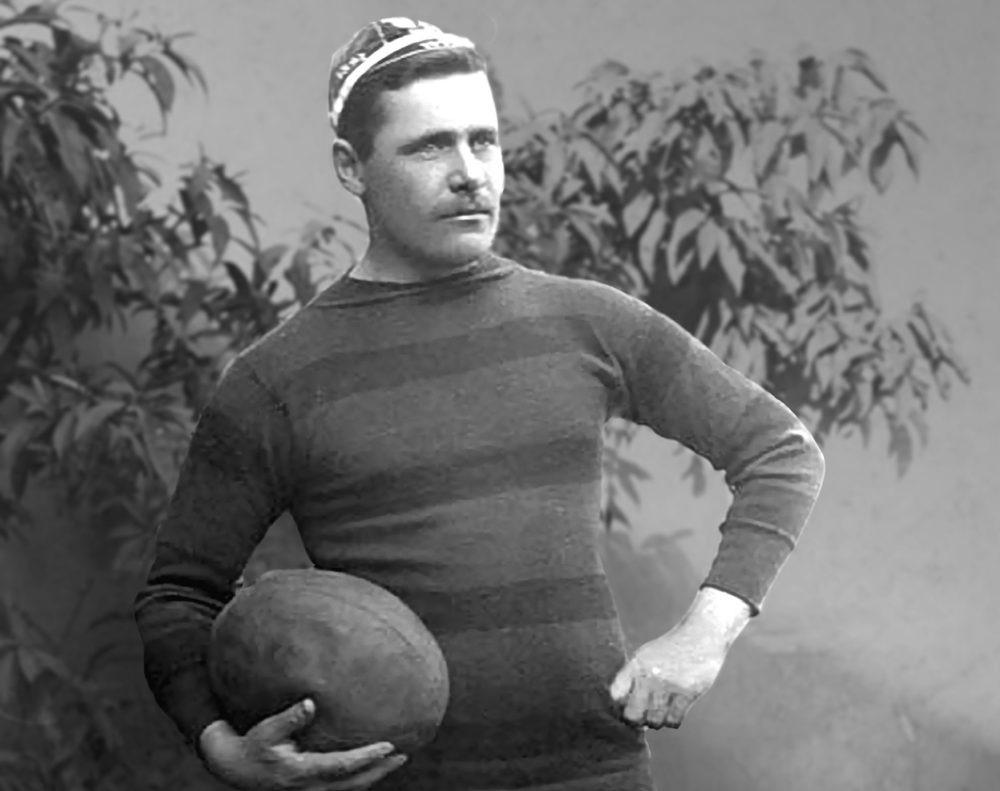
McMahon was a former fullback and captain for New South Wales and the old Randwick FC—the bitter antagonists of the Wallaroos in the 1890s. On the field, he was a most formidable opponent. As The Sun noted: “He was a massive champion—to collide with him was like ramming the G.P.O. with your shoulder.” A proud member of the NSW Lancers, he now insisted on going by the title ‘Captain McMahon.’
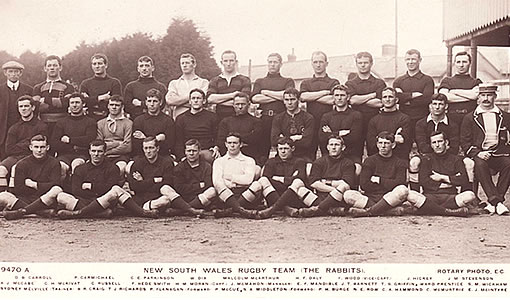
On the sea voyage out the team were “The Rabbits” all the way to England (see comments further below, as well as The Daily Mail report from on board R.M.S. Omrah, reproduced in Launceston’s The Examiner, 23 October 1908).
This includes when they played and won the tour’s opening matches against Victoria on the Melbourne Cricket Ground and Western Australia at Fremantle Oval. There wasn’t a lot of local interest in either game. Melbourne’s Punch declared with good humour mixed with football bias:
“Rugby is a beautiful game—to those who know no other.”
BOX-OFFICE RUGGER
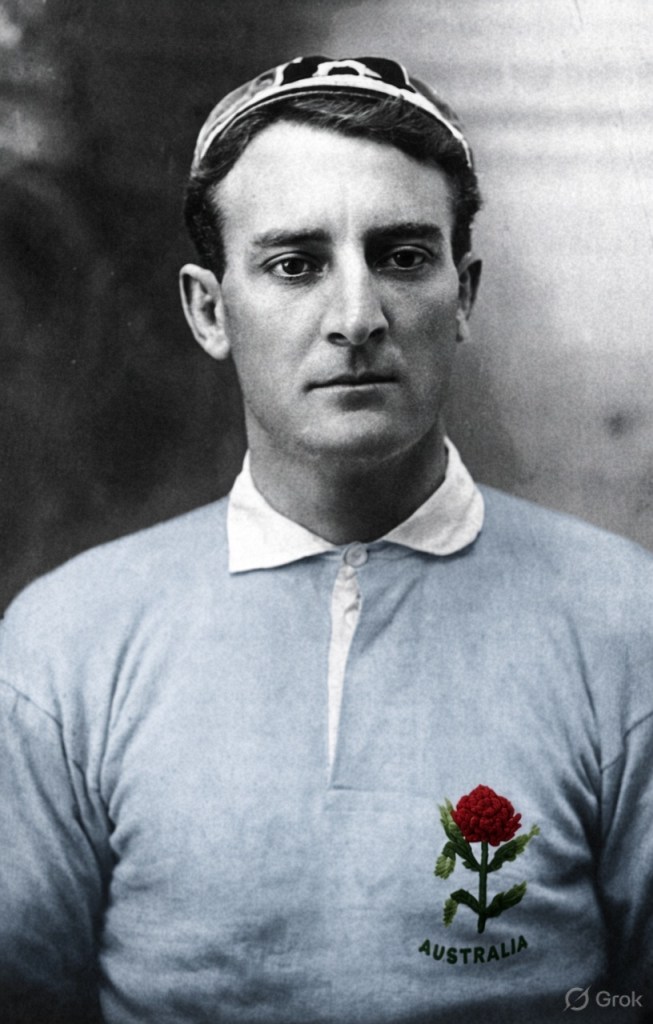
As the Australian team were representatives of the NSWRU, they wore the traditional NSW jersey designed in 1895 by Wallaroo FC co-founder Monty Arnold—a sky blue jersey featuring a red and green waratah badge. To adapt it for the national stage, the word ‘Australia’ was added beneath Arnold’s original emblem.
Following the tradition of England with its jersey and red rose, or Scotland with its thistle, the team could have simply been called Australia with no nickname. But that would not do. This tour was a box-office venture in the wake of the All Blacks and Springboks; fashion and custom demanded a distinct name and a war-cry.
PENNY POSTCARDS
Word of “The Rabbits” moniker reached England in fast time via letters and newspapers carried on the mail ships. Quick-shilling street merchants immediately started making arrangements to print “The Rabbits” postcards the moment the party stepped onto English soil and could sit for a team photograph.
Upon arrival in late September 1908, the team’s captain, Herbert ‘Paddy’ Moran, bluntly told the press:
“We certainly draw the line at being called ‘the Rabbits’, for the only thing I can imagine worse would be to christen us the ‘Convicts’ – both, by the way, came out from England, but whereas one has died out, the other has become a pest. Therefore, let us fix on something as distinctive as ‘All Blacks’ and ‘Springbokken’ were.”
Moran later wrote in a letter that:
“There was considerable discussion in English papers. Letters flocked in from all sides. ‘Wallabies, Kangaroos, Kookaburra, and Wallaroos’ were suggested.”
Many newspapers carried a report that:
“The three names most favoured were ‘The Wallabies’, ‘The Wallaroos’, and ‘The Waratah’.
This had to be resolved. Writing from Newton Abbot in Devon, McMahon shared:
“There must be fully fifty photographers around the hotel for a photo for the illustrated papers. We will certainly get all we want of photographers.”
THE TEAM VOTE
McMahon called a meeting of the players to choose a name. He seemed to know what he wanted. The team’s assistant manager, Stanley Wickham, a Wallaroo FC star of the mid 1890s in his much younger days, had no vote.
Immediately, the kangaroo tag was taken off the table. The reasoning given was that this marsupial was already on the badge of Dally Messenger and the rest of the Australian rugby league team who were also to tour England that winter.
It was a flimsy excuse; the jerseys of the last Australian rugby union team to travel overseas (to New Zealand in 1905) had been adorned with a white kangaroo badge and locally dubbed “the Kangaroo fifteen”, meanwhile James Giltinan and his rugby league men had only just docked at Tilbury and had not yet made any claim to the nickname “The Kangaroos.”
There was no immediate explanation forthcoming of the end result, only from Moran that:
“For a brief day we, who for six weeks had been ‘Rabbits’, were ‘Waratahs’, but that was only emblematic of NSW. All were agreed that any name would be preferable to ‘Rabbits’. ‘Wallabies’ won by a couple of votes.”
From London The Daily Mail announced:
“At a meeting called by Capt. McMahon, the manager of the team, it was decided to christen the team ‘Wallabies’, as this title would embrace all the players, some of whom did not hail from N.S.W.”
It was a strange justification. Wallaroos and wallabies are both native to New South Wales and Queensland. Additionally, Sydney and Brisbane each boasted pioneering Wallaroo clubs.
Though it seems odd today, no football clubs in the early 1900s had yet claimed the wallaby or the kangaroo as their moniker; indeed, very few clubs carried the name of any indigenous animal or plant.
Bizarrely, the newspaper based nearest to the team, The Western Independent, proclaimed their 24-3 win over Devon with a “Rattling Game by the Rabbits” headline. Maybe they were in the postcard-selling business.
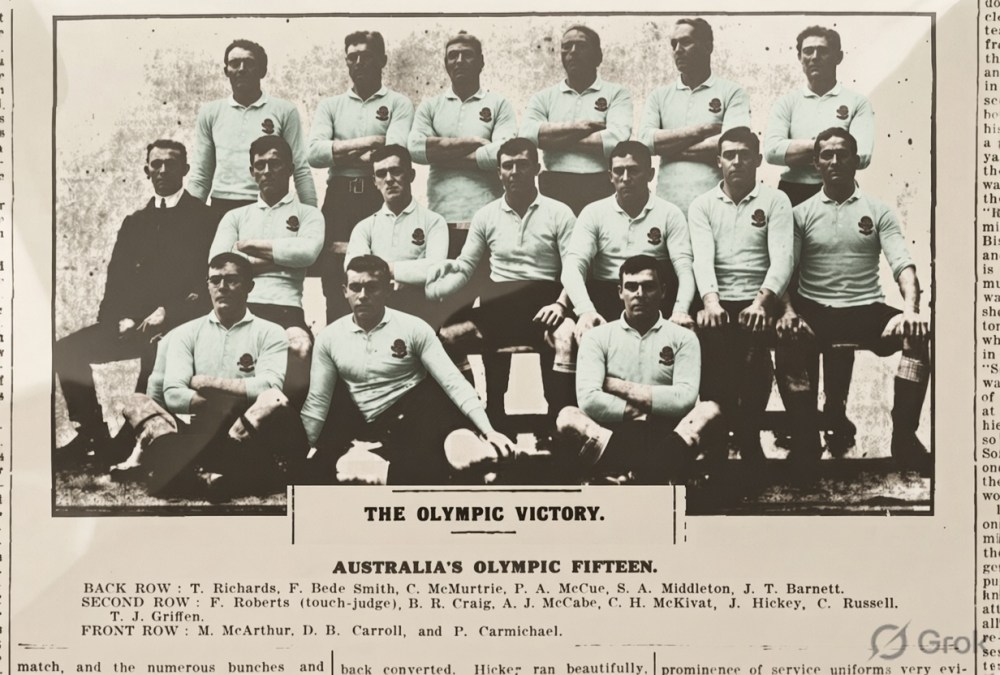
Regardless, by the end of October 1908, reports of the Australian team’s victory in London over Great Britain (represented by the Cornwall county XV) for the Olympic gold medal rang out loudly across the Empire: “Wallabies the Olympic Winners,” “Olympic Championship Won by Wallabies,” and “The Wallabies: Praises and Medals”.
But so much for the glory. McMahon’s reign as manager was no success.
THE WALLABIES HOP BACK HOME
In 1906, the All Blacks had returned home handing the New Zealand Rugby Union a staggeringly large profit of £10,000. A working man’s annual wage was around £50 all up. The Wallaby tour, by contrast, ended with the team arriving in Sydney saddling the NSWRU with a loss of £1,392. On the positive, they did bring back a swag of Olympic gold medals.
Monty Arnold was at the NSWRU meeting when news of the parlous finances were tabled. The Sydney Sportsman laconically, but with some deeper truth, observed:
“At the last meeting of the N.S.W.R.U., Monty Arnold gave a recital of his early reminiscences. Monty is THE W. S. Gilbert of the Union, and his repartee would cure any known malady—from the blues (I don’t mean Newtown, Monty) to the dogs’ disease.
“In the olden days Monty’s pet hobby was the Wallaroo Club. If only the Australian team of footballers had been Christened Wallaroo, instead of Wallaby, Monty would have made good that £1,300 deficit.”
THE LATE AMATEUR WALLABIES
Then came the ultimate disaster: the revelation of the great defection of the majority of the Wallabies team to rugby league.
A supposedly stunned McMahon said of this news:
“I must admit I was surprised when I learnt that the Wallabies had gone over to the League practically in a body.”
After all that time away together—an expedition of seven and half months, with shared hotel dining saloons, football change rooms and weeks long sea voyages—how could McMahon as the team manager not have known, had no inkling, or attempted to stop it? Not even of small talk, whispers and rumour?
Late in the 1909 season, these defectors took “The Wallabies” name with them, playing a series of rugby league matches in Sydney against “The Kangaroos.” In 1910, their star power infused new life into the rugby league club competition (now the NRL) and representative games.
Well before World War One, the bitter battle between the Rugby codes was decided in favour of the ex-Wallabies, the Kangaroos, and rugby league.
Under his pen name ‘The Cynic’, the Rugby writer for The Referee lamented:
“Surely these men must be ignorant of the significance of the Olympic contest, ignorant of all that their Olympic symbols stand for.
“Further, those who have gone, or intend going over to the professional ranks, have no right to take with them the name of ‘The Wallabies’. That name belongs to the Union amateur team.
“And if it be used by the professionals it will be insult added to injury, an insult not only to the game which has done so much for them, but insult to those other members of the same team to whom the lure is useless.”
WALLABIES NO MORE
But the toxic taint remained. The next Australian rugby union teams of 1912 (to the USA and Canada) and 1913 (to New Zealand) sailed with no given sobriquet, although the 1912 squad unofficially were “The Kangaroo Waratahs”.
Politely, the NSWRU said “The Wallabies” name belonged to the 1908 team alone, and left its explanation at that. “The Wallabies” name had been entirely cast aside by the NSWRU.
Due to the demise of the QRU, no Australian representative team again left our shores until 1931. The famous “Waratahs” tour of 1927–28 to Great Britain and France represented New South Wales alone.
When the 1931 Australians arrived in New Zealand, local press expectantly demanded to know the team’s nickname. Without any authority or prior discussion in Sydney, the manager simply blurted out: “The Wallabies”.
ONE LAST WALLAROO TRY
Even heading into 1933, as a tour to South Africa was being planned a quarter of a century after the dramas of 1908, deep disquiet with “The Wallabies” name was still very much alive.
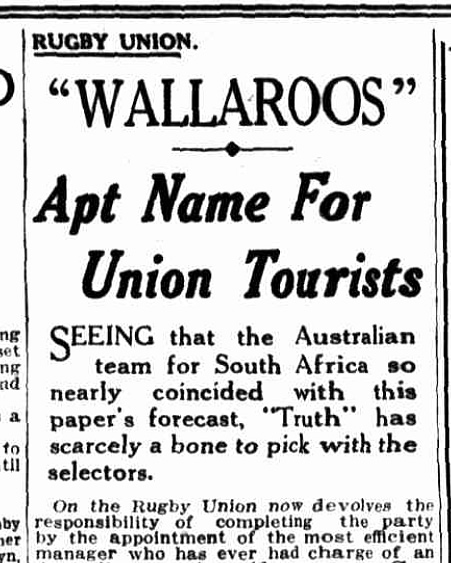
The Truth newspaper argued on 2 October, 1932:
“RUGBY UNION. ‘WALLAROOS’ Apt Name For Union Tourists
What could be more fitting than Wallaroos, an apt match for the bounding Springbok? The Union will probably confer a name on the tourists. The Waratahs were ideally labelled, but that was a New South Wales side. The wallaby name is anathema to Unionists, and the League has a lien on the Kangaroo.”
“The Wallaroos” offered a fresh slate—a return to the pure, untainted prestige of the 19th-century pioneers.
But this was a lone voice. A new generation of administrators was now in command. The original Wallabies of 1908 who remained were now grey-bearded and harmless; the bitter code wars were firmly in the past.
Time had finally scrubbed “The Wallabies” name clean.
The three east coast rugby union bodies (NSWRU, QRU, and VRU) officially agreed that the coming 1933 Australians to South Africa, and all future touring teams, would bear the name “The Wallabies”.
A NARROW ESCAPE
Was it good fortune or bad luck for the Wallaroo FC and its legacy that its name was not attached to that fateful 1908 Australian team?
Had that 1908 vote gone the other way, or had McMahon been a more forgiving Randwick man, “The Wallaroos” would have won the Olympic gold, yes—but they would have also inherited the bankruptcy, the scandal, the treason and twenty-five years of bitter historical exile.
On balance, the old Wallaroo club—the first and true marsupial club that begat the foundations of both the Kangaroos and Wallabies—kept itself entirely clear of the great Rugby code split in Australia.
Missing out on Olympic immortality looks less like a tragedy, and more like a very narrow, very fortunate escape.
WallarooFC1870.com – All website text & content © Sean Fagan
[ site homepage ]
