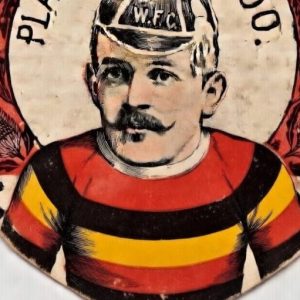
Faced with Melbourne rules advocates kicking down their front door, the brains trust of the Wallaroo FC turned to the other English football code to land a surprise knock-out blow.
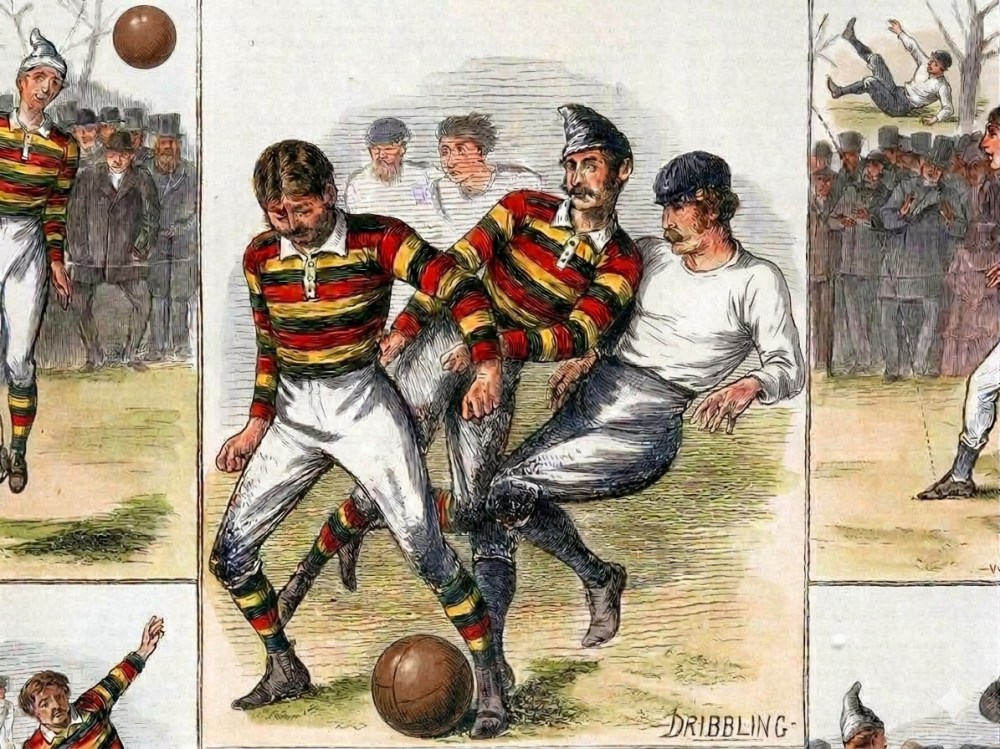
“The Wallaroo Club departed from its usual custom…by playing a match under the British Association rules with the Wanderers, which resulted, as we might have expected, in the Wallaroos’ defeat.
“But the way in which some of the Marsupials played the game proved that they were well acquainted with the rules; and with a little more experience the Wanderers would find it no easy task to beat the Wallaroos.”— Australian Town and Country Journal, 7 May 1887
THE WILDEST ENTHUSIASM
In the winter of 1880 Sydney’s football world was at war. Cross-code games between Melbourne’s Carlton FC and Sydney’s Waratahs in 1877 and ’78 had left Rugby under fire: too dangerous, too dull, too English.
Agitators, many of them expatriate Victorians, demanded radical change. The Victorians hoped to overwhelm Rugby, either from within the NSWRU itself, by changing the playing rules, or by setting up the rival NSW Football Association and having the majority of Sydney’s footballers and clubs run to it. Attempts at the former in the late 1870s had been thwarted by the Wallaroos and the loyal country clubs of NSW.
On the evening of 30 June 1880 a packed public meeting voted to form the NSWFA and play football by Melbourne rules. Wallaroo co-founder and champion of the Rugbeians, Monty Arnold, had risen at the gathering to speak in fierce opposition, insisting Rugby remained superior. The correspondent for Australian Town and Country Journal, ‘Orange and Blue,’ writing:
“A revulsion set in, and ‘there was madness.’ In vain did the ‘long un,’ [Monty Arnold] thinking this a splendid opportunity to dive in and make confusion worse confounded, and, by so doing, render abortive the attempt to introduce a game which his soul abhorred, strive to induce those around him to have the meeting squashed.”
The motion still passed. Yet even as the Victorians celebrated, Wallaroo’s Arnold brothers were already hatching a plan. A calculated response from the Wallaroo camp. Quietly, almost invisibly.
In the open, the Arnolds continued to voice their favour for Rugby and to belittle the Melbourne game. It was open warfare. But behind the scenes, they had launched a new front—one from which the Victorians could never hope to win, and where instead a fellow English code could rise.
IF I MAY BE ALLOWED SOME SPACE TO WRITE A FEW WORDS
A series of letters suddenly began appearing in Sydney’s newspapers. They looked innocent enough. Supporters of “English Association” (soccer), presumably feeling left out, were agitating that it was now time for their code’s introduction into Sydney.
One came from former Oxford University man John Walter Fletcher, who carefully explained that the dribbling game had nothing in common with the Melbourne code, and could live happily beside Rugby, just as it did in Britain. Fletcher wrote:
“I have reason to think from conversations I have had on the subject that if the game could properly be started it would become very popular, not only with players, but with the public. Unfortunately, a very general misapprehension appears to exist as to the nature of the game, a great many people I have spoken to evidently confusing it with the Victorian Association game, whereas the two games have not a single point in common …
“At the present time the football players of Great Britain, playing under Rugby and Association rules, are about equally divided, and the two games exist side by side without one interfering in the least with the other, save that of late the value of good dribbling has become universally acknowledged in the Rugby game …
“I am quite sure that the principle of the game, which forbids the use of the hands, except by goalkeeper, and does away with scrummaging, collaring, mauling, &c, will commend itself to a very large section or this community. The game is essentially a scientific one, requiring, above everything else, unselfish and organized combination.
“I do not wish to attack the old Rugby game, which, properly played, is interesting and exciting to players and spectators; but must enter a protest against the introduction of the Victorian game, which, though certainly interesting and amusing to look at, is, I believe, rougher than the Rugby, and violates the fundamental principle of all games like football – I mean the law of off side. The very thing condemned under the name of “sneaking” in the Eton [College] game is here encouraged and applauded, and in fact may almost be said to be the chief art of the game.
“In the brief space of a letter it is impossible to say all that one would in behalf of the introduction of the rules of the English Association ; but I hope that, since at the present time a radical change is demanded in the present code, football players and the public generally will give the matter a more thorough investigation than it has yet received before committing themselves to the Victorian game. I should be willing to communicate with gentlemen willing to assist in starting a club under the rules of the English Association, and perhaps it might be possible to convene a meeting to consider the whole question.”
No one in Sydney football circles had ever heard of Mr Fletcher. He was in fact a master at the Oaklands School (boarding school) in Mittagong—a proto Rugby School away to the south-west of Sydney. It was operated by Wallaroo FC ‘old boy’ Henry Edmond Southey. So we know Fletcher’s conversations were with Wallaroo gentlemen.
J.A. Todd, who had played the round-ball game in England, also pushed the line that with soccer as the city’s alternative code, Rugby was not under threat:
“In his experience he never found the Association game interfered with the Rugby game, but there were many players who could not play the Rugby game, and this Association game would fill a gap which at present existed. The advocates of Rugby football need fear nothing but a very healthy rivalry.”
Wallaroo’s Richard Arnold jumped into the conversation:
“…that, as for as he was concerned, as an old Rugby Union player, he should be very glad indeed to welcome the Association game into New South Wales, and thought it was a great pity it had not been started long ago. He was unfortunate in not having seen the game, but he had certainly seen plenty of Association play in Rugby Union matches, and was certain there was nothing that would improve the forward play in Rugby matches more than by getting players to practice the Association game.”
SIDE BY SIDE WITH RUGBY
On 3rd of August 1880 Fletcher and Todd organised a public “meeting of gentlemen favourable to the formation of a Football Club under English Association rules.” Again, as with the Victorian rules meeting four weeks earlier, anyone could attend and make their views known.
The gathering was chaired by Wallaroo’s William ‘Gurry’ Burkitt – a master at the King’s School in Parramatta since 1870, he started the School’s first Rugby team that same year, acting as on-field captain and coach. The Sydney Morning Herald reported on the discussions:
“…after explaining the object for which the meeting had been called, [Burkitt] said that football, no matter under what rules it was played, provided the game was carried on in a proper manly spirit, was worthy of support.
“It was suggested some years ago [1877] that it would be well to start football under English Association rules, but many of those who preferred that game thought that such a movement would be rather premature, and that football at that time had not prospered sufficiently in the colony to justify the introduction of the Association game; but, probably, the time had now arrived when it could be established successfully. At any rate, it would do good to the Rugby Union game by improving the forward play [by learning kicking skills].”
Richard Arnold in attendance “warmly supported” the forming of a club. Fletcher also spoke, again reinforcing that soccer was no threat to Rugby, and offered the alternative form of football that seemingly was now desired by many in Sydney football:
“…as the game [football generally] had been in a somewhat uncertain state for some time, and a movement had been started in favour of making a change at least in one direction, it seemed to him, and to some others, more advisable that it should be in the direction of the good old game which was played in England side by side with the Rugby, rather than the game which was known here as the Victorian …
“Another thing in favour of the English Association game was that it need not interfere in the smallest degree with the Rugby game, and indeed a Rugby player, by playing the Association game, could materially assist his own.
“But there were a great many players who, although they played the Rugby game, did so because they had no other. They must have some exercise, and preferred football, and therefore they played the Rugby game; but if any other game were started, he was sure they would find it far more suitable to their tastes than that at present played.
“There were a great many people who did not go to see football because it was too rough, but a game like the English Association need offend nobody. It was a fast, exciting, and interesting game, and everyone-even the most tender-hearted-could enjoy it.”
Do you see a theme at play here? Soccer was the perfect footballing-antidote for Rugby to block Melbourne rules with.
Introduced as a mild, scientific alternative that posed no threat to Rugby, it immediately divided the city’s football support three ways instead of two. Any hope Melbourne rules had of taking over Sydney in toto was now gone. No single code could topple another and hope to achieve outright dominance à la football in Melbourne or Adelaide.
MAYHAP A WANDERER, SIR?
The club became the Wanderers FC and a NSW association was formed soon afterwards. None of the Wallaroos took formal office in the new body, yet their presence and advocacy had been decisive. Burkitt arranged King’s School as opponents for the colony’s first soccer match on 14 August 1880. The Wanderers won 5–0.
Rugby retained its core support while a third option absorbed many of the restive players as well as those who had sat on the sidelines unwilling to play Rugby.
At worst, even if soccer eventually outlasted Rugby, Sydney would still enjoy international visits under Association rules—preserving the vital winter link (summer had cricket) to Britain and prospect of international tours and visits that Victorian rules could never offer.
PLUCKED PIGEONS
The NSWFA and its clubs struggled on until 1894 when finally it was no more. Rugby, rooted in Wallaroo’s 1870 foundation, continued to grow. Soccer’s presence, as predicted, proved no hindrance, and its advocates enjoyed their game’s rise and development.
The Arnolds and their Wallaroo allies had played a clever, largely unheralded hand. By accelerating soccer’s arrival they ensured the contest remained three-sided. Melbourne rules never recovered its early momentum in Sydney.
Rugby held the field—and the city’s and NSW’s football future stayed firmly in the hands of the Wallaroos and Rugby.
CROSS-CODE MATCH
Though the two English codes remained on good terms through the 1880s, the idea of dual-code clubs failed to eventuate. In May 1887 came one special day, which saw the Wallaroos and the Wanderers meet in battle on the football field in a game of soccer.
The Referee of 28 April 1887 provided a preview:
“The Wallaroos have arranged a match with the Wanderers, which will be played under British Association Rules, on Moore Park, next Saturday. This is a welcome innovation, and must be productive of a vast amount of good, not that I estimate the former anything like fit opponents for the doughtier warriors of the Wanderers, but the absence of dribbling tactics is one of the greatest hindrances to the proper and successful exposition of the Rugby game.
“I am more than pleased with the happiness of this innovation, and I hope many other Rugby clubs will follow in the wake of the Wallaroos.
“The art of dribbling, however, cannot be learned and gained in one match. The use, therefore, may be demonstrated to the Rugby players, but if they do not trouble themselves by practising and mastering that department, all the possible good to be derived from these matches must be as water on a duck’s back — perhaps worse.”
How many of the Wallaroos had experience with the round ball is not known. With many of the players raised in Britain, it was a possibility. And no doubt Charles Wade had dabbled with the code during his time in England.
The Referee of 5 May 1887 match report:
“On Saturday last the Wallaroos, who have since their formation observed and followed Rugby rules with undivided fidelity, for once allowed the belief to take a back seat and played the British Association rules against the well-known Wanderers club.
“Rugby players, as a rule, are a very orthodox lot, and have been long proverbial for their ignorance of any other rules outside their own — as the good folks say who know all about it. On Saturday, however, the Wallaroos made a most creditable show under their opponents’ rules, and for the greater part of the time were level.
“The only advantage the Wanderers possessed over their opponents was in “shooting” goals and in the goal-keeping. Had the Wallaroos had a thoroughly efficient goal-keeper or back, their opponents would not have scored as many goals by half.
“The Wanderers had not their best team afield, but the Wallaroos were not at full strength unfortunately. The play of Hungerford, Stacey, and Wade especially would have done the best British Association club credit. The Rugby men had the ball more often at their opponents’ end than otherwise, but they could not shoot straight, or if by chance they did, the Wanderers’ backs would be too wide awake to allow it to pass between the posts.
“Amongst the Wanderers Irvine and Mair were the cause of the large number of goals scored, and the Wallaroos may remember their play, which was the best shown in the park for some time. The Rugby men did not, as many will suppose, forget themselves and handle the ball often; but for all that, fouls were frequent by the ball accidentally touching the players’ arms.
“The onlookers would frequently interject ‘Now then, Wallaroos, use your heads,’ ‘Play with your heads,’ and similar remarks, which had no reference to any superior exertion of their brain powers at all, but simply implied that they should hit the ball more after the fashion of a goat fight than of a football contest.”
The result of the game was:
Wanderers 6 goals (Irvine 4, Mair 1, Murdoch 1)
Wallaroos 2 goals (Hungerford 1, Wade 1).
WallarooFC1870.com – All website text & content © Sean Fagan
[ site homepage ]
